Codex and the future of coding with AI — the OpenAI Podcast Ep. 6
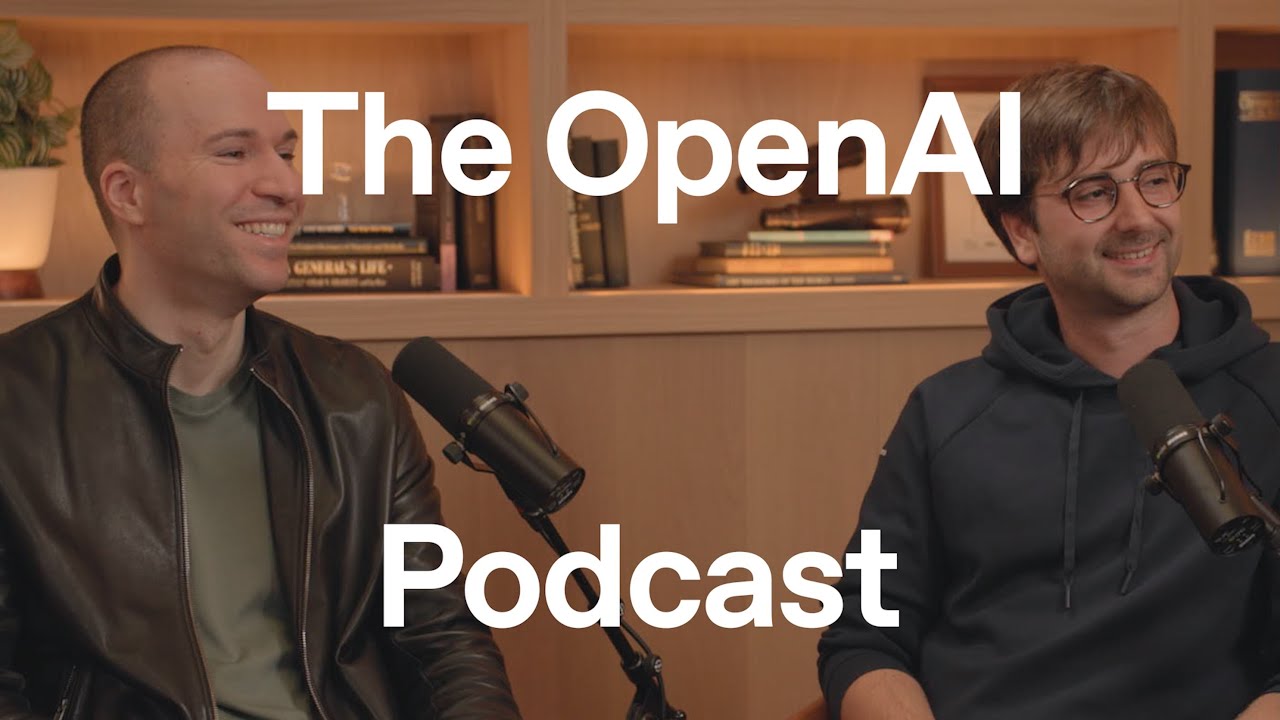
OpenAI's Greg Brockman and Thibault Sottiaux explore the evolution of AI-powered software development, from the first coding sparks in GPT-3 to today's GPT-5 Codex. They detail the concept of the "harness," the rise of agentic coding, breakthroughs in automated code review, and how AI agents capable of running for hours on complex refactoring will reshape the future of engineering.
The Genesis of AI Coding
The journey began in the GPT-3 era, with the first signs of a language model’s ability to complete code from a simple Python docstring. This initial spark demonstrated the immense potential of applying large language models to software development. While an early aspirational goal was to generate a thousand lines of coherent code, today’s models have surpassed that benchmark to the point where it’s no longer a remarkable feat. Coding has been an exceptional and deep focus area for OpenAI, leading to specialized models and metrics that push the boundaries of what’s possible.
The “Harness”: Bridging Intelligence and Action
A core concept in making AI useful for coding is the “harness.” The harness is the infrastructure that integrates the model with its environment, allowing it to act. It comprises the set of tools, the execution environment, and the agentic loop that enables the model to do more than just text input and output.
As Thibault Sottiaux explains, “Think about it a little bit as, you know, the harness being your body and the model being your brain.”
This realization—that the harness is as crucial as the model’s raw intelligence—has driven the development of more capable and useful coding agents. The interface and the model must co-evolve.
From Autocomplete to Asynchronous Agents
Early applications like GitHub Copilot highlighted a critical trade-off: latency versus intelligence. For a real-time autocomplete feature, a response must be delivered in under 500 milliseconds, which limits the complexity of the model that can be used. However, much smarter models like GPT-4, while too slow for autocomplete, unlock entirely new interaction paradigms.
This led to a shift in focus from synchronous completion to asynchronous, agentic work. Instead of the user constantly providing context (e.g., pasting stack traces into ChatGPT), the model can now be tasked with a goal and given the autonomy to find its own context, debug complex problems, and run for extended periods. OpenAI experimented with various form factors, including a terminal-based tool codenamed “10X,” before focusing on a more powerful async architecture where a developer can delegate a task, close their laptop, and let the agent work remotely. The goal is to create a single, cohesive AI collaborator accessible across the terminal, IDE, and other development surfaces.
GPT-5 Codex: Endurance and Specialization
GPT-5 Codex is a version of the GPT-5 model specifically optimized for the Codex agent and its harness. This tight integration of model and tools results in a more reliable and capable system. A key differentiator is its “grit”—the ability to work on complex tasks for extended periods.
Key capabilities include:
- Long-Duration Tasks: GPT-5 Codex has been observed running for up to seven hours on extremely complex code refactoring projects, methodically working through issues, running tests, and seeing the task to completion.
- Intelligent Planning and Execution: The model can create a plan, execute it, and navigate the complexities of a large codebase, often with a better understanding of the code’s layout than a human engineer.
- Optimized Performance: For simpler tasks, the model is significantly faster, providing quick answers and assistance without unnecessary “thinking.”
Breakthroughs in Code Review and Enterprise Use Cases
One of the most significant applications to emerge is automated code review. Historically, automated code review tools were noisy and often ignored. The new Codex-powered tool, however, has crossed a critical utility threshold. It performs deep analysis of pull requests, understanding the intended contract of the code, checking dependencies, and finding subtle bugs that even senior engineers might miss. Internally at OpenAI, it has become a mission-critical “safety net” that accelerates development velocity and improves code quality.
Beyond code review, agentic coding opens up transformative use cases for the enterprise:
- Code Migrations: Automating the tedious and costly process of migrating legacy systems (e.g., from COBOL) to modern languages.
- Security Patching: Proactively identifying and fixing vulnerabilities across a codebase.
- Tool Generation: Creating bespoke tools that are useful for both human developers and other AI agents, creating a flywheel of efficiency.
The Future of Software Development: Collaboration and Compute
Looking ahead to 2030, the nature of software development will fundamentally change. The vision is one of large populations of AI agents, supervised by humans, performing a vast amount of the coding work. This future presents new challenges and opportunities:
- Scalable Oversight: A key research problem is developing methods for humans to effectively manage and trust fleets of agents without reviewing every line of code.
- Safety and Alignment: Ensuring agents operate safely, within defined permissions, and in alignment with human intent is paramount. This includes sandboxing and developing systems for escalating permissions when necessary.
- A World of Compute Scarcity: While AI will create material abundance, the world will face “absolute compute scarcity.” The primary limitation on creation will be access to compute power. The demand for GPUs to run personal and enterprise agents will be enormous, requiring massive investment in physical infrastructure.
For developers, the advice is clear: it is a better time than ever to learn to code. However, the most critical skill is learning to use AI as a true collaborator. AI accelerates the learning process for new languages (like Rust), answers questions you don’t even know to ask (like using JSON instead of custom serialization), and frees developers from mundane tasks to focus on high-level architecture and problem-solving.