Intelligence as "Less is More" - Prof. David Krakauer [SFI]
Prof. David Krakauer redefines intelligence not as possessing more knowledge, but as the ability to do more with less. He argues that LLMs are mere 'libraries' and proposes a universal theory where all life is intelligent, operating across strategic, inferential, and representational dimensions, with the latter being key to making hard problems easy.
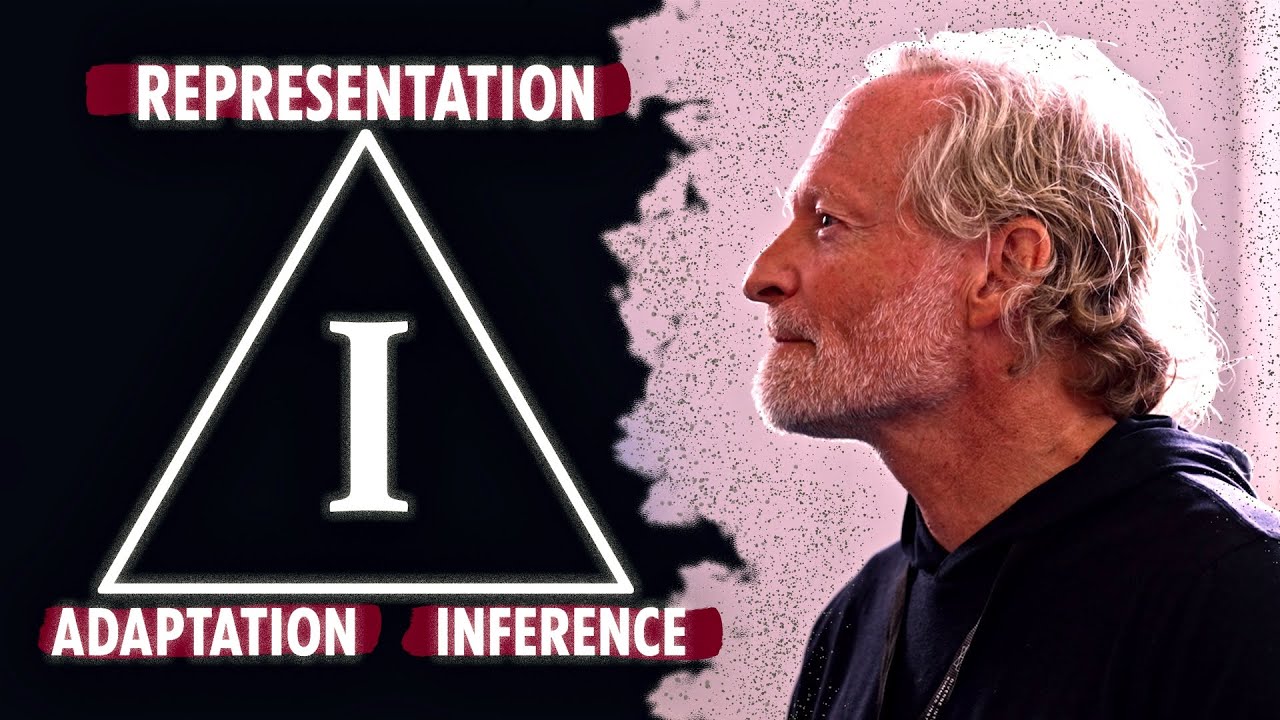
Professor David Krakauer presents a theory of intelligence that fundamentally contrasts with common notions in complexity and artificial intelligence. While emergence in complex systems is famously defined by Phil Anderson’s slogan, “more is different,” Krakauer argues that intelligence is about “less is more.” In this view, Large Language Models (LLMs) represent a “more is more” paradigm, disqualifying them as truly intelligent.
The Purpose of Science and the Nature of Intelligence
Science is framed not merely as a tool for prediction, control, or exploitation, but as a humanistic endeavor to make the universe intelligible to us, much like poetry. It seeks the underlying “rules of the game,” which correspond to fundamental physics (e.g., entropy), but the truly interesting phenomena arise from the “strategies and tactics” that operate within those rules.
Intelligence is the faculty for finding these compact descriptions and patterns in the world’s complexity. It is not synonymous with knowledge. Krakauer emphasizes this distinction with a powerful critique of LLMs.
“Notice what an LLM is here. An LLM is a library. It knows everything. Is not intelligent. […] If you were sitting next to someone in a classroom and you were given an exam and they went to the library and looked up the answer, you would not say they’re clever. You’d say they were cheats.”
The most intelligent individuals are often those who can solve problems without prior knowledge, relying instead on what humanistic thinkers like Einstein and George Eliot called “imagination” and “keen vision.”
A Unified Theory: Life and Intelligence as Conjugate Duals
A central thesis is that definitions of evolution, adaptivity, and intelligence often overlap because they are intrinsically linked. Krakauer proposes a formal relationship based on physics principles:
- Life is an intensive property of adaptive matter. Intensive properties (like temperature or pressure) do not scale with system size; they are like generalized forces or gradients.
- Intelligence is the extensive property of adaptive matter. Extensive properties (like entropy or volume) scale with system size and represent the accumulated quantity that flows along the gradient.
In this analogy, the process of evolution applies a “selection gradient” (the intensive force). The result is the accumulation of information—in a genome or a brain—which is the extensive property we call intelligence. This leads to a powerful conclusion: any system that has evolved is, by definition, intelligent.
This framework explains why it is meaningless to say an elephant is “more alive” than a worm (aliveness is intensive), but perfectly sensible to say it is “smarter” (it has accumulated more information/capacity).
The Three Dimensions of Intelligence
Intelligence is not monolithic but exists in a three-dimensional space:
- Strategic Intelligence: The capacity for adaptation and survival. Viruses, with their rapid mutation and selection, are more strategically intelligent than humans. This form of intelligence requires a willingness to discard the vast majority of “ideas” (mutations) to find one that works.
- Inferential Intelligence: The domain of logic, mathematics, and computation. Humans are notoriously bad at this, which is precisely why we invented compensatory tools like calculators, computers, and now LLMs. These are prosthetics for a cognitive weakness.
- Representational Intelligence: The most profound and uniquely human dimension. This is the ability to re-encode a problem to make it tractable. It’s not about solving the sum but about choosing the right “base” or framework, like using binary or decimal number systems.
Life and AI are traversing this space from different starting points. Life began with strategic intelligence, later developed simple inference, and finally arrived at sophisticated representation. AI began with inference (our need for calculation), is now becoming more agentic (strategic), and may one day achieve true representational insight.
The Soma Cube and the Principle of Materiality
The power of representation is demonstrated with the Soma Cube puzzle. A four-year-old can solve this combinatorial problem, which has roughly 15,000 logical clauses, not by performing a massive logical search but by physically manipulating the blocks. This illustrates the Principle of Materiality:
“The physical representation of a logical problem alters the geometry of the logical search phase in physically derived ways that lead to more efficient search.”
The physical world does the computation for us. The Pauli exclusion principle prevents two blocks from occupying the same space, and steric hindrance guides how they can fit together. Each physical affordance drastically prunes the combinatorial search tree, making an impossibly hard problem easy. This is the essence of intelligence: using representation—whether physical, conceptual, or formal—to reduce complexity.
Ultimately, intelligence is the process of making hard problems easy. Its opposite, stupidity, is making easy problems hard. This definition is universal, applying to a bacterium discovering a new receptor just as it does to a human solving a puzzle.