Cognitive science

The mathematics of AI uncertainty

The mathematics of AI uncertainty

Zoubin Ghahramani, a leading researcher at Google DeepMind and professor at Cambridge, argues that incorporating uncertainty is a missing piece for ever-improving AI. He discusses the critical difference between correctness and confidence in AI, tracing the historical evolution of probabilistic models from early neural networks to modern Bayesian approaches. Ghahramani highlights how current large language models often 'fake' uncertainty and explores successful implementations in areas like weather forecasting and AlphaFold, ultimately advocating for architectural innovations over pure scale to build more robust, trustworthy, and human-aligned intelligent systems that understand their own limitations.
Why AI Agents Don't Actually Understand You — Danielle Perszyk, Amazon AGI Lab

Why AI Agents Don't Actually Understand You — Danielle Perszyk, Amazon AGI Lab

Daniel from Amazon AGI Lab details a cognitive science-driven vision for human-aligned AI, focusing on collective intelligence, real-time interaction, and redefining reliability through user mind modeling. He emphasizes aligning AI representations with human cognition to foster generalization, prevent reduced human agency, and revolutionize areas like education, advocating for diverse AI systems and frontier research over immediate productization.

The Benchmark With No Instructions — Tufa Labs (ARC-AGI-3)

The Benchmark With No Instructions — Tufa Labs (ARC-AGI-3)

Tim Scarfe visits Tufa Labs to explore their top-ranking ARC-AGI-3 system, a benchmark for agentic intelligence that challenges LLMs in goal discovery and action efficiency. The team delves into the complexities of fractured representations, the role of human priors, and whether LLMs truly plan or merely simulate it effectively, all while balancing the bitter lesson with AI safety concerns.

"Vibe Coding is a Slot Machine" - Jeremy Howard

"Vibe Coding is a Slot Machine" - Jeremy Howard

fast.ai founder Jeremy Howard critiques the 'vibe coding' illusion, arguing that AI-assisted tools create a slot machine-like experience that erodes true software engineering skills. He revisits the origins of ULMFiT, champions interactive programming for building intuition, and reframes AI risk from existential threats to the dangers of power centralization and human enfeeblement.

The Laws of Thought: The Math of Minds and Machines, with Prof. Tom Griffiths

The Laws of Thought: The Math of Minds and Machines, with Prof. Tom Griffiths

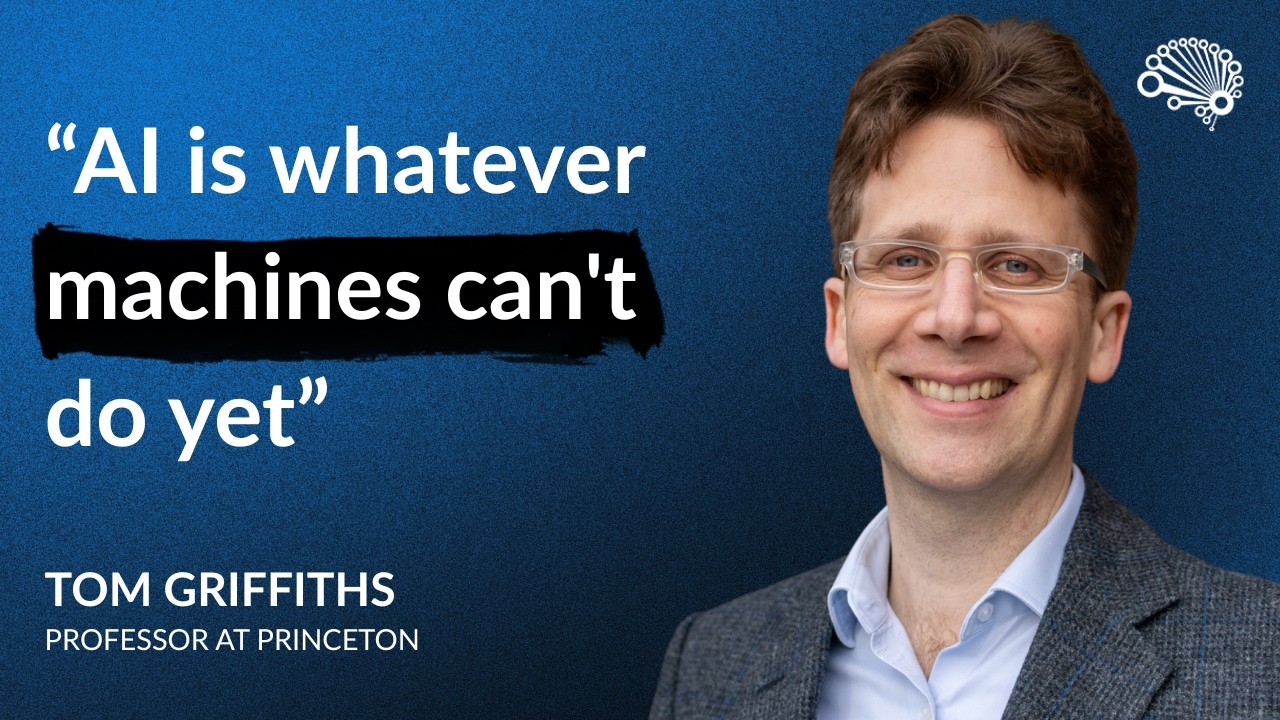
Princeton Professor Tom Griffiths discusses his book "The Laws of Thought," exploring the mathematical models that govern both biological and artificial intelligence. He details the fundamental differences between human and machine cognition, rooted in their vastly different constraints, and explains how concepts like inductive bias, probability, and curiosity can bridge the gap between cognitive science and modern AI.

Intelligence as "Less is More" - Prof. David Krakauer [SFI]

Intelligence as "Less is More" - Prof. David Krakauer [SFI]

Prof. David Krakauer redefines intelligence not as possessing more knowledge, but as the ability to do more with less. He argues that LLMs are mere 'libraries' and proposes a universal theory where all life is intelligent, operating across strategic, inferential, and representational dimensions, with the latter being key to making hard problems easy.