The Laws of Thought: The Math of Minds and Machines, with Prof. Tom Griffiths
Princeton Professor Tom Griffiths discusses his book "The Laws of Thought," exploring the mathematical models that govern both biological and artificial intelligence. He details the fundamental differences between human and machine cognition, rooted in their vastly different constraints, and explains how concepts like inductive bias, probability, and curiosity can bridge the gap between cognitive science and modern AI.
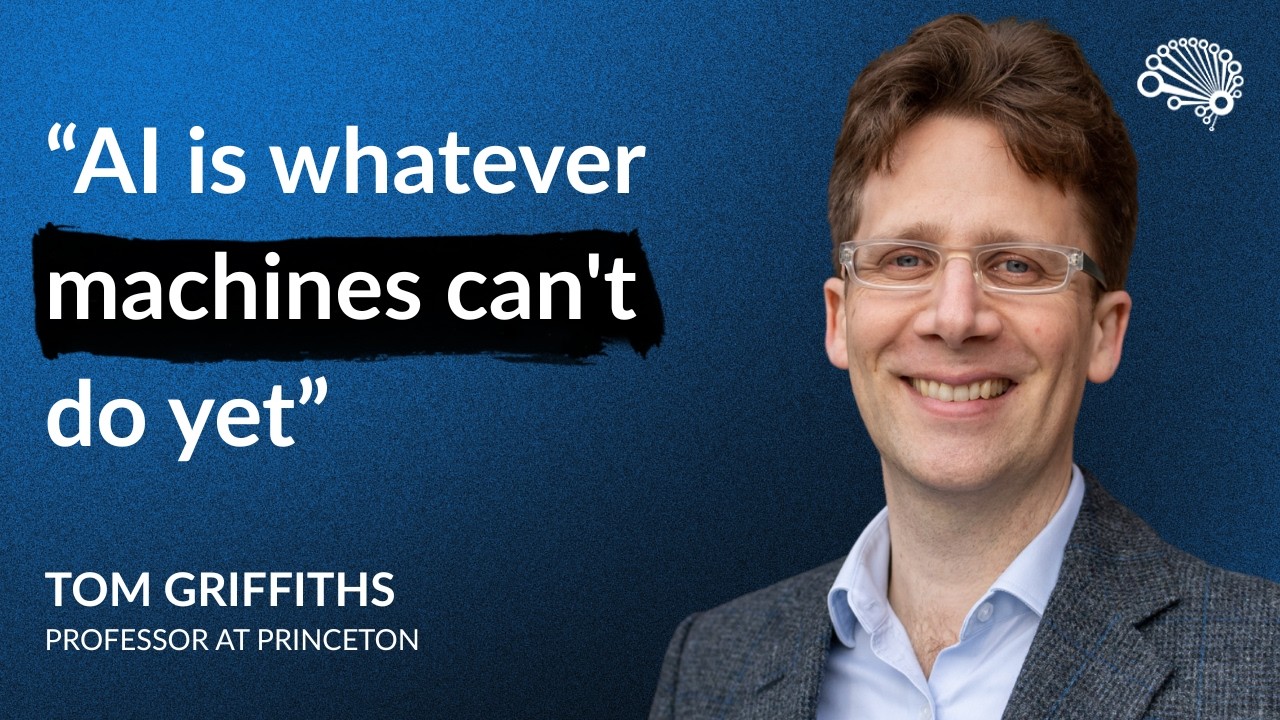
Professor Tom Griffiths of Princeton University explores the mathematical principles that form the foundation of both human and artificial intelligence, bridging the gap between two contrasting views of the human mind. While psychologists often highlight human irrationality and biases, computer scientists see human cognition as an inspiration for AI. Griffiths’ work seeks to reconcile these perspectives by framing human intelligence as a rational adaptation to significant constraints.
The Laws of Thought: A Mathematical Theory of Mind
The core idea of Griffiths’ book, The Laws of Thought, is that just as mathematical laws of nature describe the external, physical world, a complementary set of mathematical principles can describe our internal, mental world.
- From Behaviorism to Cognitive Science: Early psychology struggled to scientifically study internal thoughts, leading to the rise of behaviorism, which focused only on observable behaviors. The cognitive revolution was made possible by the development of computers and mathematical concepts like logic and probability, which provided a new, rigorous language to form and test hypotheses about the mind.
- Research Methodology: Modern cognitive science research often involves large-scale online experiments. In Griffiths’ lab, participants are presented with problems that require them to make inferences or decisions from data. By analyzing the responses from thousands of participants using modern machine learning tools like neural networks, researchers can develop and refine computational models of human cognition.
Human vs. AI: A Tale of Two Intelligences
A key distinction between human and artificial intelligence lies in the constraints they operate under. Humans are limited by time (a finite lifespan), computation (a few pounds of neural tissue), and communication bandwidth. In contrast, AI systems can be scaled with more data and compute and can transfer information perfectly. This leads to fundamentally different problem-solving approaches.
- Inductive Bias and The Data Gap: A human child learns a language in about five years, whereas an LLM requires the equivalent of thousands of years of text data. This vast difference highlights the powerful inductive biases, or priors, built into human cognition. These biases provide a starting framework that makes learning from sparse data possible.
- The Machine Learning Paradigm: Since the success of AlexNet in 2012, the dominant paradigm in machine learning has been one of weak inductive biases and massive datasets. The philosophy is that with enough data, a sufficiently complex model can learn the necessary features and solutions without human-engineered priors. This is the opposite of the human approach.
- Engineering Inductive Bias: To create more human-like AI, we may need to engineer these biases. Meta-learning is one such technique, where a model learns an optimal set of initial weights by being trained on a wide variety of tasks. This provides a “soft bias” that guides the model toward effective solutions without rigidly constraining it, making it better at few-shot learning.
Deconstructing Large Language Models
Griffiths’ research provides a scientific lens for understanding the behavior of LLMs.
- Deductive vs. Inductive Problems: Early symbolic AI excelled at deductive problems (e.g., logic, chess), where all necessary information is provided. However, it struggled with inductive problems—the cornerstone of human intelligence—where conclusions must be drawn from incomplete information. Probability theory, particularly Bayes’ rule, provides the mathematical framework for induction.
- “Embers of Autoregression”: LLMs are trained to predict the next token in a sequence, which makes them highly sensitive to the statistical patterns in their training data. This can lead to counter-intuitive behavior. For example, an LLM might be more likely to state that a sequence contains 30 letters than 29, simply because the number “30” appears more frequently on the internet. For deterministic problems, modern models often compensate by writing and executing code to verify their answers, creating a cognitive architecture around the probabilistic core.
- Creativity and Novelty: LLMs can achieve a form of “compositional generalization” by blending existing concepts in novel ways (e.g., explaining Shakespeare in the style of Snoop Dogg). However, their training objective, which favors high-probability outputs, makes them inherently conservative. They are less likely to produce truly “out-of-the-box” ideas. A useful technique to find rare information is to procedurally generate improbable, compositional prompts, forcing the model into less-explored corners of its knowledge space.
Modeling Curiosity in AI Systems
Curiosity can be modeled computationally as a form of rational information seeking.
- The Value of Information: We aren’t curious about everything new, nor are we interested in what is already familiar. Curiosity peaks for things we have encountered a few times. The computational explanation is that these are the phenomena most likely to recur and about which we still have much to learn. Therefore, gathering information about them has the highest potential value for future actions.
- Internal Rewards for AI: This model of curiosity can be implemented in AI agents as an internal reward function. Instead of rewarding an agent for external achievements (e.g., winning a game), you reward it for reducing its uncertainty about the world in a way that maximizes future utility. This drives the agent to explore its environment in a targeted, efficient manner.
A Scientific Approach to AI Evaluation
Griffiths argues against relying solely on benchmarks to evaluate AI systems.
- Benchmarks vs. Experiments: Benchmarks are an engineering tool designed to measure performance on a set of tasks. A more scientific approach, borrowed from cognitive psychology, involves designing targeted experiments. In this method, the specific pattern of successes and failures on carefully constructed problems becomes diagnostic of the system’s underlying mechanisms, offering a deeper understanding than a single performance score.