Computational models for brain science
Dr. Laschowski discusses his lab's research in computational neuroscience, focusing on three core areas: reverse-engineering human motor control using reinforcement and optimal control models, developing high-accuracy neural decoding algorithms for brain-machine interfaces (BMIs), and creating brain-inspired deep learning models for computer vision. The talk highlights a long-term vision of discovering the fundamental principles of intelligence to build more efficient and robust AI.
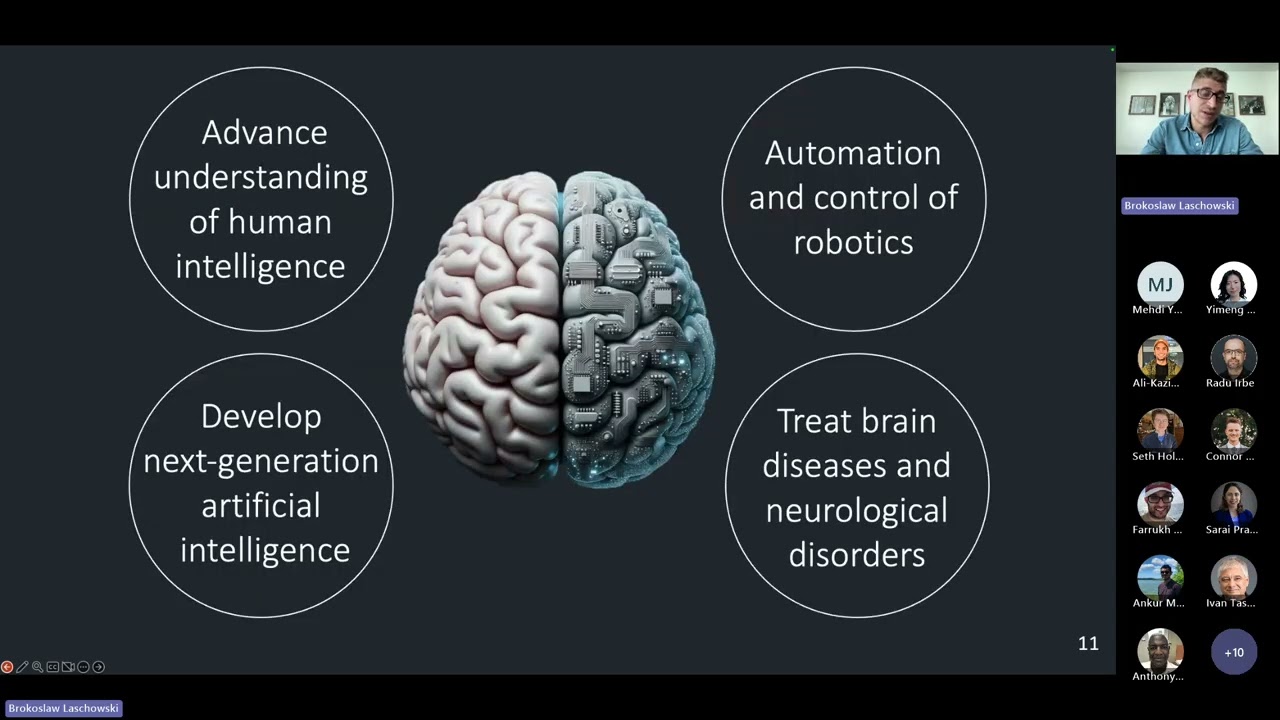
The human brain can be viewed as a biological information processing system. This computational framework allows us to reverse-engineer the fundamental principles of intelligence, which has profound applications in developing next-generation AI, treating neurological disorders, and advancing robotics. My lab at the University of Toronto is organized into three main research programs that explore this intersection of neuroscience and machine learning.
Computational Motor Control: Reverse-Engineering Movement
The primary mission of this program is to understand how neural computations in the motor cortex produce complex human movement. Unlike cognitive tasks such as chess, where the rules are known, the “algorithm” for motor control remains one of the great unsolved challenges in neuroscience. We are tackling this problem from two main angles:
- Optimal Control Theory: We use goal-driven optimization to predict human movement in silico. This approach, known as inverse optimal control, involves defining a biologically inspired objective function—such as minimizing energy expenditure—and solving for the optimal movement policy. In collaboration with the Canadian Sport Institute, we have developed mathematical models, personalized with medical imaging from Paralympic athletes, to test which objective functions best predict experimental motor behaviors.
- Reinforcement Learning (RL): Inspired by dopamine-based learning in the brain, we use RL to model how an agent learns an optimal policy through interaction and reward. In one study, we used an imitation learning framework to train a controller for a neuromuscular skeletal model. Our novel algorithm, which uses KD trees for an efficient policy representation, learned to accurately predict motor behaviors while requiring 87 times less compute and 7 times less memory compared to the state-of-the-art, better aligning with the efficiency of the human brain.
Future work will focus on developing deep RL algorithms that are more neuroanatomically aligned, allowing for direct comparison between artificial and biological neural networks. This contributes to the field of mechanistic interpretability, aiming to make AI models more explainable. We will also address the challenge of data efficiency, drawing inspiration from the human ability for one-shot learning.
Brain-Machine Interfaces (BMIs): Decoding Neural Intent
This program focuses on developing machine learning models to decode neural activity from the brain. Our goal is to advance BMI research from a computational neuroscience perspective.
- Decoding Motor Commands: Using surface electromyography (EMG), we developed a recurrent neural network that decodes descending motor commands with over 94% classification accuracy across more than 100 subjects, demonstrating high generalizability. We are now building an open-source EMG foundation model to support transfer learning for the research community.
- Universal Neural Decoders: A major challenge in non-invasive EEG-based BMIs is the need for subject-specific calibration. To address this, we developed a novel unsupervised deep contrastive learning algorithm. This model enables “zero-calibration” decoding by learning discriminative representations that can be adapted to a new user without any labeled data from that individual. In “low-calibration” scenarios with minimal data, it significantly outperforms the state-of-the-art.
- Real-Time Control: We have developed real-time embedded neural controllers with a closed-loop processing time of less than 3 milliseconds, enabling students in our lab to control a robotic actuator by simply thinking about moving their leg.
Looking ahead, we plan to develop closed-loop BMIs that co-adapt with the user, where the artificial brain learns from the human brain and vice-versa. We will explore using RL to manage this mutual learning process over longer timescales, such as during rehabilitation. We will also incorporate data from more invasive sensors, like implanted microarrays, to study neural dynamics at a finer resolution.
Brain-Inspired Computer Vision
Our third program aims to build deep learning models of visual intelligence inspired by the hierarchical processing of the brain’s ventral stream. While modern computer vision models are powerful, they lack the robustness of human vision, often failing against minor adversarial attacks.
- Performance-Optimized Models: Initially, we focused on optimizing neural networks for performance on tasks like image classification. We developed efficient models for mobile deployment on neuromorphic processing units (NPUs) and created one of the largest open-source datasets of egocentric images, containing over 5.6 million annotated images.
- Biologically Plausible Learning: Recognizing that the brain does not rely on millions of labeled examples, we explored more efficient learning paradigms. We developed a semi-supervised learning algorithm that achieved 99% accuracy while requiring 35% fewer labeled images than supervised methods.
- Depth Perception: Taking further inspiration from neuroscience, we are building a monocular depth estimation algorithm that uses deep learning to reconstruct 3D environments from 2D images, with preliminary results showing accuracy comparable to state-of-the-art depth cameras.
The future of this program is to move beyond just matching performance to creating models that are more neuroanatomically aligned. We will extend the classic Turing test to compare not only the input-output behavior of machines and humans but also their internal neural representations, layer by layer.
The Long-Term Vision: Discovering the Principles of Intelligence
Most of our work has used AI to understand the brain, but there is enormous, relatively untapped potential in using the brain to inspire new AI. Our only known example of general intelligence is human intelligence. By reverse-engineering the brain, we may discover fundamental principles that could enable us to build true Artificial General Intelligence (AGI). The goal is not necessarily to build AI that looks like a brain, but to build AI that operates on the same fundamental principles of intelligence, much like airplanes and birds both rely on the principles of physics to fly.