The Biggest Mistakes Companies Make With Manufacturing AI - Namwoo Kang | Deep Dive
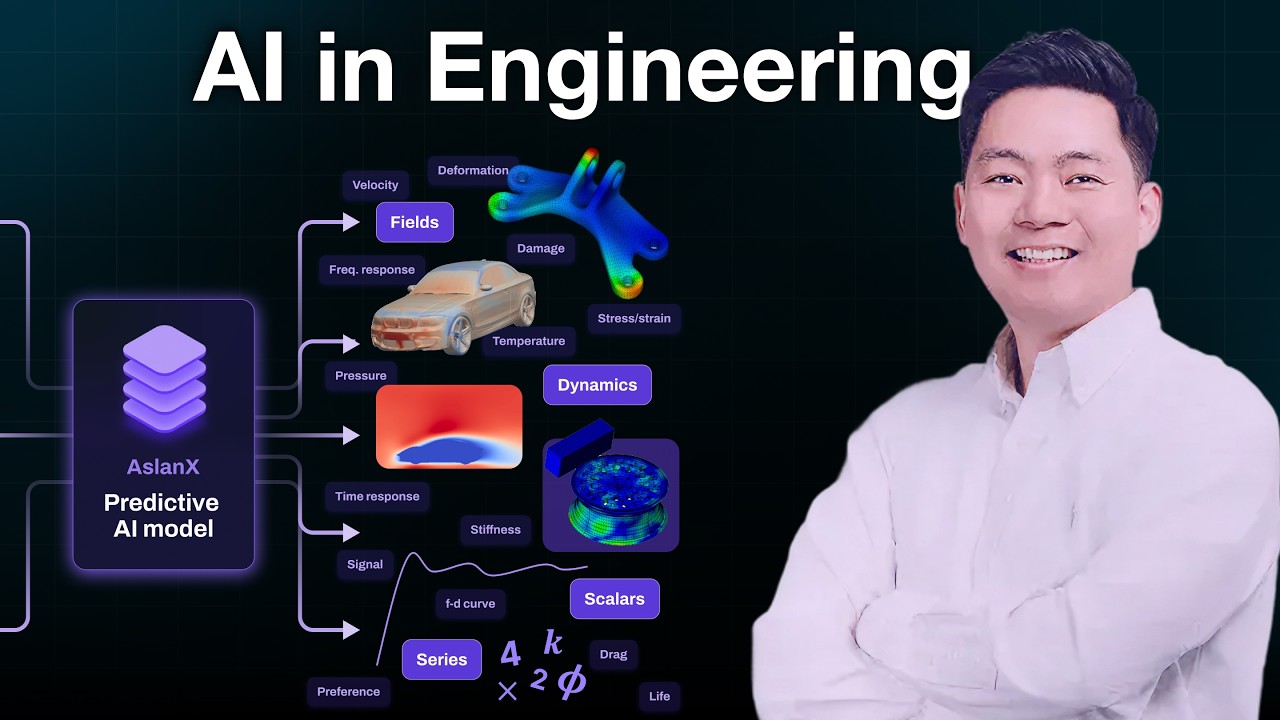
Namwoo Kang, CEO of Narnia Labs, outlines why AI Transformation (AX) is now a survival necessity in manufacturing. He details a five-part strategy for successful AI adoption—focusing on problem definition, data, models, execution, and skills—and introduces AselanX, a no-code platform designed to empower domain experts to solve complex engineering problems without deep AI expertise.
The manufacturing industry is undergoing a fundamental shift where AI Transformation, or AX, is no longer an optional upgrade but a critical necessity for survival. While software once “ate the world,” we are now in an era where manufacturing is poised to do the same, driven by the implementation of AI-powered physical systems. This transformation is especially urgent for economies heavily reliant on manufacturing, which face compounding crises of an aging population, a shrinking workforce, and weakening global competitiveness.
The most significant impact of AI within manufacturing can be realized by focusing on the pre-production phase. According to the “smile curve” of value creation, product development holds the greatest potential for value-add. Therefore, optimizing this stage with AI promises the largest return on investment.
Five Strategies for Effective AI Adoption in Product Development
Successfully implementing AI in manufacturing requires a strategic approach centered on five key perspectives:
1. Problem Definition: Domain Knowledge First
The core principle is to “solve the right problem.” In manufacturing, domain knowledge—understanding physics, materials, design, and processes—is paramount. AI should be treated as a powerful tool, not the ultimate goal. This leads to a crucial insight:
It’s more effective to teach AI to domain experts than to teach domain expertise to AI engineers.
Many organizations are realizing this as they encounter AI experts who lack the specific domain context to identify and solve the most impactful problems.
2. Data: The Foundation of AI
While many companies claim to have abundant data, it is often inconsistent, incomplete, or unusable for training robust AI models. Data quality has a greater influence on outcomes than the model itself. If high-quality data is unavailable, it must be systematically created. This involves building automated systems for data collection and pre-processing, a task that often requires more time and resources than model development. Due to the sensitive nature of manufacturing data, on-premise solutions are often necessary, making the process of preparing data feel more like “manual labor disguised as intelligence.”
3. Model: Specialize for Success
In the context of manufacturing, a specialized AI model that excels at one specific task is far more valuable than a generalist model that performs reasonably well across many. The problems in this sector are diverse, complex, and difficult to generalize, with a scarcity of public datasets. This is why manufacturing AI requires deep expertise. Even when leveraging large-scale generative AI systems, domain-specific agents are essential to achieving meaningful and accurate results.
4. Execution: Start Small, Think Big
Companies should avoid the pitfall of trying to build a comprehensive AI system all at once. The recommended approach is to “start with one brick at a time.”
- Focus on a long-term vision, not just short-term wins.
- Begin with a proof-of-concept (POC) to identify gaps quickly and iterate.
- Tackle high ROI problems first to build momentum and demonstrate value.
- Collaborate with capable partners and startups to accelerate progress.
5. Skill: Using AI Efficiently
To maximize the value of AI, it’s crucial to understand its strengths and weaknesses.
- Let AI do what it does best: Handle high-volume, repetitive tasks where speed is more important than perfection. Humans are slow but careful; AI is fast but clumsy.
- Stop chasing perfect accuracy: The value of AI often comes from being “fast enough,” not flawless.
- Use AI only where it’s truly needed: Many automation tasks don’t require complex AI. Don’t use a sledgehammer to crack a nut.
- Develop from the user’s perspective: Create simple, intuitive tools that domain experts can easily adopt into their existing workflows.
Narnia Labs: Accelerating Product Development with AI
The greatest challenge in engineering is the time and cost associated with the iterative design-simulation-test cycle. Narnia Labs aims to drastically shorten this process using a two-pronged AI approach:
- Predictive AI: Learns from historical simulation and test data to instantly predict the performance of new designs. This allows engineers to iterate rapidly without waiting for lengthy simulations or physical tests.
- Generative AI: Takes this a step further by automatically creating new design candidates, predicting their performance, and recommending optimized solutions.
By combining these technologies, Narnia Labs has achieved dramatic results, such as reducing the design time for a car brake system from one month to just one minute and automatically generating over 30,000 wheel design candidates. These technologies have been validated across numerous sectors, including mobility, consumer electronics, heavy industries, energy, and even nuclear reactor design.
AselanX: A No-Code Platform for Domain Experts
To make these powerful AI capabilities accessible, Narnia Labs developed AselanX, a no-code AI platform. It empowers domain experts—the engineers and designers on the front lines—to build, train, and deploy their own AI models without writing a single line of code.
The platform simplifies the process into six steps: Import, Process, Build, Train, Test, and Deploy.
- Users can upload 1D, 2D, or 3D engineering data.
- The platform automatically pre-processes the data for AI training.
- A simple visual workflow interface allows users to define inputs/outputs, select models, and train them.
- Trained models can be deployed as APIs or GUI applications for broader use.
The workflows are fully extensible, allowing users to combine generative, predictive, and optimization AI modules to solve complex, end-to-end engineering problems. This puts the power of AI directly into the hands of those with the domain knowledge to use it most effectively.