AI Agents + LLM Reasoning: Transforming Autonomous Workflows
Explore the distinction between LLMs and AI agents, focusing on how agents leverage reasoning, tool calling, and the ReAct prompting framework for autonomous decision-making and task execution in complex business workflows.
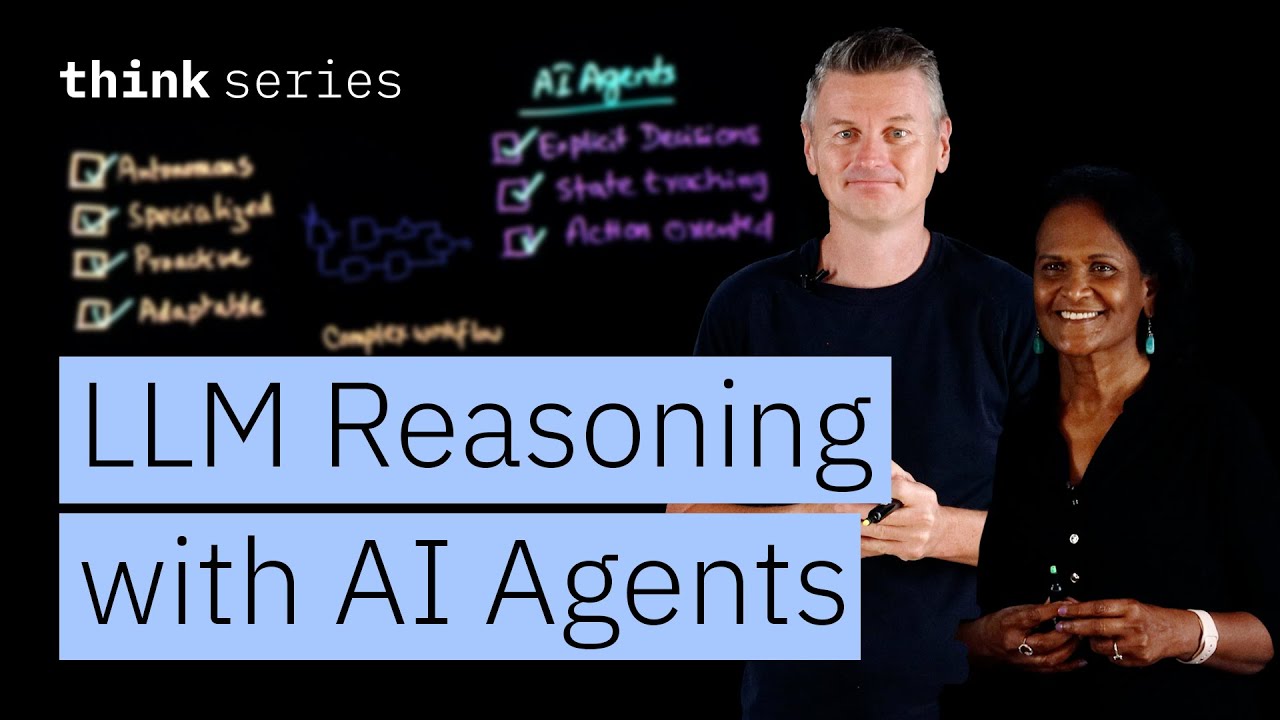
AI agents represent the next step in the evolution of Large Language Models (LLMs), moving from information retrieval to autonomous decision-making and execution. While LLMs excel at generating text based on trained knowledge, agents are action-oriented and designed to perform tasks, making them critical for complex business applications.
Core Characteristics of AI Agents
The primary characteristics that set AI agents apart are:
- Autonomy: They operate without constant manual intervention, navigating complex workflows and resolving issues as they arise.
- Specialization: Agents can be designed for very specific, specialized tasks.
- Proactivity and Adaptability: They can handle outliers and adapt to new or unknown situations.
To achieve this, AI agents integrate three key components:
- Tools: Access to APIs and other resources to perform actions.
- Rules: Adherence to business logic and constraints when making decisions.
- Pools: Utilization of data sources to inform their actions.
Reasoning: LLMs vs. AI Agents
There is a fundamental difference in how LLMs and AI agents approach reasoning.
LLM Reasoning:
- Mechanism: Functions as a next-token predictor, with reasoning based heavily on pattern matching from its pre-training data and context window.
- Scope: Typically focused on a singular task like summarization or translation.
- Memory: Implicit memory is non-persistent; context from one session does not carry over to another.
AI Agent Reasoning:
- Mechanism: Involves explicit decision-making based on a combination of workflows, business rules, and available tools.
- State Tracking: A critical capability where the agent maintains awareness of the previous, current, and future states of a task. This is essential for multi-step processes.
- Action-Oriented: The goal is not just to generate text, but to accomplish tasks by executing API calls or performing other actions.
Common AI Agent Reasoning Techniques
Agents employ various strategies to make decisions and navigate tasks:
- Conditional: Basic
if-then-elselogic. It is simple to implement but can be brittle when faced with unexpected outliers. - Heuristics: Using “rules of thumb” or mental shortcuts to make quick decisions when multiple options are roughly equivalent (e.g., choosing the cheapest option).
- ReAct (Reason and Act): A popular and powerful prompting technique. It’s a variation of Chain-of-Thought where the agent explicitly reasons about the situation and the rules before taking an action, rather than blindly applying logic.
- Self-Reflection: The agent reviews previous actions and considerations to refine its decisions before execution, adapting if the situation requires it.
- Multi-Agent Systems: Multiple specialized AI agents collaborate to solve highly complex problems that a single agent could not handle alone.
A Deep Dive into the ReAct Framework
The ReAct framework is particularly effective for handling complex workflows with potential deviations. The process involves several stages:
- Understand: The agent first receives and clarifies the requirements of the task.
- Diagnose: It determines the necessary course of action, including which rules to apply and which tools to call, based on its understanding.
- Adapt (The Core of ReAct):
- If the task follows a known path, the agent proceeds directly to resolution.
- If it encounters an unknown situation, the agent enters the adapt stage. Here, it uses self-reflection to handle the deviation. It might adapt business rules, call different tools, or utilize new APIs to navigate the challenge. This adaptability allows a single workflow to handle both known and unknown scenarios.
- Resolve: After navigating the path (either known or adapted), the agent executes the final action to complete the task.
An example is an agent tasked with software installation. For a known piece of software, it follows a standard procedure. For new software, it enters the Adapt stage to recognize the new requirements (e.g., different memory needs, new APIs, unique security rules) and modifies its process accordingly before completing the installation.
The true power of AI agents lies in this capacity for self-learning and adaptation. They are not merely executing pre-programmed tasks but are dynamically solving problems, making them invaluable for modern enterprises where workflows are rarely simple or static.