Distant conversational speech recognition: Challenges and Opportunities
Dr. Samuele Cornell from Carnegie Mellon University discusses the persistent challenges in distant automatic speech recognition (DASR) for spontaneous, multi-party conversations. He explains why state-of-the-art systems falter in real-world scenarios and presents recent advancements through three key efforts: (1) insights from the CHiME-7/8 DASR challenges, which benchmark robust meeting transcription; (2) progress towards unified end-to-end models that jointly handle diarization and recognition; and (3) novel techniques for generating realistic, large-scale training data using a combination of large language models and multi-speaker text-to-speech systems.
The Unsolved Problem of Conversational ASR
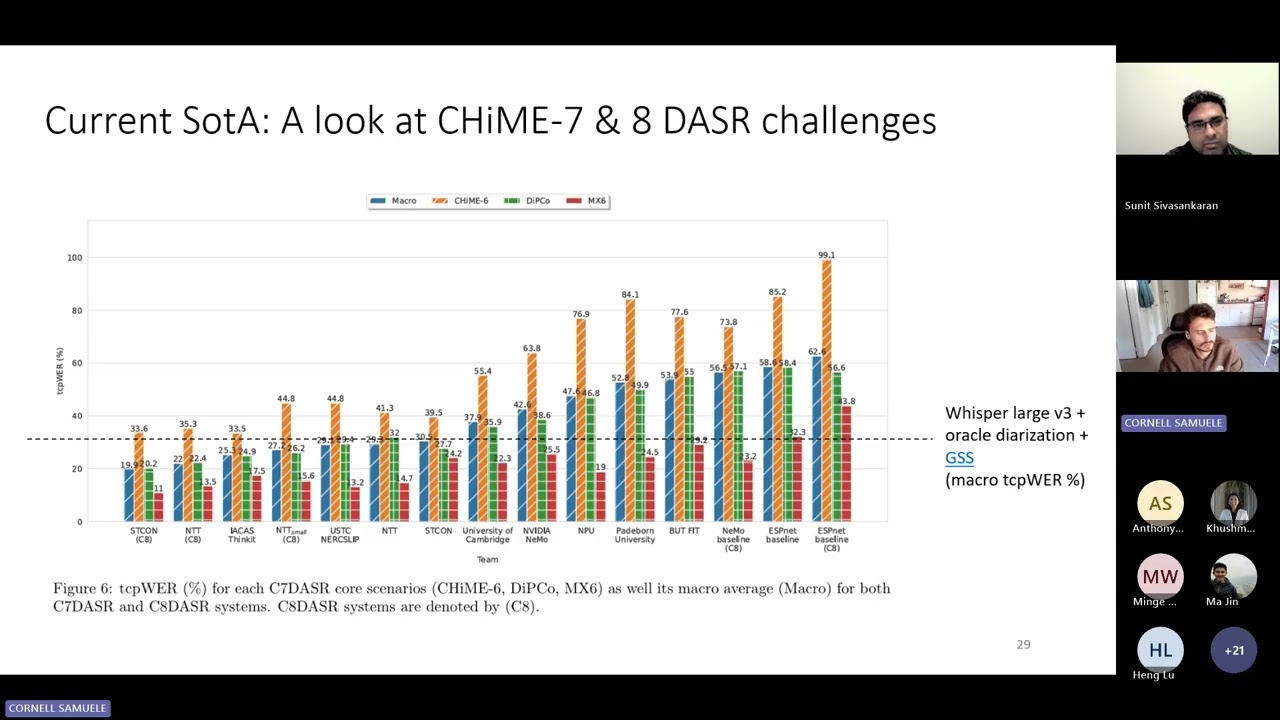
State-of-the-art Automatic Speech Recognition (ASR) systems like Whisper claim human-competitive performance, but this success is largely confined to close-talk, single-speaker, or non-conversational domains like audiobooks. Dr. Samuele Cornell argues that these results are often based on the unrealistic assumption of having “oracle segmentation and diarization,” which provides perfect information about who is speaking and when. When applied to real-world, far-field conversational speech—such as dinner parties (CHiME-6, DipCo) or interviews (Mixer 6)—these systems struggle significantly, with word error rates (WER) exceeding 30-36%, even with oracle diarization.
The core challenge lies in the complexity of spontaneous, multi-party conversations, which involve overlapping speech, background noise, reverberation, and dynamic turn-taking. A robust solution to this problem is fundamental for creating truly capable AI agents that can operate in natural human environments, from service robots in restaurants to intelligent assistants in business meetings.
The Traditional DASR Pipeline and Evaluation
The established approach to Distant ASR (DASR) is a multi-stage pipeline:
- Diarization: Segmenting the long-form audio to identify who is speaking and when.
- Speech Separation: Handling overlapping speech by separating the mixed audio into individual speaker streams.
- Recognition: Running an ASR model on each separated stream.
This pipeline is fraught with challenges, including variability in speaker count and meeting duration, and the difficulty of handling different conversational dynamics (e.g., formal interviews vs. colloquial chats). Overlapped speech, which can constitute up to 15% of the audio in datasets like AMI, can severely degrade recognizer performance.
Evaluating such systems requires more than just WER. Metrics like TCP-WER (Time-Constrained Permutation Word Error Rate) are used, which account for errors in word recognition, speaker attribution, and segmentation timing by finding an optimal alignment between the system’s hypothesis and the reference transcript.
Findings from the CHiME-7 and CHiME-8 DASR Challenges
The CHiME challenges were designed to push the boundaries of robust meeting transcription by requiring systems to perform well across multiple diverse scenarios (dinner parties, interviews, office meetings). Key findings from the challenges include:
- Generalist Systems are Competitive: Systems designed to be domain-agnostic performed surprisingly well, even competing with specialist systems that were highly tuned for a single scenario. This suggests that training for robustness across multiple domains leads to better generalization.
- Speaker Counting is Critical: For modern pipelines that use Target-Speaker Voice Activity Detection (TS-VAD), getting the speaker count wrong leads to “catastrophic error propagation.” The diarization error rate (DER) was found to be less correlated with the final TCP-WER than the Jaccard error rate, which is more sensitive to speaker counting errors.
- Transcription vs. Summarization: A surprising discovery was the poor correlation between transcription accuracy (TCP-WER) and the quality of downstream meeting summarization. Experiments using Gemini for summarization showed that even with significant word-level errors (e.g., randomly deleting 50% of words), summarization quality remained high. However, errors in speaker attribution caused a significant drop in quality, highlighting its importance for downstream understanding.
Towards Simpler, End-to-End Architectures
While modular pipelines are currently superior, their complexity motivates research into streamlined, end-to-end (E2E) systems. The talk highlights two directions:
- Transcribe-to-Diarize: This approach refines an initial diarization by conditioning an E2E ASR model on speaker embeddings.
- SLIDER (Sliding Window Diarization-Augmented Recognition): This framework, developed by the speaker, uses a sliding window over the audio. Within each window, a model performs localized ASR and diarization, outputting text with local speaker labels and corresponding speaker embedding vectors. A final clustering step over all embeddings resolves the speaker identities across the entire meeting. While promising, this method struggles with high speaker counts and significant overlap, and is hampered by the lack of large-scale annotated data.
The Power of Synthetic Data Generation
Data scarcity is the primary bottleneck for training robust E2E models. The solution lies in synthetic data generation. While traditional simulators that mix existing speech corpora are fast, they produce semantically incoherent conversations. A more advanced approach combines Large Language Models (LLMs) and multi-speaker Text-to-Speech (TTS) systems:
- LLMs for Coherent Content: LLMs can generate realistic conversational scripts.
- Multi-Speaker TTS for Realistic Interaction: Instead of synthesizing each speaker independently, a multi-speaker TTS model like Parakeet (trained on podcast data) can generate audio with realistic turn-taking, interruptions, and prosody.
Experiments showed that fine-tuning Whisper on this synthetically generated conversational data works nearly as well as using a large amount of real, out-of-domain data. This proves the viability of using synthetic data to train models for domains where real data is scarce, such as doctor-patient conversations.
Conclusion: The Path Forward
- Modular Still Reigns Supreme: For now, modular pipelines (e.g., robust diarization followed by a model like Diarization-Conditioned Whisper) deliver state-of-the-art performance. E2E systems are a promising research direction but are not yet competitive.
- LLMs Have Limitations: While powerful, autoregressive LLMs like Gemini are not well-suited for diarization tasks. They suffer from catastrophic error accumulation in timestamp prediction, leading to drift and hallucinations over long audio sequences. A better approach may be to integrate LLMs with external, specialized diarization models.
- Data is Key: The future of DASR relies on solving the data problem. This involves bootstrapping better models through cycles of pseudo-labeling with ASR and generating higher-quality data with TTS, and extending these techniques to handle more than two speakers.