Tokenless

Interactive discovery

Explore the topic map

Follow the connections between themes, people, and ideas across the Tokenless archive in an interactive topic modeling map.

Machine Learning

View All
Uncertainty-Guided Data Augmentation for Engineers | Deep Dive - Yongmin Kwon

Uncertainty-Guided Data Augmentation for Engineers | Deep Dive - Yongmin Kwon

This session details a data-efficient method for training engineering surrogate models by using uncertainty quantification (UQ) to guide geometric data augmentation. Instead of random deformations, the approach lets the deep ensemble model identify its own knowledge gaps (epistemic uncertainty), then uses Free-Form Deformation (FFD) to generate new shapes specifically in those uncertain regions. This ensures every expensive simulation run yields maximally informative data, significantly improving model accuracy for a fixed computational budget across domains like structural mechanics and aerodynamics.

Q-learning with Flow-Matching Policies

Q-learning with Flow-Matching Policies

This talk explores methods for optimizing expressive, multi-modal policies, such as those based on flow-matching, with off-policy reinforcement learning. The speaker presents two novel algorithms, FQ-RL and CAM, designed to overcome the instability of backpropagation through multi-step generative models, enabling effective online self-improvement and adaptation for robotic manipulation tasks.

Graph Neural Networks Explained: A Clear Guide to GNN Basics & Models

Graph Neural Networks Explained: A Clear Guide to GNN Basics & Models

An introduction to Graph Neural Networks (GNNs), covering fundamental concepts like nodes, edges, and embeddings. This post delves into the core message-passing mechanism and provides a detailed overview of key architectures including GCN, GraphSAGE, GAT, GIN, and Graph Transformers, explaining their unique approaches and mathematical formulations.

Artificial Intelligence

View All
⚡️Every product of the future will be a living system  — Ronak Malde, Trajectory.ai

⚡️Every product of the future will be a living system — Ronak Malde, Trajectory.ai

Ronuk Malde, CEO of Trajectory.ai, discusses his journey from building AI coding agents at Windsurf to his current focus on continual learning for enterprise AI. He shares insights on leveraging real-world user data, the unique challenges of model acquisition, and how Trajectory.ai's platform, powered by innovations like scaled SDPO and a novel training stack, enables dynamic, always-learning AI models for diverse industries from legal to finance.

6 Things to Know about AIE World's Fair 2026

6 Things to Know about AIE World's Fair 2026

Discover the AI Engineering World's Fair 2026, the largest iteration yet, offering an unparalleled deep dive into AI engineering with expanded tracks on auto research, GPU specialization, and new verticals like finance and healthcare. Highlights include an innovative expo experience, exclusive leadership initiatives like the "Token Billionaires Program," and unique side events fostering community, including "Posters on AI" where attendees can defend their tweets. This event is designed to be a curated hub for practical, cutting-edge insights and networking in the AI/ML professional landscape.

The data black hole at the center of AI

The data black hole at the center of AI

AI progress is fundamentally driven by vast amounts of data and compute, rather than improvements in sample efficiency, creating a stark contrast with human learning. This essay explores the "black hole of data" powering AIs, quantifies the massive sample-efficiency gap between humans and machines, counters common objections, and discusses the implications for white-collar automation and future AI research.

Technology

View All
3‑2‑1 Backup Rule Explained: Protect Your Data from Disaster

3‑2‑1 Backup Rule Explained: Protect Your Data from Disaster

Jeff Crume outlines essential data resiliency strategies, starting with the 3-2-1 backup rule—three copies, two media types, one offsite—and expanding to include immutable or air-gapped backups, rigorous testing, and encryption. He emphasizes these principles for robust disaster recovery, ransomware protection, and minimizing costly downtime, highlighting the trade-offs in achieving high availability.

The Media Game Has Changed

The Media Game Has Changed

The conversation explores the shift from legacy media to creator-led platforms, why authenticity has become a competitive advantage, and how founders can build audiences by communicating directly with customers, employees, and the public. They discuss podcasts, social media, storytelling, corporate communications, and the changing relationship between companies, journalists, and audiences. Along the way, they examine how founders can develop a public voice, why some leaders become influential communicators, and what it means to build a brand in a world where distribution is increasingly decentralized.

The C4 Model: Visualizing Software Architecture • Simon Brown & Susanne Kaiser • GOTO 2026

The C4 Model: Visualizing Software Architecture • Simon Brown & Susanne Kaiser • GOTO 2026

Simon Brown, creator of the C4 Model, discusses its origin as a practical solution to clarify messy software diagrams. He explains the four hierarchical levels (context, container, component, code), emphasizing that most teams only need the top two for significant value. The discussion highlights the importance of including technology in diagrams, C4's collaborative nature, and practical advice on modeling microservices and bounded contexts, all while advocating for a lightweight, accessible approach to architectural visualization.


Recent Post

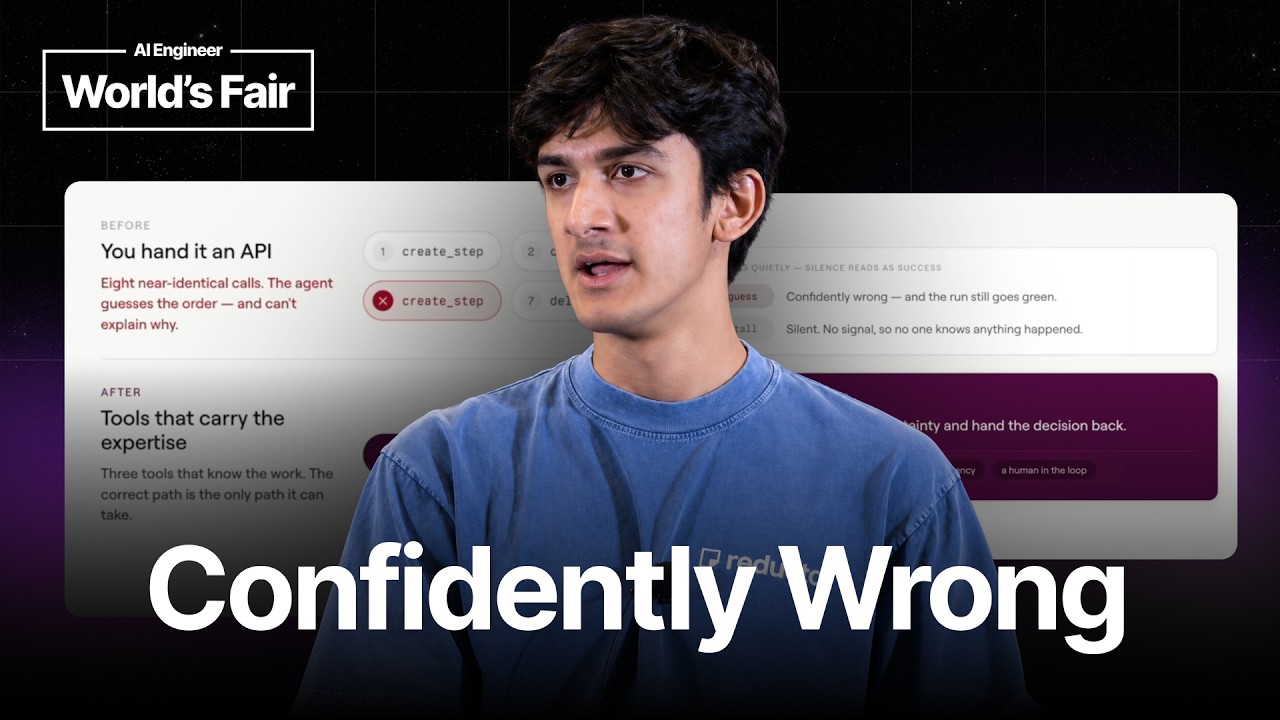
How Transformers Finally Ate Vision – Isaac Robinson, Roboflow

How Transformers Finally Ate Vision – Isaac Robinson, Roboflow

Isaac Robinson from Roboflow explains why Vision Transformers (ViTs), despite their initial disadvantages in computational complexity and lack of inductive bias, ultimately surpassed Convolutional Neural Networks (CNNs) for computer vision tasks. The talk covers the critical roles of massive, ViT-specific pre-training methods like MAE and DINO, the architectural evolution through models like Swin, ConvNeXt, and Hiera, and optimizations borrowed from the LLM ecosystem. It culminates in a discussion on the practical deployment challenges of large foundation models like SAM and how Neural Architecture Search can bridge the gap.

Thin Harness, Fat Skills: The New Way To Build Software

Thin Harness, Fat Skills: The New Way To Build Software

This episode explores the transformative shift in software development, where AI agents empower solo developers to achieve unprecedented productivity. Featuring YC President Gary Tan's return to coding after 13 years, it delves into new workflows, the 'tokenmaxxing' philosophy, and the rise of personal, user-controlled AI.

Agentic Search for Context Engineering — Leonie Monigatti, Elastic

Agentic Search for Context Engineering — Leonie Monigatti, Elastic

Leonie Monigatti from Elastic provides a practical guide to agentic search, arguing that effective context engineering is not just a retrieval problem, but a search problem. The workshop explores the trade-offs between specialized tools (like semantic search) and general-purpose tools (like shell and SQL execution), offering a "low floor, high ceiling" framework for building a robust and efficient retrieval stack for AI agents.

Inside Mythos: Anthropic's Locked-Down Frontier Model — with Jon Krohn (@JonKrohnLearns)

Inside Mythos: Anthropic's Locked-Down Frontier Model — with Jon Krohn (@JonKrohnLearns)

Anthropic's Claude Mythos Preview is a frontier AI model with emergent hacking capabilities so advanced it's being withheld from public release. This summary details its near 100x performance leap in exploit generation, the 'Project Glasswing' industry consortium for responsible disclosure, and practical advice for developers to secure AI-generated code in this new era of automated vulnerability discovery.

Live from Think 2026: AI operating model, VC funding & CAIO evolution

Live from Think 2026: AI operating model, VC funding & CAIO evolution

Live from IBM Think 2026, experts discuss the maturation of enterprise AI, moving from siloed applications to integrated, end-to-end solutions. The panel explores the rising trust in AI for strategic decisions, the evolving role of the Chief AI Officer (CAIO), and the state of AI investment, arguing that the field is broadening to solve specific business problems.

Inside China's AI Labs with Interconnects & SAIL Media

Inside China's AI Labs with Interconnects & SAIL Media

Firsthand reflections from a visit to China’s most prominent AI labs, exploring the human side of the Chinese AI ecosystem, the technical constraints they face from chip supply, and how their research culture compares to the Bay Area.

Stay In The Loop! Subscribe to Our Newsletter.

Get updates straight to your inbox. No spam, just useful content.