Your AI Agent Has No Nervous System — Matt Gibiec, Dynatrace
Matt Gibiec of Dynatrace argues that coding agents are fast but blind without real context about how services run in production, and introduces Bluebox, an observability agent that brings dependency maps, production baselines, and change history into local testing, issue detection, fix suggestions, and pre-build planning, with a human approving the final result.
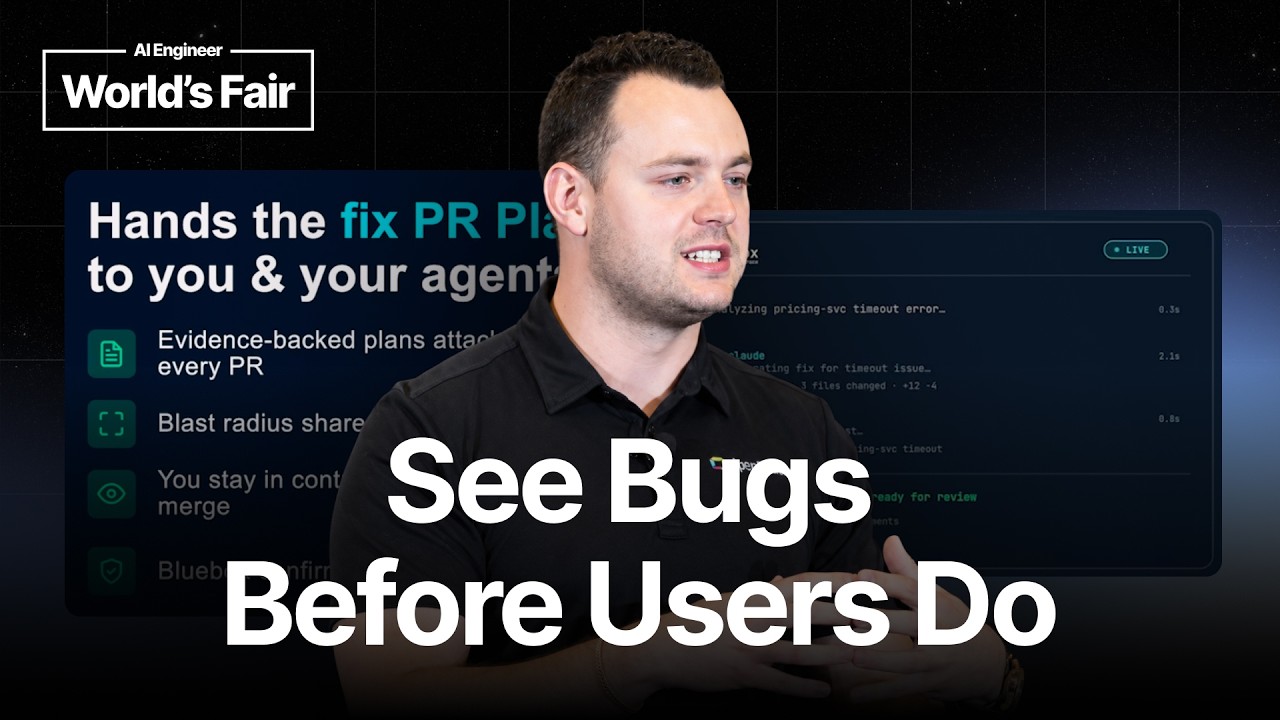
Agents work fast, but blind
Matt Gibiec, who leads AI-native solutions engineering at Dynatrace, opens with a provocative premise: your AI agent has no nervous system. He is not claiming agents should behave like people. His point is that organizations increasingly use agents to replace work people used to do, and that doing this well requires enough input for the agent to reason about the environment it is changing, rather than automating processes that already don’t work well.
Symptoms of working without context
He uses a series of audience polls to make his case. Nearly everyone has watched an agent get stuck in a loop, repeating the same action and burning tokens without progress. A human researcher would notice that an approach isn’t working and change angle; today’s agents generally don’t. Operational issues and security concerns drew similar hands. He then questions how value is measured. Many teams rush into the AI wave without defining success metrics, and he argues that leaders should pause to decide what they are trying to accomplish before committing engineering time, effort, and money to agents.
Fast, but without sight
He builds on a framing from Dynatrace’s CTO: agents operate at speed but without sight. An agent is only as good as the data it can see. When that data is missing context, details, or the permissions needed to reach tools across the environment, you get hallucinations and automations that look correct locally but deliver little value. His example is a coding agent such as Claude working inside the SDLC. Without visibility into service dependencies and how users actually use the applications, the agent produces advice that seems right in the moment and fails over the long term. His summary line is ‘context is king,’ and he frames that context as the nervous system you give your agents, the connective tissue that drives every automated process.
Bluebox as an observability agent for coding agents
He introduces Bluebox by Dynatrace as an agent that sits inside the development lifecycle and feeds context to AI coding agents and proprietary agents. He walks through four scenarios.
- Works locally, breaks in production. A feature passes local tests, gets merged, and suddenly three other services fail. Bluebox maps services and dependencies for every agent and AI workload, then brings production context into local testing so developers can see the wider impact of a change before it ships.
- Catching issues before users do. Using historical load data, Bluebox establishes what normal looks like end to end. When behavior deviates, such as a service slowing down or throwing errors it never threw before, the developer’s IDE-side agent is alerted. Because Bluebox also integrates with the code repository, it can correlate the deviation with a specific change or a failed merge.
- Fixing without breaking other things. Once an issue is detected and the repository context is known (who pushed what, and when), Bluebox suggests remediation steps. He stresses that a one-line fix can ripple through the rest of the application, so the fix has to account for the dependency graph, not just the symptom.
- Planning before you prompt. Instead of developers building whatever a feature request describes, Bluebox briefs agents with research drawn from existing applications and agents, so the team understands what a feature needs to deliver to users before code is written.
A human stays in control
He closes the loop on automation with a note on human oversight. The sequence is to observe the environment and build the dependency map, provide production context to developers during testing, detect issues, suggest fixes grounded in the whole system, and drive the SDLC up to the point where a person decides whether a feature or fix ships. The stated goal is to help agents ship code you trust to production.
Editorial note
The talk is openly a product pitch, and the question-and-answer segment was skipped because the audience had none. The core argument, that agents need environment context to be useful and safe, is sound and well illustrated with relatable scenarios. The mechanics of how context is gathered and how fixes are validated were left fairly high level, so technical listeners will need to dig into the product itself to evaluate those claims.