Ai

How we built Grok Bot in a month | Roman Ugarte (SpaceXAI)

How we built Grok Bot in a month | Roman Ugarte (SpaceXAI)

Roman Ugarte, a key figure behind Grok Bot, shares insights into its rapid development, emphasizing the strategic choice to build it as a separate, cloud-first product with bots having their own dedicated 'computers.' The discussion highlights a "colleague-pilled" product philosophy focused on full delegation and constant reinvention, enabling the creation of autonomous AI teammates for both work and personal life.

Inside the Team That Killed Mandatory Code Review — Quinn Slack, AMP

Inside the Team That Killed Mandatory Code Review — Quinn Slack, AMP

Quinn from AMP discusses a paradigm shift towards cloud-native AI agents and remote development, advocating for the end of local development and traditional code review. He details how AMP's 'Orbs' enable parallel, secure, and remote execution, and how agents are transforming internal tools ('jellyware'), diminishing the role of GitHub and traditional CI/CD, and fostering a lean, high-trust company structure.

Self-Improving Harnesses, Local Personal AI And YC's Agent For Work | YC Paper Club

Self-Improving Harnesses, Local Personal AI And YC's Agent For Work | YC Paper Club

A deep dive into the evolving world of LLM harnesses, demonstrating how they've transformed from simple prompt engineering into sophisticated self-improving systems. The discussion covers architectural advancements (e.g., Prime Agent's context as cache, Turing vs. Von Neumann), practical applications (auto-researchers, on-device personal AI like OpenJarvis, YC's QM for work), and the challenges and future directions of agentic AI. It emphasizes that harness innovation is key to unlocking significant performance gains and enabling LLMs to operate autonomously and adaptively.

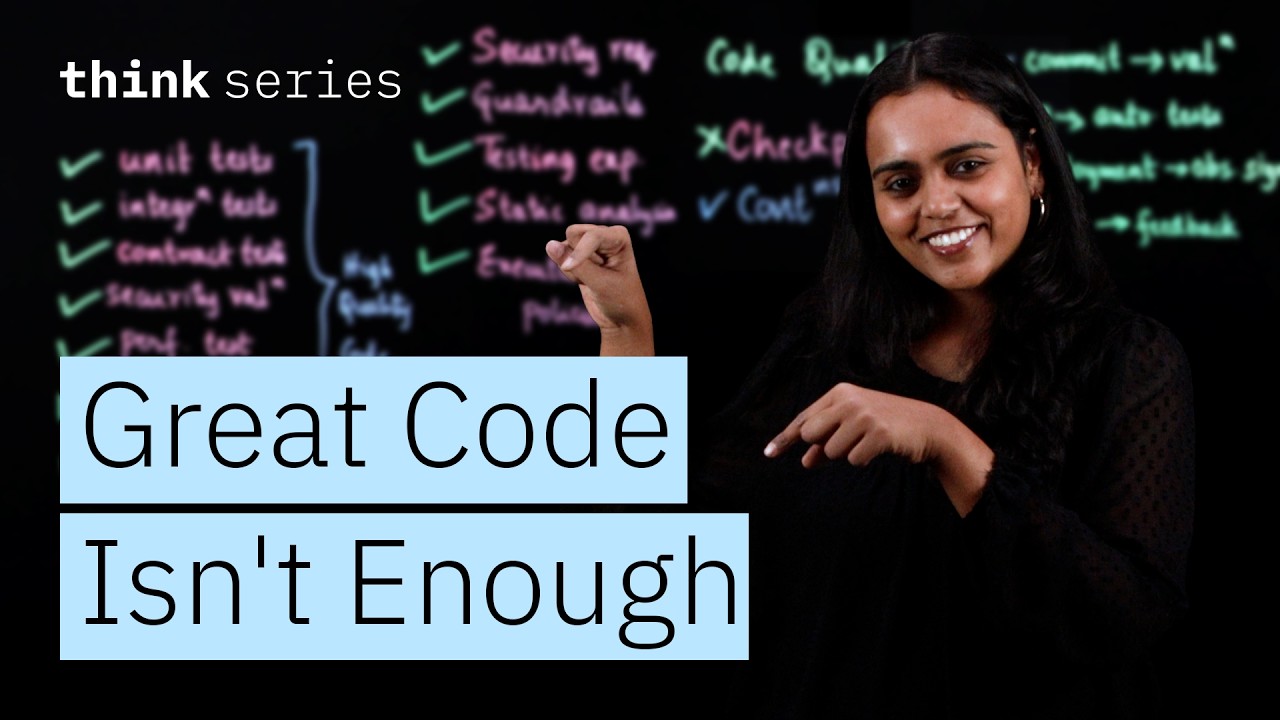
Code Quality in the Age of AI: Why Great Code Isn't Enough

Code Quality in the Age of AI: Why Great Code Isn't Enough

Meenakshi Kodati discusses how AI is transforming software engineering, shifting the focus from coding to critical decision-making. As AI rapidly generates code, the true challenge and value lie in architectural choices, system-level understanding, governance, testing, and continuous quality assurance to deliver meaningful business outcomes, emphasizing human judgment over mere implementation.

Why companies are becoming a series of loops | Anish Acharya (a16z)

Why companies are becoming a series of loops | Anish Acharya (a16z)

Anish Acharya, a General Partner at a16z, shares profound insights into the AI era. He debunks fears of a "permanent underclass," arguing that AI amplifies human agency and ambition. Anish introduces the concept of company building as creating cascading "loops" across all functions, with human intuition crucial for overcoming local maxima. He identifies the biggest consumer opportunity as "/loop, make me happier," focusing AI on fundamental human needs like connection and fun. He also discusses the nuances of model specialization, how moats are discovered rather than designed, the rising importance of distribution, and the potential for "expensive consumer software," offering actionable advice for product builders to embrace AI.

Faster Chips That Don't Melt — Anima Anandkumar & Benedikt Jenik, Accelerated Understanding

Faster Chips That Don't Melt — Anima Anandkumar & Benedikt Jenik, Accelerated Understanding

Accelerated Understanding is building a foundation model for the physical world, leveraging neural operators, resolution invariance, and physics-informed self-improvement to model diverse physical systems, aiming for universal application across domains like semiconductors and energy.