Code Quality in the Age of AI: Why Great Code Isn't Enough
Meenakshi Kodati discusses how AI is transforming software engineering, shifting the focus from coding to critical decision-making. As AI rapidly generates code, the true challenge and value lie in architectural choices, system-level understanding, governance, testing, and continuous quality assurance to deliver meaningful business outcomes, emphasizing human judgment over mere implementation.
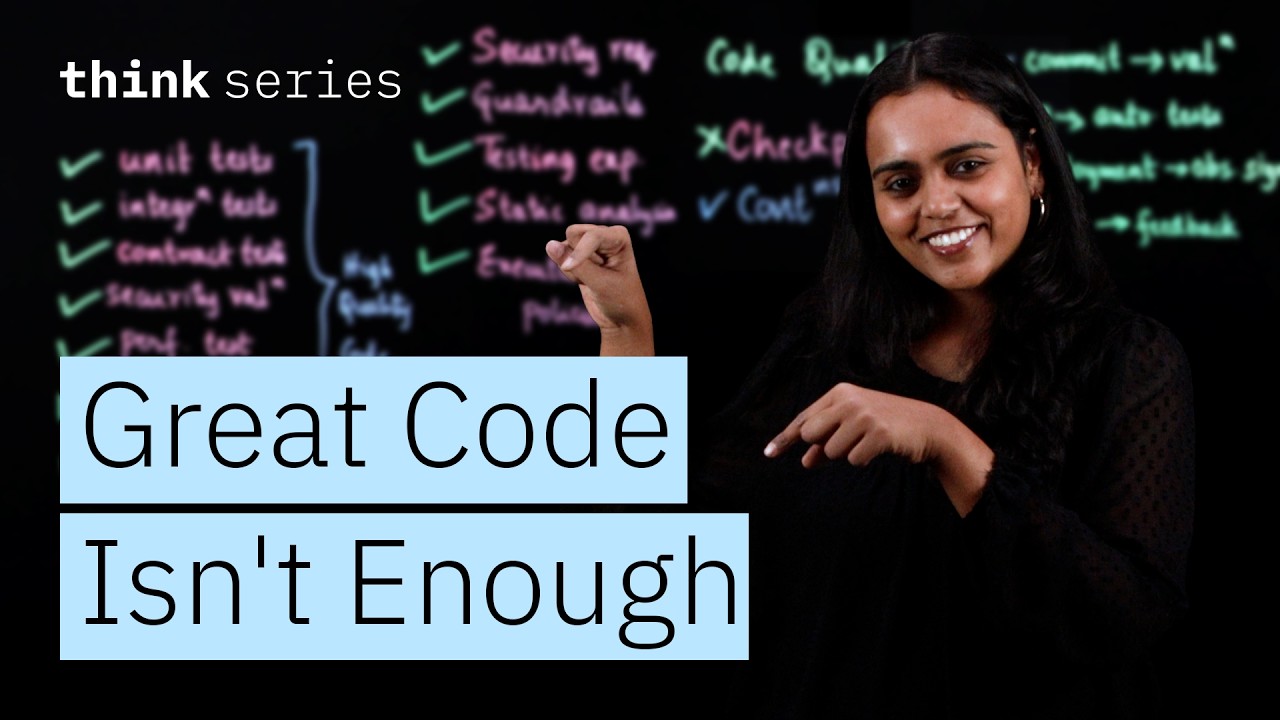
Meenakshi Kodati discusses the profound shift in software engineering driven by AI, moving the focus from code implementation to critical decision-making and system-level thinking.
The Evolving Landscape of Software Engineering
The conversation in software engineering has transformed rapidly. Previously centered on debates like ’tabs versus spaces’ or framework choices, it now addresses fundamental questions about AI’s role in code generation and trust. The pace of development has accelerated dramatically in the last two years, largely due to AI tools that can generate hundreds of lines of code, prototype features rapidly, eliminate boilerplate, and automate documentation and unit test suggestions.
Beyond Code Writing: The Real Challenge
Contrary to common concerns, the industry is not primarily worried about AI writing code. The deeper concern lies in “what happens after” the code is generated. The speaker argues that writing code was never the hardest part of software engineering; the true challenge has always been building the right solution for a business problem and ensuring the software delivers intended business outcomes. The value of AI is not measured by the volume of code it generates, but by whether that software creates meaningful outcomes.
Redefining Code Quality: From Implementation to Decision Quality
Traditional definitions of code quality—readability, maintainability, reliability, efficiency, modularity, and adherence to design principles—remain relevant but are no longer the primary differentiator. AI can readily produce “clean, working code” for well-defined problems. However, AI struggles with:
- Evaluating competing architectural approaches.
- Understanding long-term business context.
- Anticipating operational complexities.
- Recognizing when the simplest solution is not the best.
This leads to a critical insight: “implementation quality is becoming easier, whereas decision quality is becoming harder, or the differentiator.” This fundamental shift elevates the importance of human judgment in strategic choices over mere code implementation.
The Enhanced Role of the Engineer
Human expertise is becoming more critical. While AI accelerates implementation, developers remain accountable for trade-offs, governance, security, reliability, and maintainability. The engineer’s role is “shifting up the stack,” focusing on ensuring the right decisions are made around the code, rather than solely on writing it.
Illustrative Example: Building a Notification Feature
An AI might instantly generate an API endpoint, database schema, queue consumer, and frontend integration. An experienced engineer, however, would ask a series of higher-level questions:
- Architectural Decisions: Event-driven vs. synchronous/asynchronous, retry mechanisms, handling downstream service unavailability.
- System-Level Impact: Latency, scalability from 10,000 to 10 million users.
- Business Alignment: Solving the right problem, optimizing for speed, cost, reliability, or user experience, and defining success metrics. These “code-engineering decisions” are far more influential in determining software quality than code style or conventions.
System-Level Evaluation and Continuous Quality
Modern software changes are interconnected, impacting APIs, infrastructure, event streams, data contracts, cloud resources, monitoring, security, and numerous downstream services. Consequently, quality must be evaluated at a “system level,” moving from “is this function correct?” to “what impact will this change have across the entire platform?” Engineers must understand the entire system.
Testing as the Primary Proof of Quality
Testing has evolved from a best practice to “the primary proof of quality.” When AI generates code, its correctness is established through comprehensive validation via unit tests, integration tests, contract tests, security validation, performance testing, runtime monitoring, and observability. Confidence now stems from validated behavior, not reliable authorship.
Evolving Standards and Automated Governance
Outdated document-based standards are ineffective in an AI-assisted workflow. Standards must be embedded directly into the development process through automated guardrails. This includes automatically enforcing security requirements, encoding architectural guidelines into templates, integrating testing expectations into pull requests, continuous static analysis, and executable policies. This approach scales AI adoption safely, ensuring consistent compliance and making “the correct path the easiest path” for developers.
Quality as a Continuous Practice
The traditional view of quality as a pre-release checkpoint is obsolete. With continuous deployment accelerated by AI, quality must be “woven through the entire cycle, right from planning…all the way through deployment. And even operations.” Every commit, pull request, and deployment should trigger validation, automated tests, observable signals, and feedback for iterative improvement.
The Future: The Value of Judgment
AI will not replace programmers but will elevate the value of judgment. Future successful engineers will excel at asking better questions, understanding complex systems, recognizing trade-offs before coding, designing resilient architectures, and critically assessing when to trust versus challenge AI-generated solutions. AI’s role is to generate solutions; the human responsibility is to determine “whether those are the right solutions.” Software engineering’s core mission of problem-solving remains, with AI merely raising the bar on the thoughtfulness required to achieve it. The future of code quality lies in making better engineering decisions and delivering superior business outcomes.