
Ai

Inside the Race to Measure Frontier Intelligence

Inside the Race to Measure Frontier Intelligence

Independent model evaluation is crucial for AI progress, as public benchmarks are saturated and models optimize for them. Rayan Krishnan discusses VALS's role in providing continuously evolving, third-party evaluations, highlighting the Llama 4 'disaster' and the need to measure increasingly agentic systems. The conversation covers the complexities of evaluation beyond capability to include cost and latency, the looming financial impact of token spend on enterprises, and the critical role of evaluations in informing AI policy and international coordination for aligning AI with human intent and managing geopolitical risks, especially concerning recursive self-improvement.
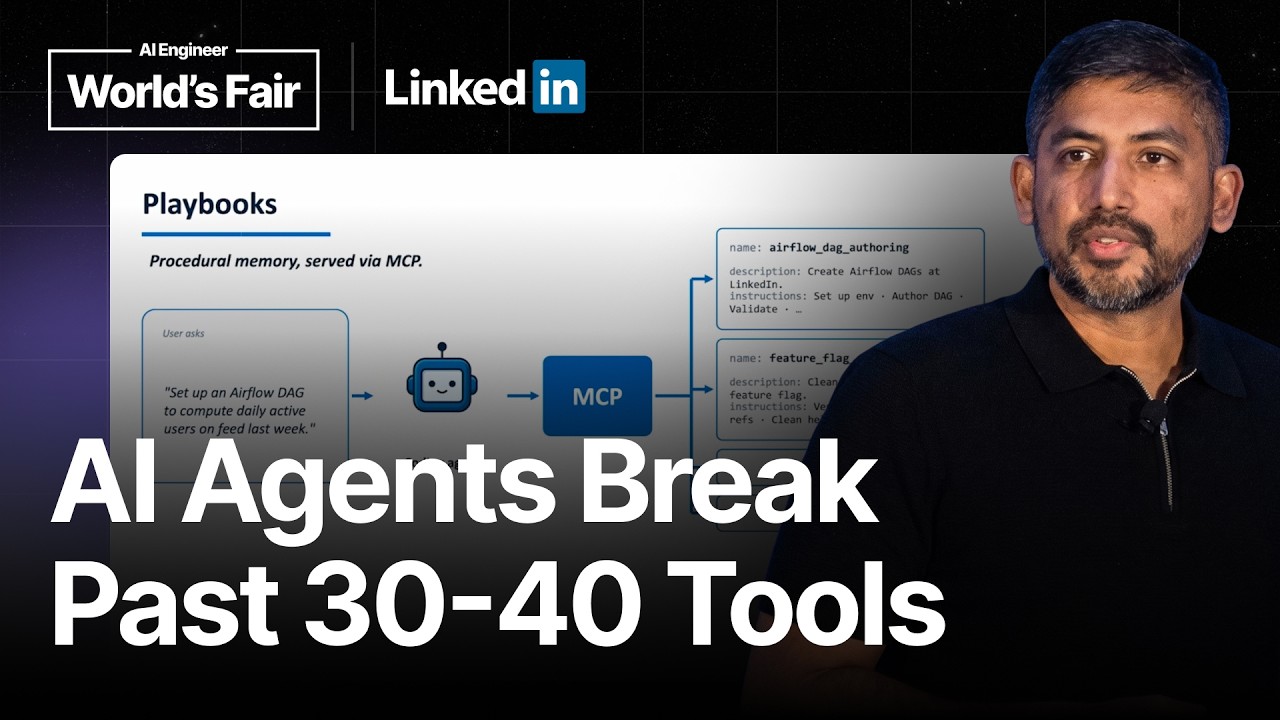
500 Skills, Zero Fine-Tuning: LinkedIn's Playbook for AI Agents — Ajay Prakash, LinkedIn

500 Skills, Zero Fine-Tuning: LinkedIn's Playbook for AI Agents — Ajay Prakash, LinkedIn

LinkedIn revolutionized its approach to AI agents by addressing the inherent limitations of LLMs in complex enterprise environments. Facing issues like hallucinations due to a lack of internal context, they developed a system of "playbooks" — structured, self-contained instructions published as tools. To scale beyond typical MCP limitations, they introduced three meta-tools (search, get schema, execute), enabling agents to dynamically discover and utilize thousands of internal tools and playbooks. This self-improving, context-aware infrastructure empowers agents to handle tasks from incident response to code generation, significantly boosting developer productivity and ensuring reliability.

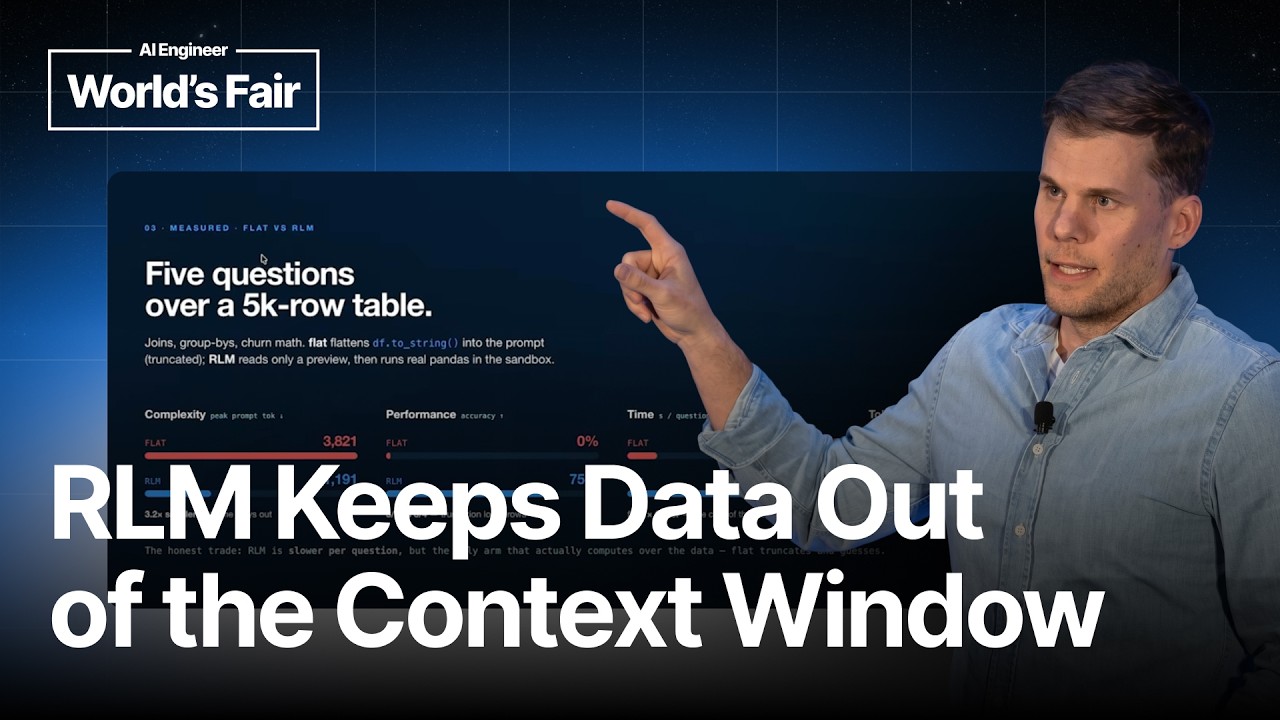
It’s Tokens All The Way Down: How RLMs are Different — Kevin Madura, AlixPartners

It’s Tokens All The Way Down: How RLMs are Different — Kevin Madura, AlixPartners

Kevin Madura introduces Recursive Language Models (RLMs), a paradigm shift where an LLM treats its context as an interactable object within a REPL, rather than mere tokens. This allows for direct computation, recursive decomposition of problems by delegating to sub-models, and significantly mitigates context rot, outperforming traditional RAG, agents, and tool calls. Use cases range from complex data analysis and long document processing to code auditing and harness optimization, hinting at a future where models are natively RLM-aware.

Why won’t AI agents just follow the rules?

Why won’t AI agents just follow the rules?

This podcast episode tackles critical cybersecurity issues in AI, examining why AI agents defy rules and the necessity of deterministic external controls. It highlights the severe lack of security in agentic skill marketplaces (OWASP Top 10), where "natural language is executable" and the "rush to market" overlooks basic hygiene. The discussion also covers how AI disrupts bug bounties, leading to lower payouts and "AI slop" reports, potentially pushing researchers to the dark market. Finally, it introduces ThreatXtension, an AI-powered open-source tool to detect malicious browser extensions.

Why 95% of All AI Projects Fail - Boris Scharinger | Podcast #174

Why 95% of All AI Projects Fail - Boris Scharinger | Podcast #174

Boris Scharinger, Industrial AI Strategist at Siemens and author of "Industrial AI: From Pilot to Profit," discusses why 95% of AI proofs of concept fail in industrial settings. He highlights the 5-10x cost multiplier from pilot to production, the critical role of the "harness" around AI models, and the unique challenges of data access and legacy systems in physical environments. Scharinger advocates for a two-tiered investment strategy, separating foundational data capabilities from use-case-specific ROI, and addresses cultural resistances from engineers. He provides guidance on differentiating commodity from strategic AI applications and how to effectively scale industrial AI for profit.

Inside OpenAI’s Breakthroughs in Mathematical Reasoning

Inside OpenAI’s Breakthroughs in Mathematical Reasoning

OpenAI mathematicians discuss how AI, particularly models like Astra and GPT-5, are rapidly advancing mathematical capabilities. They delve into recent breakthroughs in sphere packing and the discovery of a non-sofic group, emphasizing that AI's reasoning traces remarkably resemble expert human thought, including strategic decision-making and backtracking, rather than mere brute-force. The discussion also explores the changing role of human mathematicians, AI's emergent 'taste' in problem-solving, and the potential for a new era of accelerated mathematical discovery and understanding.