Inside OpenAI’s Breakthroughs in Mathematical Reasoning
OpenAI mathematicians discuss how AI, particularly models like Astra and GPT-5, are rapidly advancing mathematical capabilities. They delve into recent breakthroughs in sphere packing and the discovery of a non-sofic group, emphasizing that AI's reasoning traces remarkably resemble expert human thought, including strategic decision-making and backtracking, rather than mere brute-force. The discussion also explores the changing role of human mathematicians, AI's emergent 'taste' in problem-solving, and the potential for a new era of accelerated mathematical discovery and understanding.
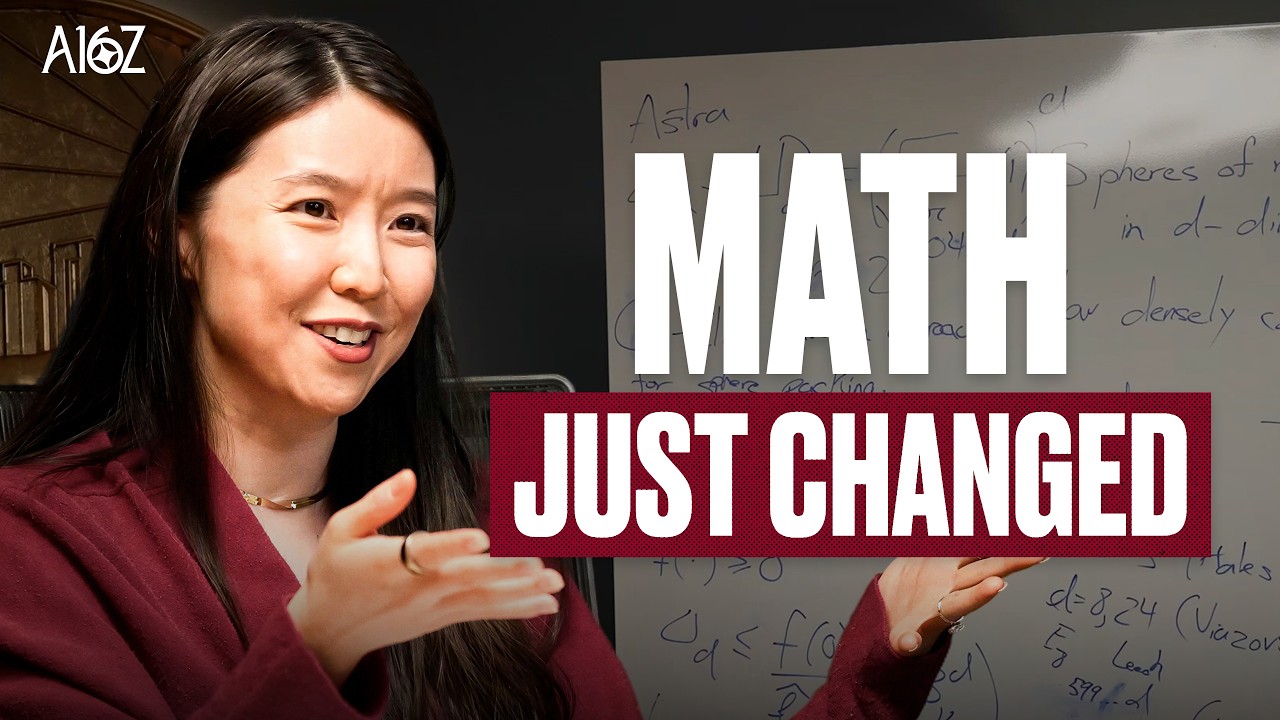
Mehtaab Sawhney and Mark Sellke from OpenAI discuss the rapid advancements of AI in mathematics, highlighting their personal journeys into AI research from pure mathematics. Mehtaab recounts his ‘conversion moment’ when GPT-5 swiftly found a reference for an obscure Paul Erdos problem, a task that had previously stumped human mathematicians for hours or weeks.
AI’s Advanced Mathematical Reasoning
AI’s progress in mathematics goes beyond mere search and connection-making:
- Execution and Detail: AI is exceptionally good at executing ideas, particularly with ‘finicky details’ such as epsilon-delta arguments, which humans often find tedious or prone to error. This contrasts with humans who can ‘get lost in these kinds of details’.
- Strategic ‘Betting’: The models demonstrate ‘good taste’ by making correct strategic ‘bets’ on promising approaches, effectively pruning vast search spaces. They combine existing knowledge to make ’the right decisions’ and prune the search tree.
- Resilience to Failed Paths: Unlike humans, who can get ‘pigeon holed’ or have their ‘context window polluted’ by failed attempts, AI can easily ‘start over’ or run parallel explorations. The models ‘make mistakes and then they go back and think about it,’ continuously updating the likelihood of an approach working without being mentally constrained by past failures. This iterative process mirrors how mathematicians approach problems.
- Human-like Reasoning Traces: The reasoning traces produced by AI are ‘shockingly like an expert human’s,’ resembling ‘reading a colleague’s notes.’ This dispels the notion that the model is ‘just guessing in some insane way.’
- Training Data vs. Emergent Reasoning: The speakers acknowledge that typical math papers and textbooks are often ‘poor training sets’ for real mathematical thought, as they present clean, crisp results without the struggle or motivation behind them. The models’ ability to demonstrate ‘good mathematics’ with emergent reasoning, backtracking, and combining ideas is attributed to OpenAI’s focus on training ‘general purpose reasoning models.’ These behaviors, though seen in mathematics, are ‘general purpose tools for reasoning’ that emerge when models are trained to reason better and for longer.
Deep Dive: The Astra 10-Problem Set
The discussion extensively covers two problems from OpenAI’s Astra set:
Sphere Packing
This fundamental problem asks how densely spheres can be packed in N dimensions:
- Historical Context: In 2D, the hexagonal lattice (proven in the 1960s) is optimal. In 3D, Hales’ proof for stacking oranges (early 2000s) spans hundreds of pages and is considered ‘famously ugly.’ In 8D and 24D, optimal solutions related to the E8 and Leech lattices were found in 2017, celebrated for their ‘very pretty structures.’ Beyond these specific dimensions, little is known.
- High-Dimensional Mystery: In high dimensions, sphere packing density decays exponentially (e.g., 2^-d). For a long time, the best known lower bound was 2^(-0.599d), from a ‘one page’ paper by Kabatyansky and Levenshtein in the 70s, based on solving ‘an extremely ugly optimization problem.’
- Viazovska’s Work: Maryna Viazovska (Fields Medalist 2022) used the Conan-Elkis linear programming approach, which involves constructing a function
fwith specific properties (f(x) < 0 for |x|>1 and Fourier transform of f non-negative). She found specific functions for 8D and 24D that matched the optimal lattice densities, considered ‘miracles of nature.’ - Astra’s Contribution: The model showed that the linear programming bound in large dimensions has an ’extremely nice asymptotic behavior,’ specifically e^(2π + o(1))^(-d), which is approximately 2^(-0.61d). This represents the ‘best possible bound’ achievable within this framework. The model constructed the optimal function
fand proved its optimality. The resulting proof was ‘quite short’ and ‘a few pages of complex analysis,’ described as ‘unbelievable’ for its elegance once seen.
Spherical and Binary Codes
These problems are closely related to sphere packing:
- Definition: Spherical codes are sphere packings on the surface of another sphere. Binary codes, relevant for error-correcting codes, are configurations on a hypercube (points separated by a certain Hamming distance).
- Astra’s Discovery: The models found improved bounds for these cases. Initially, the model used representation theory to improve code bounds. When prompted to ‘push this further,’ it applied more sophisticated representation theory, which unexpectedly led to recovering the high-dimensional sphere packing result, establishing a deep connection between these problems.
- Interactive Process: This was an interactive case where human guidance (‘push this further’) helped the model deepen its exploration, suggesting that models are ’task oriented’ and may not always explore the full extent of a discovery without further prompting.
The Existence of a Non-Sofic Group
This is another significant result from Astra:
- Group Theory Basics: A group abstracts symmetry, defined by a set of elements and a multiplication operation (associativity, identity, inverse). Groups can be finite (e.g., rotations of a square) or infinite (e.g., rotations of a circle, integers under addition).
- Sofic Groups: A group is sofic if it can be approximated by finite groups. Mathematicians hoped all groups were sofic because sofic groups have desirable properties, like being surjunctive (related to dynamical systems).
- Related Conjectures: The Aldous-Lyons conjecture, a broader statement about approximating random graphs by finite ones, was disproved two years prior by a highly complex, 250-page proof involving quantum complexity theory.
- Astra’s Contribution: The model proved the existence of a non-sofic group. This direct proof is ‘much shorter and easier’ (around 15 pages) than the Aldous-Lyons disproof, staying within group theory. It uses existing results by Kun and Tom, providing a ‘very reasonable normal kind of proof.’
- Proof’s Nature: The proof is a ‘very delicate combinatorics argument’ that identifies a ‘concrete combinatorial obstruction’ preventing approximation by finite groups. It’s described as ‘very short and elegant,’ a stark contrast to the expected length and complexity, suggesting that AI proofs tend to be concise.
The Future of Mathematics with AI
The integration of AI will profoundly impact the mathematical community:
- Increased Productivity and Accessibility: AI will produce ’exponentially more mathematics’ but will also ‘make it much easier to absorb it’ by helping to explain complex proofs or concepts. This means more people can engage with advanced mathematics.
- Shifting Human Role: The ‘bottleneck’ shifts from proving results to understanding, absorbing, internalizing, and explaining new mathematics. Human ’taste’ and judgment will remain crucial for framing new results, communicating them to others, and discerning which paths to pursue.
- Empirical vs. Theoretical: While AI might make some aspects seem more empirical, the ‘ceiling for difficulty of a math problem is pretty high’ (e.g., P vs. NP), meaning there will always be profound theoretical challenges for humans. AI can accelerate applied mathematics significantly.
- Collaboration and Discovery: AI acts as a powerful collaborator, helping mathematicians gain insight into long-standing problems. The hope is that the math community will build upon these AI-generated results, fostering a ‘renaissance of results and understanding.’