Ai

The Future of Frontier Model Architectures with Walter Goodwin, Founder & CEO of Fractile

The Future of Frontier Model Architectures with Walter Goodwin, Founder & CEO of Fractile

Walter Goodwin, founder and CEO of full-stack AI chip company Fractile, discusses the bets behind his company's inference chips, including memory bandwidth as the key constraint, the value of owning the entire chip stack, compressing the gap between chip design and deployment, and how the accelerator market may evolve as frontier labs pursue faster inference.
OpenAI cancels Astra release, Sonnet 5.5 & what Meta Muse means for work

OpenAI cancels Astra release, Sonnet 5.5 & what Meta Muse means for work

IBM's Mixture of Experts panel examines OpenAI's decision to withhold GPT-6.1 Astra, Anthropic's Sonnet 5.5 blurring the line between mid-tier and top-tier models, and Meta's Muse agent as a bridge between consumer AI habits and enterprise expectations, with a detour into token budgets, model routing, and AI governance.

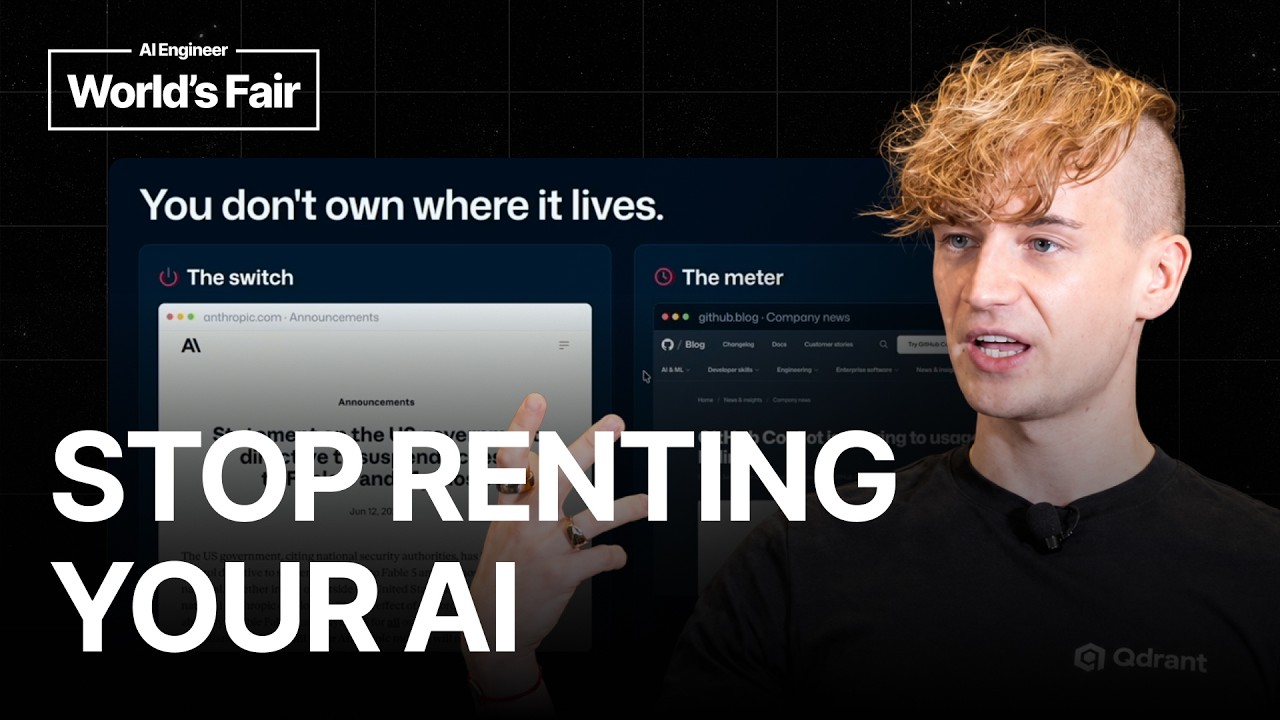
Stop Renting Your AI's Memory — Dylan Couzon, Qdrant

Stop Renting Your AI's Memory — Dylan Couzon, Qdrant

Dylan Couzon, developer relations engineer at Qdrant, argues that frontier-class models now run on hardware people can own, but the memory that makes an assistant personal still lives in someone else's cloud. He covers why owning inference gives autonomy while owning memory gives continuity, the CPU, RAM, and disk model for LLMs, why retrieval beats stuffing everything into the prompt, and a live offline demo of a drone building searchable memory with Qdrant Edge, plus opt-in shared memory.

How a Voice Agent Learns the Rhythm of Conversation — Shawn Wen

How a Voice Agent Learns the Rhythm of Conversation — Shawn Wen

Shawn, CTO of PolyAI, explains why voice agents are harder than text agents: voice adds time, and good conversation depends on adapting to the person on the line. He describes Dialog-RSN-1, an audio-native model that predicts turn-taking, replies in text with citations, and writes the transcript last for auditability, along with training on real noisy calls, latency and what agents should do while thinking, voice personality, benchmarking, harness ownership, and the shifting bottleneck from producing content to validating it.

From deepfakes to DNA: the science of watermarking AI

From deepfakes to DNA: the science of watermarking AI

Hannah Fry talks with Pushmeet Kohli and Jeremy Ratcliffe about SynthID, DeepMind's invisible watermarking technology. They cover its origins and design requirements, how it works for text, images, and video, why it matters for regulation and misinformation, and how SynthID Bio extends watermarking to protein structures and sequences to help screen AI-designed biological material without changing function.

Better AI Starts With Better Verification

Better AI Starts With Better Verification

Halluminate, a Y Combinator S25 company, builds RL environments and benchmarks that teach AI models to do non-coding knowledge work, starting with financial services. In this fireside with YC Partner Jon Xu, co-founders Jerry Wu and Wyatt Marshall trace their pivot from evals to training environments, explain why verification quality matters more than task volume, and outline a roadmap toward multi-agent simulated companies. They also address reward hacking, alignment as an industry-wide responsibility, and what they look for in new hires.