A walkthrough of CoreWeave's three inference paths (Serverless, Dedicated, and Inference on CKS), covering when each fits, how a multi-agent research assistant uses OpenAI-compatible endpoints across model types, and live demos of gateways, deployments, and Kubernetes-based vLLM, Dynamo, and LLM-D serving.
Large clusters for small models — Daniel Svonava, Superlinked
Daniel Svonava argues that small open-source models, when specialized and properly served, can achieve frontier performance for specific tasks, offering significant cost savings and latency improvements over large, generalized models or managed endpoints. He highlights challenges with existing serving infrastructure for a fleet of diverse small models and introduces Superlinked's open-source solution, which leverages a pull-based, centralized queuing system, a Rust sidecar for runtime abstraction, and an autoresearch loop for automated model tuning, enabling high throughput (e.g., half a million embedding tokens/sec on one GPU) and efficient deployment of specialized models and LoRAs.
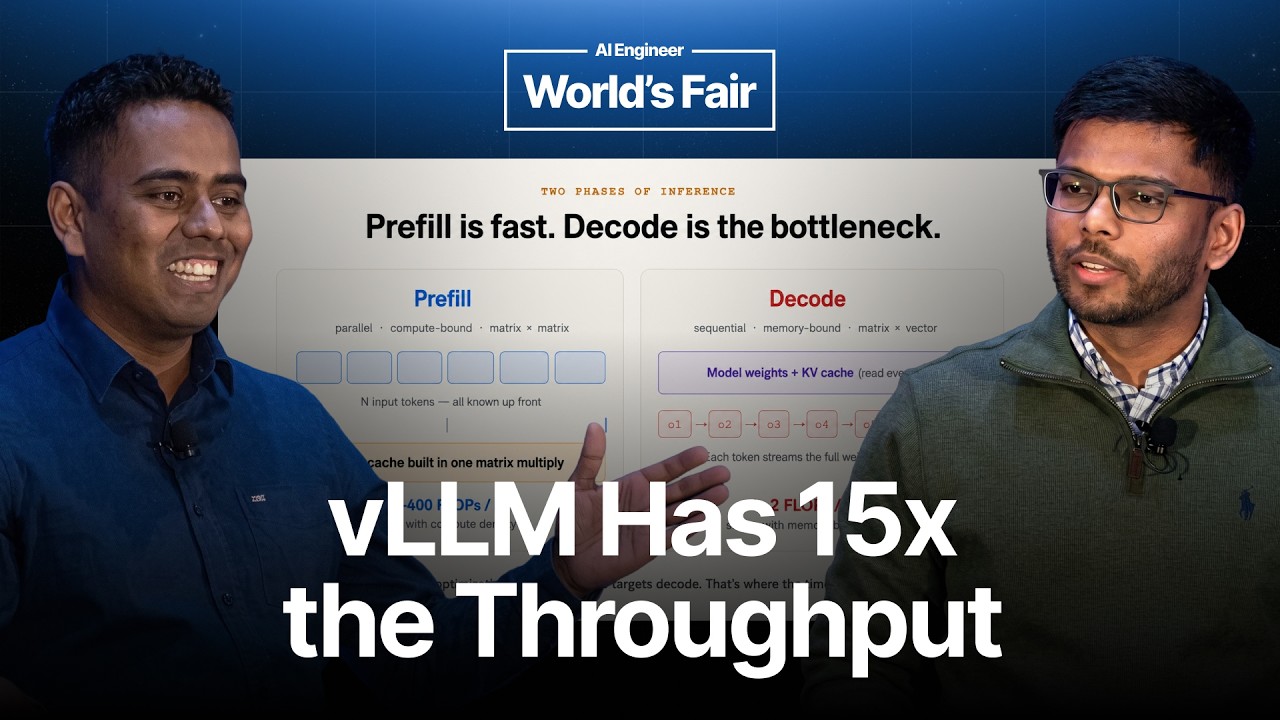
Deep dive on LLM Inference at Scale — Harshul Jain, Audible & Tanmay Sah, Independent AI Researcher
A workshop by Harshul Jain and Tanmay Sah breaks down LLM inference optimization from first principles, addressing memory, TTFT, and throughput issues. It covers foundational concepts like KV cache mathematics and the prefill/decode phases, then dives into model-side optimizations (quantization, attention variants like GQA, FlashAttention) and serving-side techniques (Paged Attention, continuous batching, prefix caching, KV quantization). The session concludes with benchmarks of popular inference engines like vLLM and SGLang, highlighting their strengths for different workloads, and outlines future research directions.
How Open Source Became AI's Backbone | Inferact with a16z
Simon Mo, CEO of Inferact and lead maintainer of vLLM, discusses how open-source AI, exemplified by vLLM, transformed into critical infrastructure. The conversation highlights the technical complexities of serving LLMs, the evolving economics and licensing of open-weight models, the need for control over guardrails, and the rapidly disappearing capability gap between open and proprietary AI.
Llama.cpp vs vLLM: Which Local LLM Engine Actually Scales?
Explore the strengths and optimal use cases of `llama.cpp` and `vLLM` for local LLM inference. `llama.cpp` excels on consumer hardware with optimizations like quantization and CPU support, while `vLLM` is designed for production-scale efficiency with features like continuous batching and speculative decoding on high-performance accelerators.
How KV Cache Speeds Up LLMs for Faster AI Models on GPUs
LLMs often slow down under heavy traffic due to inefficient GPU memory management during inference. This overview explains how KV cache and Paged Attention, implemented in VLLM, optimize memory usage across prefill and decode phases, significantly boosting LLM throughput, reducing latency, and improving GPU utilization through advanced context handling and specific tuning techniques like prefix caching and speculative decoding.