Vllm

How Open Source Became AI's Backbone | Inferact with a16z

How Open Source Became AI's Backbone | Inferact with a16z

Simon Mo, CEO of Inferact and lead maintainer of vLLM, discusses how open-source AI, exemplified by vLLM, transformed into critical infrastructure. The conversation highlights the technical complexities of serving LLMs, the evolving economics and licensing of open-weight models, the need for control over guardrails, and the rapidly disappearing capability gap between open and proprietary AI.

Llama.cpp vs vLLM: Which Local LLM Engine Actually Scales?

Llama.cpp vs vLLM: Which Local LLM Engine Actually Scales?

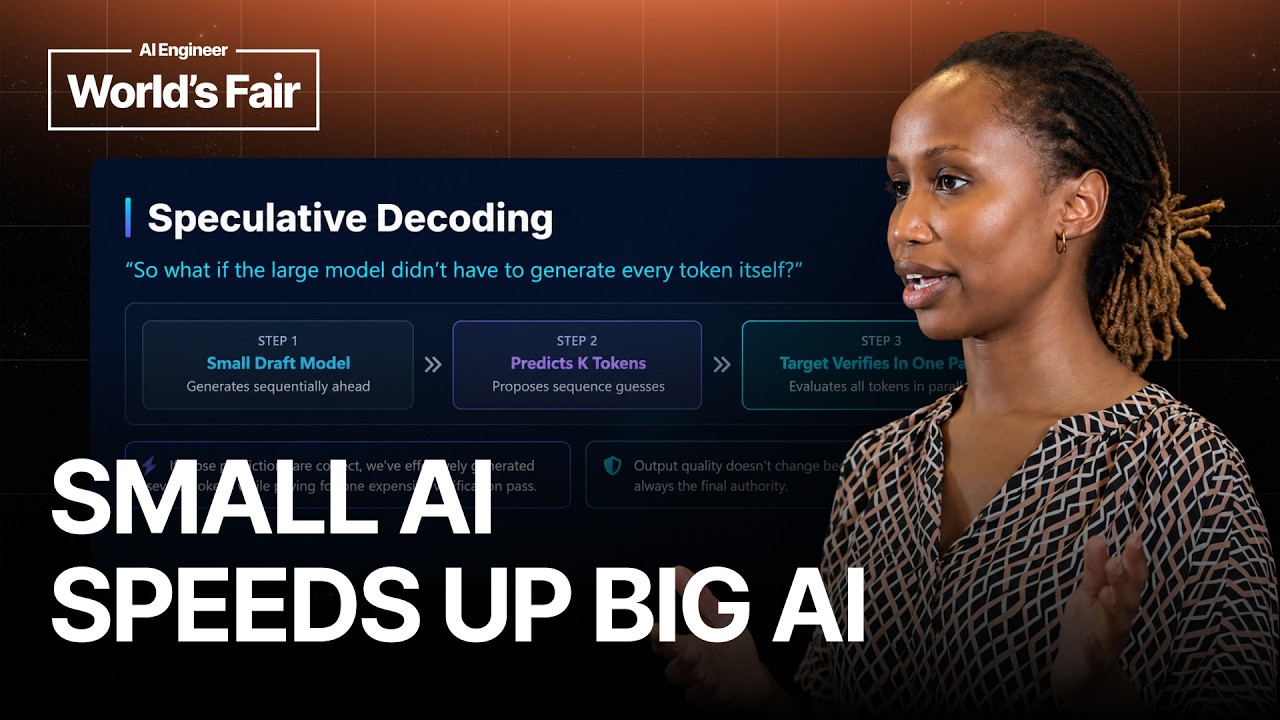
Explore the strengths and optimal use cases of `llama.cpp` and `vLLM` for local LLM inference. `llama.cpp` excels on consumer hardware with optimizations like quantization and CPU support, while `vLLM` is designed for production-scale efficiency with features like continuous batching and speculative decoding on high-performance accelerators.

How KV Cache Speeds Up LLMs for Faster AI Models on GPUs

How KV Cache Speeds Up LLMs for Faster AI Models on GPUs

LLMs often slow down under heavy traffic due to inefficient GPU memory management during inference. This overview explains how KV cache and Paged Attention, implemented in VLLM, optimize memory usage across prefill and decode phases, significantly boosting LLM throughput, reducing latency, and improving GPU utilization through advanced context handling and specific tuning techniques like prefix caching and speculative decoding.

You Asked About AI: Agents, Hacking & LLMs

You Asked About AI: Agents, Hacking & LLMs

An exploration of the evolving AI landscape, covering the paradigm shift in cybersecurity due to AI agents, the practicalities of running local LLMs with tools like Ollama and vLLM, and the emerging stack for agent-to-agent communication.

The CEO Behind the Fastest-Growing AI Inference Company | Tuhin Srivastava

The CEO Behind the Fastest-Growing AI Inference Company | Tuhin Srivastava

Tuhin Srivastava, CEO of Baseten, joins Gradient Dissent to discuss the core challenges of AI inference, from infrastructure and runtime bottlenecks to the practical differences between vLLM, TensorRT-LLM, and SGLang. He shares how Baseten navigated years of searching for a market before the explosion of large-scale models, emphasizing a company-building philosophy focused on avoiding premature scaling and "burning the boats" to chase the biggest opportunities.

Serving Voice AI at $1/hr: Open-source, LoRAs, Latency, Load Balancing - Neil Dwyer, Gabber

Serving Voice AI at $1/hr: Open-source, LoRAs, Latency, Load Balancing - Neil Dwyer, Gabber

An in-depth look at Gabber's experience deploying the Orpheus text-to-speech model to production, covering latency optimization, high-fidelity LoRa-based voice cloning, and a cost-effective inference stack using vLLM and a consistent hash ring for load balancing.