Software architecture

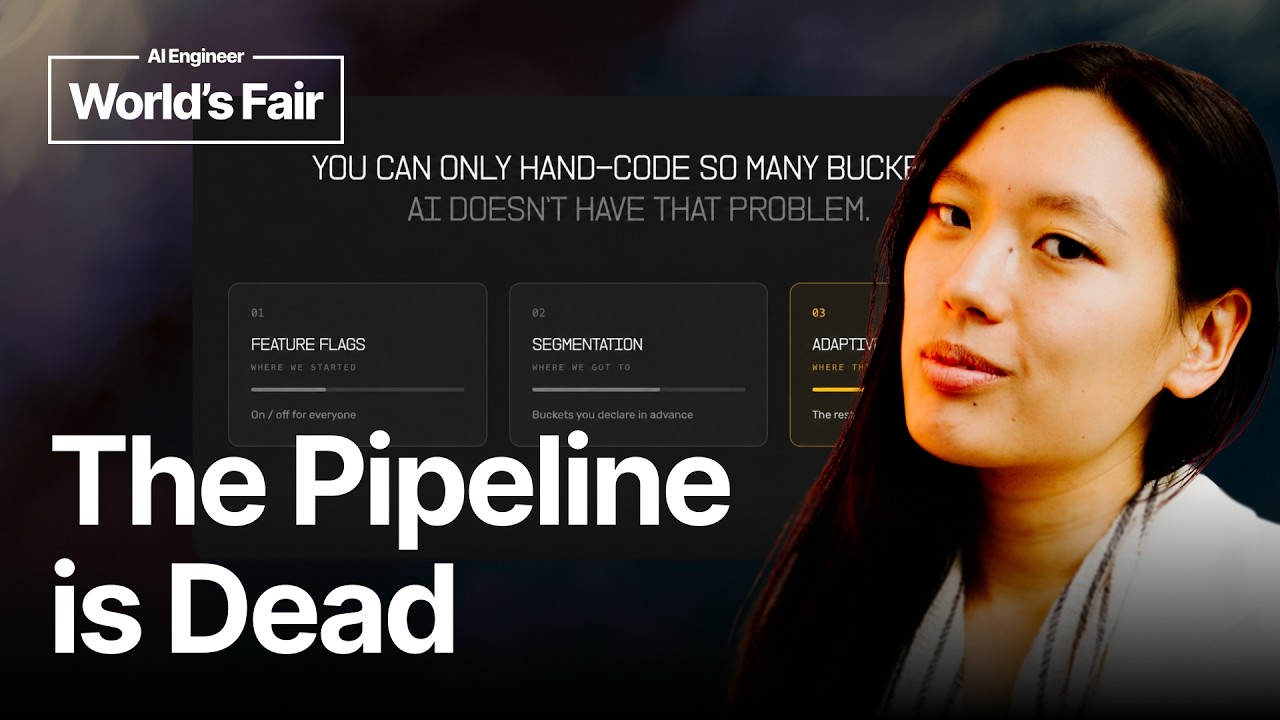
The Pipeline Is Dead - Iris ten Teije, Sky Valley Ambient Computing

The Pipeline Is Dead - Iris ten Teije, Sky Valley Ambient Computing

This talk fundamentally challenges the long-standing 'frozen artifact' model of software distribution, arguing it's obsolete due to the collapsing cost of software changes (driven by AI) and persistent demand for personalization. Iris ten Teije introduces Differ's vision of 'adaptive software' using a 'stem and divergences' architecture, where each user runs a unique, live-adapted version. The presentation delves into the complex architectural, testing, and coordination challenges of this new paradigm, emphasizing the need for robust infrastructure to manage user-specific, mutable software safely.

Platforms: Build Abstractions, not Illusions • Gregor Hohpe • GOTO 2025

Platforms: Build Abstractions, not Illusions • Gregor Hohpe • GOTO 2025

Gregor Hohpe explains the critical role of platforms in managing the growing cognitive load on developers due to complex distributed systems. He contrasts platforms, driven by "economies of speed" and fostering innovation through diversity, with traditional IT services and oversimplified abstractions that create dangerous illusions. Hohpe emphasizes building platforms that provide intuitive, domain-specific abstractions to solve real business problems, rather than just repackaging existing cloud services.

Full Stack Greenfield Projects : Are they still relevant?

Full Stack Greenfield Projects : Are they still relevant?

Bharat Goenka, co-founder of Tally, discusses the company's unconventional approach to software development through "Full Stack Greenfield" projects. He explains why building every component from scratch, despite being a high-risk strategy, has been crucial for Tally's success in serving the SMB market, fostering extreme customer loyalty, and aspiring to connect 200 million businesses. The talk delves into the historical context, the philosophy of questioning and choosing constraints, and the distinction between product and custom engineering.

The C4 Model: Visualizing Software Architecture • Simon Brown & Susanne Kaiser • GOTO 2026

The C4 Model: Visualizing Software Architecture • Simon Brown & Susanne Kaiser • GOTO 2026

Simon Brown, creator of the C4 Model, discusses its origin as a practical solution to clarify messy software diagrams. He explains the four hierarchical levels (context, container, component, code), emphasizing that most teams only need the top two for significant value. The discussion highlights the importance of including technology in diagrams, C4's collaborative nature, and practical advice on modeling microservices and bounded contexts, all while advocating for a lightweight, accessible approach to architectural visualization.

Growing & Thriving in a Multi-model World • Alberto Brandolini • GOTO 2025

Growing & Thriving in a Multi-model World • Alberto Brandolini • GOTO 2025

Alberto Brandolini delivers a compelling talk on how to combat software model decay and avoid the "Big Ball of Mud" by strategically applying Domain-Driven Design principles, especially Bounded Contexts. He emphasizes the critical role of visual thinking, structured architectural discussions, and organizational habits in maintaining clean, evolvable systems, particularly when scaling across teams and international markets. The talk highlights the need for continuous design effort, disciplined decision-making, and proactive identification of model boundaries to build resilient software in complex socio-technical landscapes.

BDD, ADR, PRD, WTF: Capturing Decisions for Humans and AI Alike — Michal Cichra, Safe Intelligence

BDD, ADR, PRD, WTF: Capturing Decisions for Humans and AI Alike — Michal Cichra, Safe Intelligence

Michal Cichra from Safe Intelligence explains how to maintain consistency in AI-driven software development by capturing decisions and enforcing rules. He argues for reviving Behavior-Driven Development (BDD) with Cucumber to close the loop left by spec-driven development. The core idea is to enforce architectural and product decisions (ADRs, PRDs) through an automated loop of git hooks and CI, ensuring both human and AI developers adhere to established standards.