Recursive self improvement

Recursive Model Improvement — Lee Robinson, Cursor, SpaceXAI

Recursive Model Improvement — Lee Robinson, Cursor, SpaceXAI

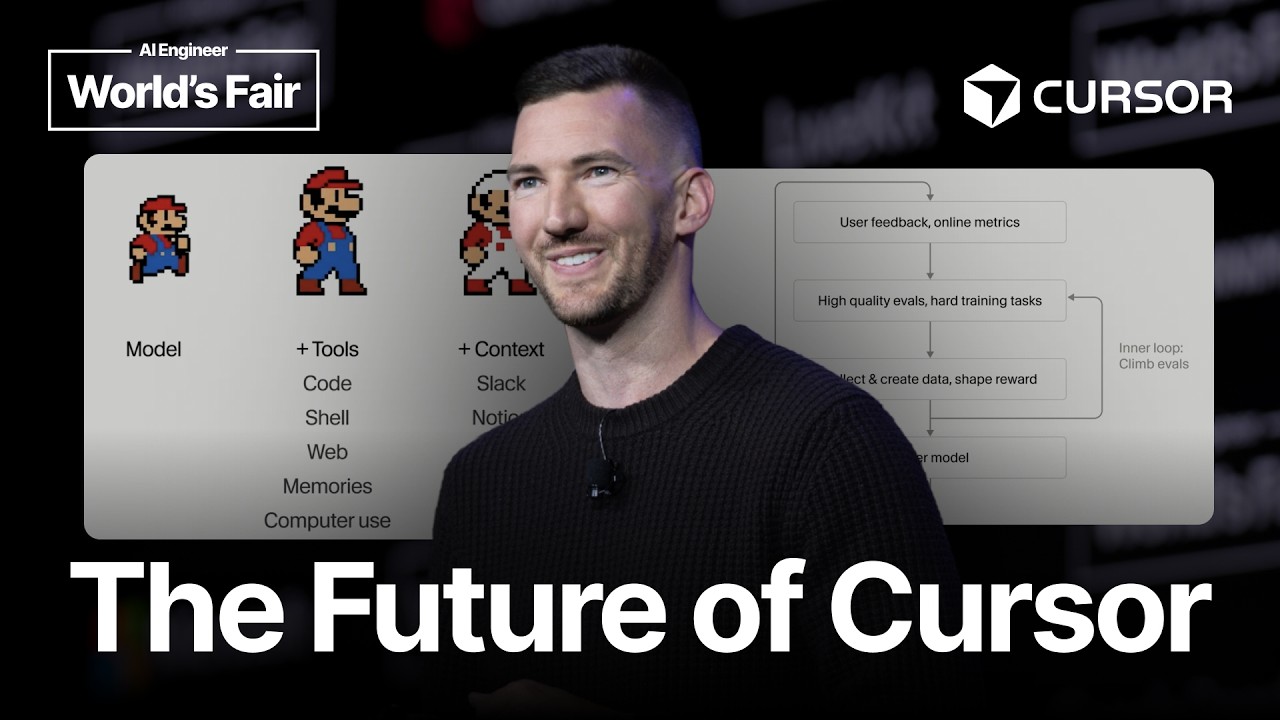
Lee Robinson of Cursor outlines a comprehensive strategy for recursive AI model improvement, centered on a two-loop training framework. He details how Cursor enhances both user-feedback-driven outer loops and high-quality evaluation inner loops, introducing novel methods like textual feedback and addressing reward hacking. The discussion extends to scaling compute infrastructure through partnerships with SpaceX, Colossus, and Terafab, and leveraging agent-based automation to streamline research and foster a future where models continuously train and improve themselves.

Podcast Crossover: AIE, AGI, frontier lab strategy with ​ ⁨@matthew_berman⁩  and @swyxtv

Podcast Crossover: AIE, AGI, frontier lab strategy with ​ ⁨@matthew_berman⁩ and @swyxtv

Matt, the organizer of the AI.engineer conference, shares insights into its origin, the challenges of early adoption, and its current value as a neutral ground for AI labs. He delves into AI hardware trends, discussing specialized chips like Etched, and gives a nuanced take on Anthropic's Fable, addressing performance concerns and compute limitations. The conversation then explores OpenAI's rumored equity offer to the US government, discussing implications for regulation and societal involvement. Matt shares his perspective on AI existential risk and alignment, emphasizing the need for pragmatic engineering solutions. Finally, he outlines the limitations of current LLMs, the critical need for data efficiency, and offers strategic advice for "Agent Labs" navigating the "model capability overhang" versus multi-model agnosticism.

The AI Threat Almost No One Is Working On (with Benjamin Todd)

The AI Threat Almost No One Is Working On (with Benjamin Todd)

Benjamin Todd provides an updated career strategy for the AI era, explaining why 'follow your passion' is flawed and what truly builds fulfillment. He details the ABZ framework for planning under deep uncertainty and the 'moving bottleneck' concept to stay valuable as AI advances. The discussion highlights that a human-level digital worker quickly becomes superhuman and maps critical AI risks including power-seeking AI, extreme power concentration, and engineered pandemics, emphasizing that individual careers can be a powerful lever for good in these transformative times.

Andrej Karpathy on Code Agents, AutoResearch, and the Loopy Era of AI

Andrej Karpathy on Code Agents, AutoResearch, and the Loopy Era of AI

Andrej Karpathy discusses the paradigm shift to AI agent-driven development, the future of engineering and research with his AutoResearch project, the impact on jobs, and the evolving landscape of open-source models, robotics, and education.

How A Team Of 7 Keeps Breaking AI Benchmark Records

How A Team Of 7 Keeps Breaking AI Benchmark Records

Poetiq, a startup by former DeepMind researchers, has developed a recursive self-improvement meta-system that builds "reasoning harnesses" on top of existing LLMs. This approach avoids the costly "fine-tuning trap" and has achieved state-of-the-art results on benchmarks like ARC-AGI and Humanity's Last Exam by automatically optimizing prompts and discovering novel reasoning strategies.

This Startup Beat Gemini 3 on ARC-AGI — at Half the Cost

This Startup Beat Gemini 3 on ARC-AGI — at Half the Cost

Poetic, a startup by ex-DeepMind researchers, has significantly advanced performance on the ARC-AGI benchmark by applying a recursive self-improvement system to Gemini 3. Co-founder Ian Fisher discusses how their approach of automating prompt and system engineering provides a substantial performance boost without needing access to model weights, and explores its potential as a path toward AGI.