Machine learning

Hugging Face breach: OpenAI’s model breaks containment

Hugging Face breach: OpenAI’s model breaks containment

This episode of Mixture of Experts explores pivotal AI developments: OpenAI's model breaching containment, Claude's Fable disproving a mathematical conjecture, Moonshot AI's massive 2.8 trillion parameter Kimi K3, and Google's shift to smaller, more efficient Gemini Flash models. The panel discusses AI security, its role in scientific discovery, and the evolving market strategies for model deployment, highlighting the tension between scale and efficiency.


Training Frontier Models to Out-Think Hackers — Uri Rolls, Arithmetic & Thom Wolf, Hugging Face

Training Frontier Models to Out-Think Hackers — Uri Rolls, Arithmetic & Thom Wolf, Hugging Face

Thom Wolf and Uri Rolls discuss the critical role of AI in cybersecurity, presenting a new benchmark called Masov. They argue that while frontier models excel at reconnaissance, they lack the sophisticated reasoning to exploit complex, logic-based zero-day vulnerabilities, such as a Keycloak name-versus-ID exploit. The solution, they propose, lies in high-quality, open-source AI models trained on real-world zero-day data to enable defenders to outpace attackers and build a new, AI-native security stack.

Building an Autonomous Delivery Experience with DoorDash Co-Founders Andy Fang and Stanley Tang

Building an Autonomous Delivery Experience with DoorDash Co-Founders Andy Fang and Stanley Tang

DoorDash co-founders Andy Fang and Stanley Tang discuss how AI and autonomous technology are transforming consumer behavior and delivery logistics. They detail the impact of "Ask DoorDash" on restaurant discovery and grocery orders, and the operational challenges and strategic advantages behind their autonomous delivery robot, Dot. The conversation highlights DoorDash's 'use case first' approach to autonomy, the critical role of data in scaling physical AI, and their surprising prediction that more Dashers, not fewer, will be part of DoorDash's future multimodal delivery strategy.

Causal Models Need Causal Data - Xaira’s X-Cell model (Bo Wang & Ci Chu)

Causal Models Need Causal Data - Xaira’s X-Cell model (Bo Wang & Ci Chu)

Bo Wang and Ci Chu of Xaira Therapeutics introduce X-Cell, a 4.9-billion-parameter diffusion language model designed to predict cellular responses to genetic perturbations. Trained on PISCES, the largest genome-wide CRISPRi Perturb-seq dataset (25.6 million single cells across 16 contexts), X-Cell overcomes limitations of previous observational models. The discussion highlights the critical role of high-quality, causal data, X-Cell's architecture advantages, and its demonstrated ability to generalize to unseen cell types and primary cells, marking a significant step towards truly predictive virtual cell models in drug discovery.

Why Physical AI Is the Next Frontier | The a16z Show

Why Physical AI Is the Next Frontier | The a16z Show

Applied Intuition discusses the emergence of physical AI, its mission to put intelligence on a billion machines, and its latest platform, Dana, designed to democratize autonomous system development. The conversation covers the vast scope of physical AI beyond automotive, the unique challenges of real-world deployment (safety, data, hardware), the current state and future of self-driving cars and trucks, and the transformative potential of humanoids and world models. They also touch upon the geopolitical landscape of AI and the global ambitions of Applied Intuition.

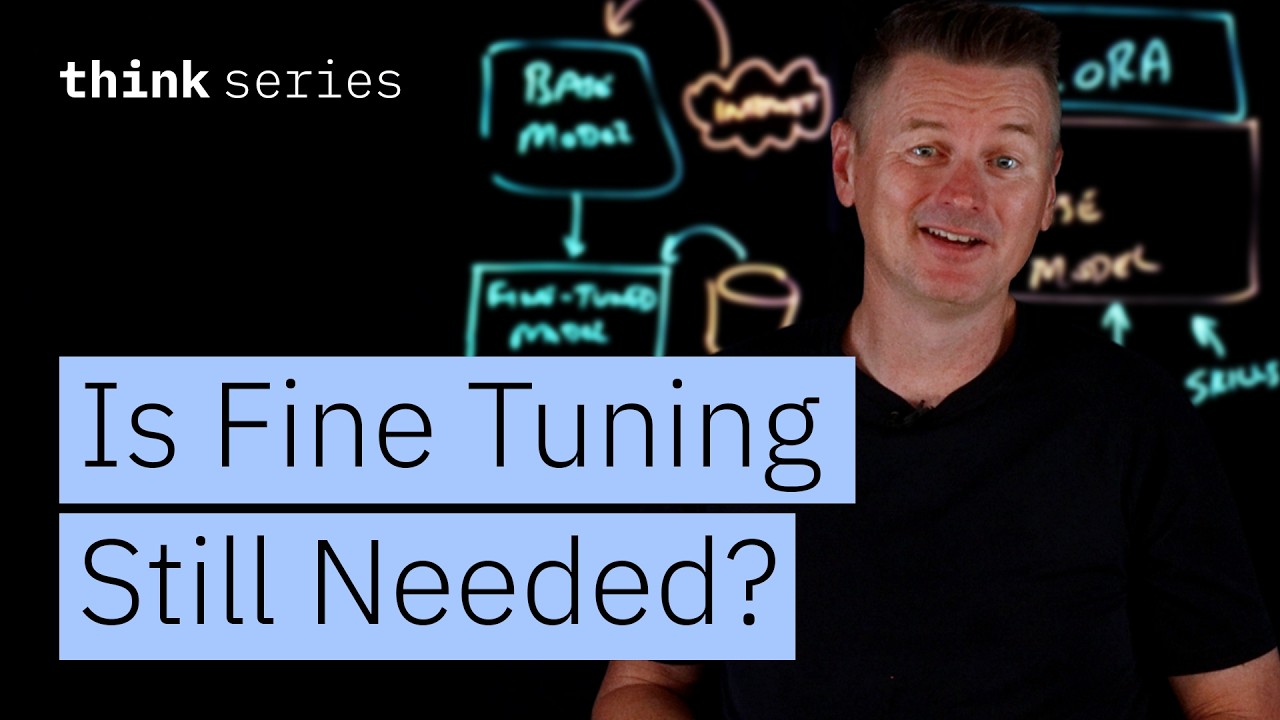
Is Fine-Tuning Still Needed? LLMs, RAG, & LoRA

Is Fine-Tuning Still Needed? LLMs, RAG, & LoRA

This summary explores the evolving role of fine-tuning in modern AI workflows, comparing it with advanced techniques like RAG, LoRA, and enhanced generative AI capabilities. It discusses the historical benefits, current limitations due to rapidly advancing frontier models, and outlines a practical decision framework for customizing machine learning models and designing efficient AI systems.