Fine tuning

Thinking Machines Lab drops Inkling & Meta’s Muse Spark 1.1

Thinking Machines Lab drops Inkling & Meta’s Muse Spark 1.1

This episode covers Thinking Machines' Inkling, an open-source, customizable model prioritizing architecture over benchmarks; Meta's Muse Spark 1.1, positioned for agent orchestration and enterprise use; OpenAI's GPT-5.6 Sol's 8% score on ARC-AGI-3, reigniting AGI debates; and Anthropic's "J-space" paper, exploring internal model reasoning and its implications for AI safety and interpretability.

Has AI Finally Cracked Time Series Forecasting?

Has AI Finally Cracked Time Series Forecasting?

Ameet Talwalkar, CMU professor and Datadog's Chief Scientist, traces the journey of time series foundation models from early skepticism to their current impact. He details Datadog's Toto V1 and V2, highlighting breakthroughs in zero-shot performance, scaling, and the crucial role of data mix. The discussion extends to the vision of 'world models' for observability, integrating diverse data for self-healing software systems, and concludes with insights on open-weights models and AI's transformative effect on computer science and academic research.

The Prime Intellect Stack — Will Brown, Prime Intellect

The Prime Intellect Stack — Will Brown, Prime Intellect

Deep dive into Prime Intellect's open-source ecosystem for post-training LLMs, covering the modular Verifiers V1 environment design, the asynchronous and scalable Primer RL training framework, and the Lab platform for hosted training and fine-tuning. Learn about advanced reward systems, the interception server pattern, and tokenization control with the Renderers library, all designed to enable frontier agentic model development.

How we taught agents to use good retrieval - Hanna Lichtenberg, Mixedbread AI

How we taught agents to use good retrieval - Hanna Lichtenberg, Mixedbread AI

Mixedbread AI addresses the "Oracle Gap" – the disparity between LLM reasoning and retrieval capabilities – by developing agents trained to use advanced search tools effectively. They demonstrate how current LLMs generate poor queries due to training biases and introduce a sophisticated agent harness with diverse search tools and a unique training regimen, including supervised fine-tuning and reinforcement learning with custom rewards, to teach agents to form precise semantic queries. This approach significantly improves performance on benchmarks like Oblique Congress and Snowflake's Match QA, closing the gap between theoretical perfect retrieval and real-world agent performance.

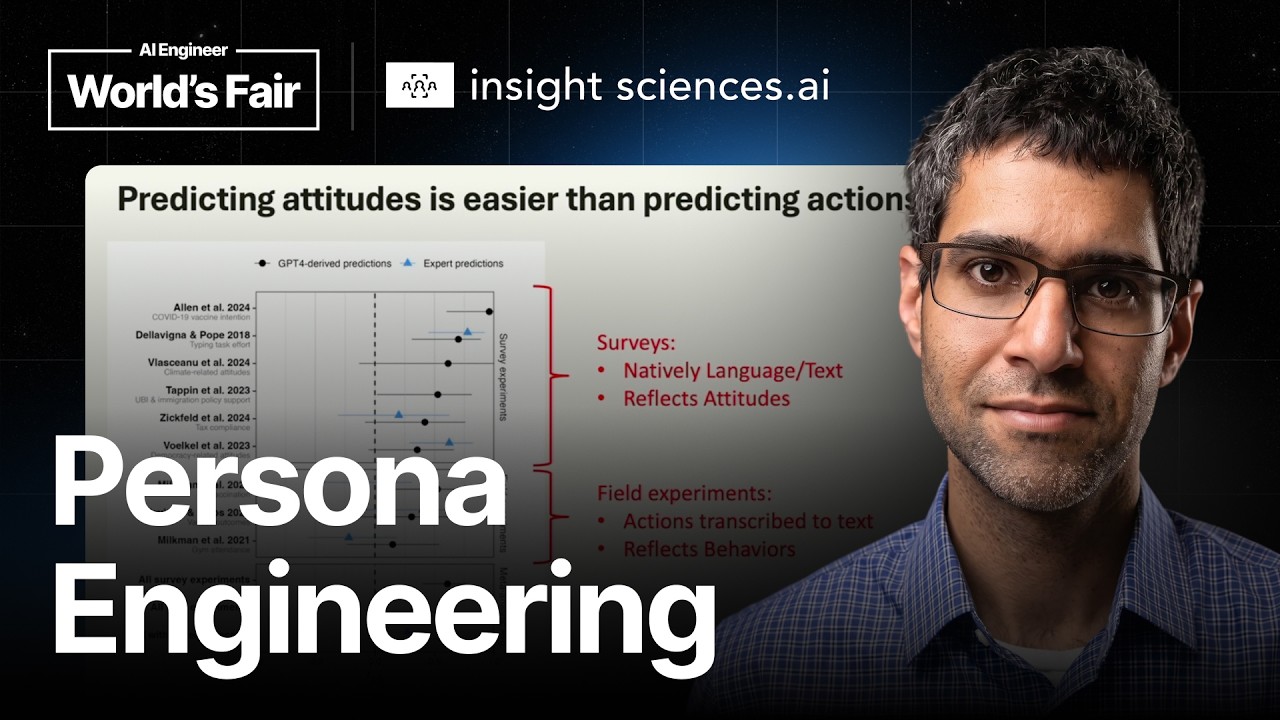
The Miranda Hypothesis: How Hamilton Poisoned Persona Evals - Jacob E. Thomas, Results Gen

The Miranda Hypothesis: How Hamilton Poisoned Persona Evals - Jacob E. Thomas, Results Gen

This talk exposes "Miranda distortion," a critical flaw in AI personas where models, influenced by modern cultural narratives, produce convincing but anachronistic outputs. Current evaluations fail to detect this, prioritizing fluency over fidelity. The speaker proposes "epistemic simulation"—a new paradigm grounded in corpus-bounded, temporally-anchored, and expert-evaluated reasoning—and introduces the "Prism Experiment." This rigorous, pre-registered protocol uses Abraham Lincoln to demonstrate how a weighted rubric, created by historians and de-emphasizing rhetorical fluency, can detect anachronism. It advocates for the "humanist in the loop" as a technical requirement to ensure AI personas are true to their documentary records, not just convincing.

Task Fidelity Scaling Laws — Kobie Crawdord, Snorkel

Task Fidelity Scaling Laws — Kobie Crawdord, Snorkel

An experiment by Snorkel AI reveals that in agentic AI training, the quality of tasks is paramount. Using the same model and compute, fine-tuning on high-quality tasks yielded a 6% performance improvement, a 5x greater uplift compared to the 1% gain from low-quality tasks. The key difference lies in the nature of the tasks: high-quality tasks are genuinely harder, featuring more tool calls and cleaner failure modes that provide a meaningful learning signal. In contrast, low-quality tasks often fail due to ambiguity and environmental noise, hindering effective model improvement.