Persona Engineering: A Field Guide to AI Synthetic Personas — Ishan Anand, InsightSciences.ai
Ishan Anand discusses synthetic personas for market research, drawing parallels to weather forecasting. He outlines three key failure modes—latent confounders, prompt sensitivity, and difficulty predicting actions—and explores techniques like fine-tuning and calibrated prompting to overcome them. Anand stresses the importance of validating personas against human data using distributional metrics and establishing a "noise floor" based on human-to-human consistency, advocating for their use as economic actors and complements to, rather than replacements for, human research.
Ishan Anand introduces synthetic personas as a burgeoning field in market research, leveraging large language models (LLMs) to simulate human respondents. He draws a core analogy between synthetic personas and weather forecasting, noting that both were enabled by computational advancements and operate within specific predictive regimes. Just as weather forecasts have limits, so do synthetic personas; understanding these boundaries is crucial.
Anand highlights that while “people forecasts” were ambitiously attempted in the 1950s and ’60s without success, modern LLMs offer a new medium for simulation. Unlike traditional simulation that relies on mathematical equations, LLMs use language itself as the atomic unit, allowing for the modeling of nuanced human feelings, actions, and choices.
A compelling demonstration involved modeling LLM agents against a thousand human participants who underwent extensive interviews and surveys. The agents achieved 83% alignment with their corresponding humans, a figure normalized against the inherent noise and inconsistency of humans themselves (who were only 80% consistent when retested).
However, Anand cautions against premature excitement, detailing three critical failure modes:
- Latent Confounders and Prompt-based Improv: In an experiment where an LLM acted as a customer assessing product purchase probability based on price, the model exhibited an “inverted U-shaped curve” unlike human behavior. As price increased, purchase probability initially rose, suggesting the LLM was inferring unstated “latent confounders” (e.g., higher price implying better quality or different competitive landscape) rather than treating other product attributes as fixed, akin to playing improv. This underscores the need for richly grounded personas and context within the prompt, even specifying study construction to prevent the LLM from inventing its own reality.
- Prompt Sensitivity: LLMs exhibit extreme sensitivity to prompt variations, such as the order of choices in a multiple-choice question. Swapping the order of “Yes” and “No” options could lead to wildly different model responses, with averages washing out into noise. While humans also show some order bias, the LLM’s bias is significantly stronger, necessitating durability testing against reorderings, rewordings, and adversarial inputs.
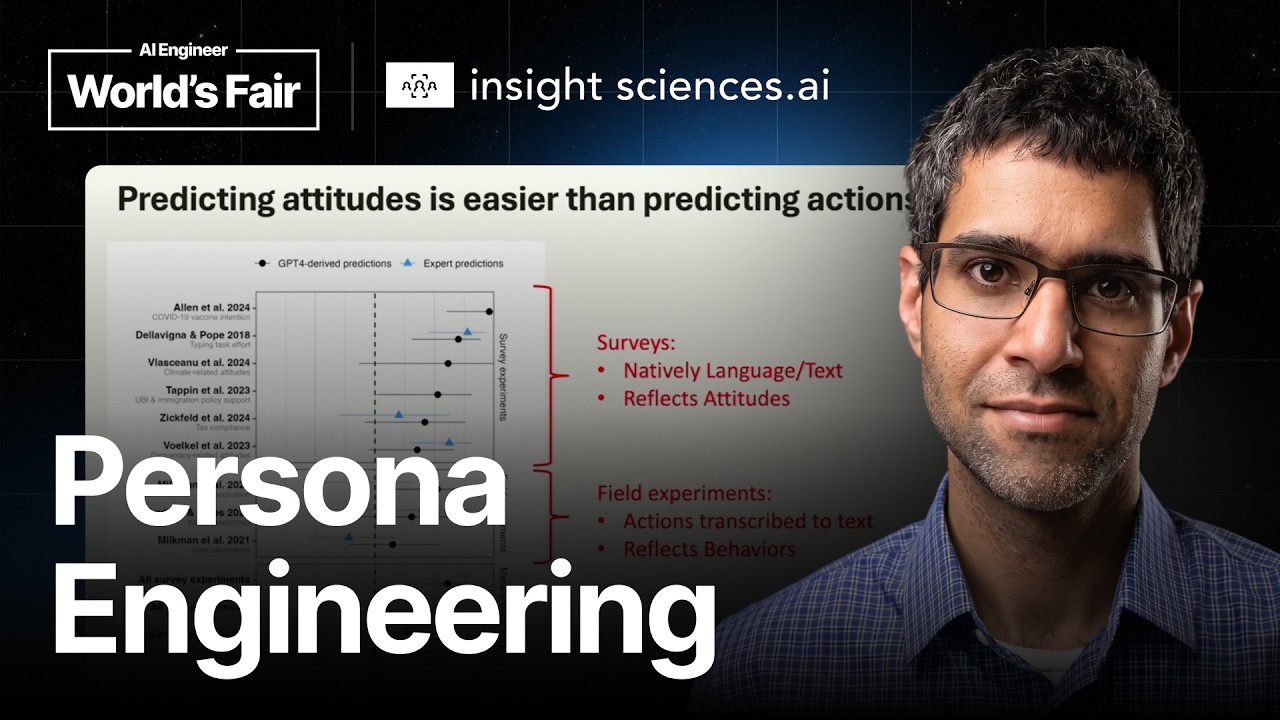
- Predicting Stated Attitudes vs. Actions: LLMs are trained on textual data, meaning they excel at predicting what people say (stated attitudes) but are less adept at predicting what people do (actions or behaviors). This is because attitudes are natively text-based and prevalent in training data, whereas behaviors often need to be transcribed into actions and are less common in text. Research shows LLMs perform better on language-based surveys than on field experiments measuring behavior. The advice is to triangulate behavior from attitudes when designing questions.
Anand then explores techniques to build more robust synthetic personas:
- Prompting Techniques: Early research, like the Argyle paper, demonstrated basic “I am” role-play prompting. The key is empirical validation against human ground truth, as different prompting techniques and models will yield varied results. Overly detailed persona constructions can sometimes amplify bias rather than improve accuracy.
- Fine-tuning (Subpop Method): The Subpop paper showed that fine-tuning LLMs on specific demographic data and survey responses can align model distributions with known human data. Interestingly, fine-tuning for specific groups also improved alignment for unseen groups, suggesting LLMs may possess a latent understanding of these populations and fine-tuning helps them “learn the task” of survey response.
- Calibrated Prompting for Distributional Capture: A sophisticated method involves asking the LLM to generate free-text responses (e.g., “how likely are you to purchase?”) rather than a numerical rating. Humans then provide examples of text corresponding to different rating scales (e.g., “Hell no, I’ll never buy that” for a 1, “Absolutely, I’ll buy 20” for a 5). Semantic similarity between the LLM’s text and human examples is then used to map to a probability distribution of purchase likelihood. This approach not only captures accurate average values but also the full shape of the distribution and variation, addressing a common issue where LLMs flatten details.
Finally, Anand discusses measuring alignment and validation:
- Statistical Significance: More synthetic samples do not increase statistical significance. Just as rerunning a weather forecast without changing inputs doesn’t make it more accurate, generating more synthetic responses from the same persona doesn’t increase certainty. Validation must be against actual human data.
- Distributional Metrics: Traditional evaluation metrics are insufficient. Given that models can get averages right but distort the shape of the distribution, multiple metrics (e.g., correlation and shape-type metrics) are needed to capture how well the model reflects various aspects of personas.
- Establishing a Noise Floor: The inherent inconsistency of humans (e.g., 80% self-consistency) sets a “noise floor” for how accurate any model can ever be. Synthetic persona accuracy should be judged relative to this human-to-human agreement, not against a perfect, non-existent match. If direct human retesting isn’t possible, a ground truth dataset can be split into two “human” chunks, with one treated as synthetic to estimate this noise floor.
Anand concludes by reiterating that synthetic personas are forecasts, not people. They are bounded, continuously improving, and most trustworthy when validated against reality. He emphasizes they are complementary to human research, not a replacement. In an era where AI agents mediate many human economic decisions, a “human-only” study no longer represents the full “gold truth.” Synthetic personas can extend human data, allowing for research at earlier stages or for questions that weren’t initially asked. The future holds promise for generative agent-based modeling, where multiple personas can interact in simulations.