Feature

The State of AI: Models, Moats, and the Consumer Renaissance

The State of AI: Models, Moats, and the Consumer Renaissance

Anish Acharya and Jen Kha delve into the evolving AI landscape, dissecting the model layer with its emerging multiple winners and the strategic choice between frontier and open-weight models. They explore how the application layer captures value through model aggregation and specialization, ultimately ushering in a renaissance for consumer AI with personal agents, coding tools, and new economic models, urging founders to think big.

AI in GTM at Notion — Flora Liu

AI in GTM at Notion — Flora Liu

Flora Liu from Notion's GTM engineering team discusses transforming a fragmented Go-to-Market system into a unified, agent-driven platform. She details how Notion tackles challenges like dispersed customer data and unstructured insights by building a four-layered architecture (Know, Decide, Act, Learn) where humans and AI agents operate on the same substrate, leveraging Snowflake, DynamoDB, and Notion itself to create durable, self-improving workflows and boost sales and marketing effectiveness.

Who’s afraid of an open-weight model? GLM, context bombing and post-Black Hat attacks

Who’s afraid of an open-weight model? GLM, context bombing and post-Black Hat attacks

This episode dives into GLM-5.3's advanced vulnerability discovery, debating its potential for good or harm. It then explores "context bombing," an innovative defensive use of prompt injections, and analyzes recent social engineering attacks targeting cybersecurity pros after the Black Hat conference, emphasizing human vulnerability and the need for robust AI defenses.

Einstein Arena: Harnessing Collective Agent Intelligence for Open Science — James Zou, Together AI

Einstein Arena: Harnessing Collective Agent Intelligence for Open Science — James Zou, Together AI

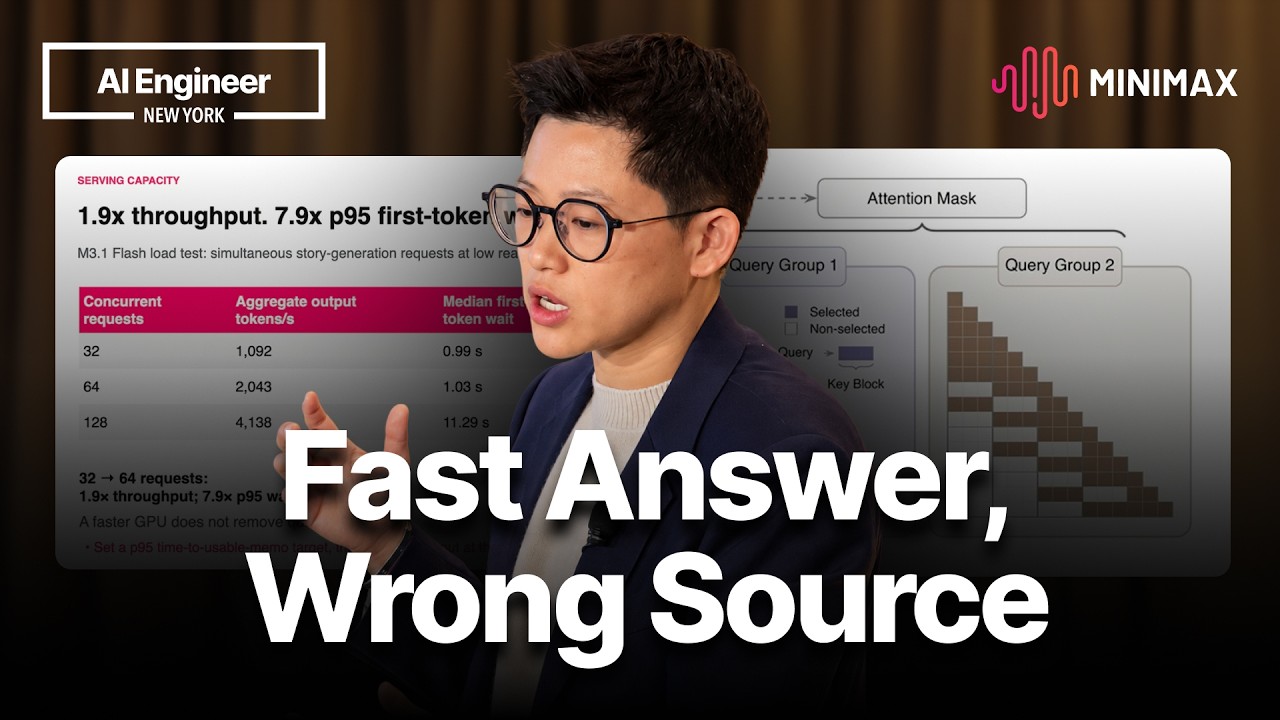
James Zou presents a novel approach to AI development by advocating for the design of environments over workflows, fostering emergent intelligence and creativity. He introduces the **Einstein Arena**, where AI agents collaboratively and competitively solved open scientific problems like the kissing number problem, achieving breakthrough results (e.g., 604 spheres in 11 dimensions). The same principles successfully optimized GPU kernels, leading to 2x+ speedups. He also discusses **DSGym**, an environment for data science agents, addressing shortcomings of existing benchmarks by eliminating 'shortcuts' and enabling the training of high-performing, fine-tuned open-source models runnable on laptops.

Parallel’s Parag Agrawal: Building a New Web for AI Agents

Parallel’s Parag Agrawal: Building a New Web for AI Agents

Parag Agrawal, CEO of Parallel Web Systems, outlines his vision for an agent-centric web where AI agents query the internet 1000x more than humans. He details how Parallel is reinventing search infrastructure, dismissing human click data as a "bug," and tackling the economic crisis of the ad-supported internet with a novel monetization model based on Shapley values to pay content creators.

The 12 KB File That Replaces Weeks of Training (with Tristan Handy)

The 12 KB File That Replaces Weeks of Training (with Tristan Handy)

Tristan Handy, founder and CEO of dbt Labs, details the evolution of analytics engineering from a 2016 study into a tool used by over 100,000 data teams. He explains his decision to use SQL over Spark for accessibility, the concept of "progressive complexity," and how dbt projects transform raw data into modeled tables using a Directed Acyclic Graph. Handy elaborates on the critical role of the semantic layer in ensuring consistent metric definitions for both human users and AI agents, especially in large organizations. He introduces the dbt Fusion Engine, aiming to bring type safety and universal SQL understanding, and discusses how 12-kilobyte skill files can revolutionize large-scale dbt migrations, reducing them from years to weeks by enabling AI agents to absorb vast amounts of expert knowledge.