Feature

Building Agents Is Trivial Now, Context Is the Next Frontier — Jeff Ng, Unblocked

Building Agents Is Trivial Now, Context Is the Next Frontier — Jeff Ng, Unblocked

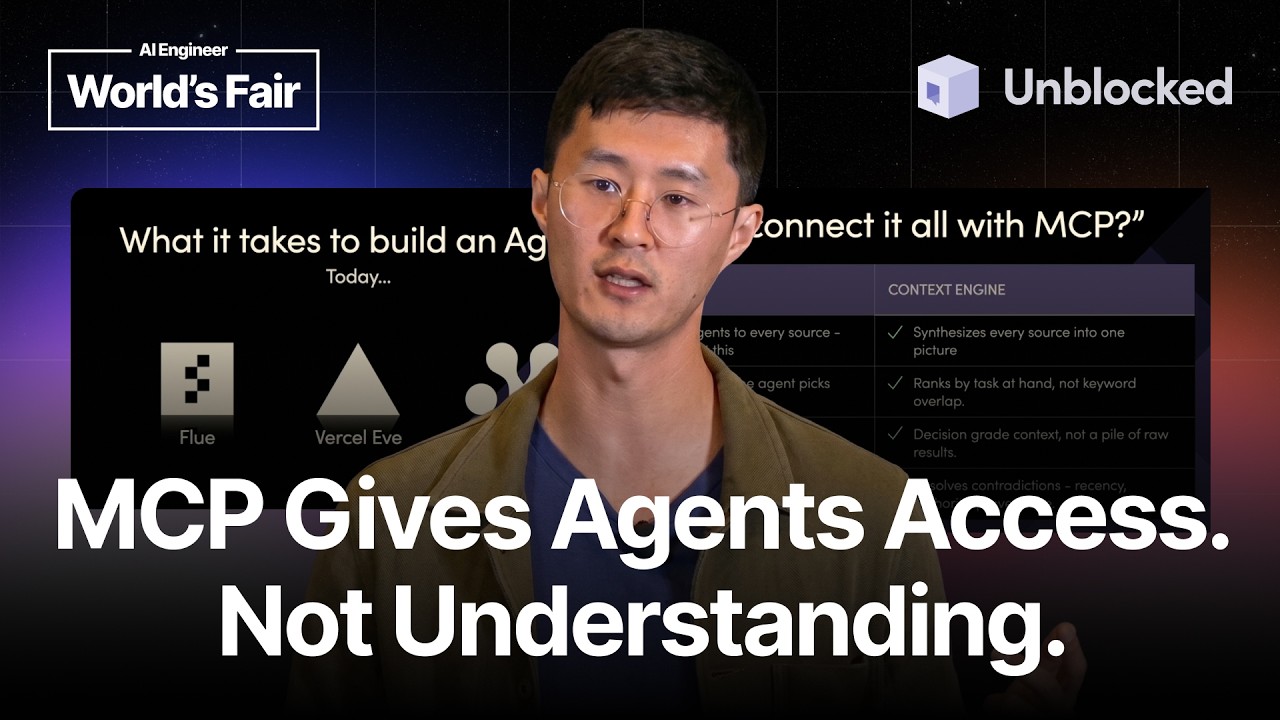
Building AI agents is now easier than ever, but they frequently make confident yet incorrect decisions. This is because agents often lack critical context that humans provide, such as historical discussions, postmortems, and tribal knowledge. The solution proposed is a 'context engine' that synthesizes and grounds information from across an organization's documents, code, tickets, and conversations, providing agents with a holistic and reconciled view, thus bridging the 'context gap' that current LLMs often miss.

Agentic SDLC at Uber — Uday Kiran Medisetty & Adam Huda, Uber

Agentic SDLC at Uber — Uday Kiran Medisetty & Adam Huda, Uber

Uber has transformed its software development with an agentic AI-powered factory, leading to a dramatic increase in engineer productivity. The presentation details six key infrastructure components: a unified model gateway with strict PII and safety guardrails, an MCP gateway for streamlined agent tool access and token optimization, agentified dev pods for rapid execution, a managed skills marketplace, a comprehensive context graph, and the Cortana AI assistant. Adam Huda then demonstrates an end-to-end feature development workflow, highlighting a critical shift to inner-loop validation (stopping short of CI) and automated, managed maintenance loops. The ultimate takeaway is that the bottleneck has moved from technical execution to strategic decision-making: "should we build it?" rather than "can we build it?"

Every Exponential Ends — Silicon Valley Forgot — Adam Becker

Every Exponential Ends — Silicon Valley Forgot — Adam Becker

Adam Becker, author of *More Everything Forever*, challenges Silicon Valley's pervasive techno-utopian narratives, including the 2045 singularity, mind uploading, Mars colonization, and the AI apocalypse. Drawing on his physics background, Becker deconstructs the scientific flaws in these ideas, arguing that exponential growth always ends, space is inherently hostile, and current AI models are sophisticated "pocket calculators for language" rather than pathways to sentient AGI. He contends that these influential, evidence-free concepts are bankrolled by tech billionaires seeking a narrative of perpetual growth and serve to distract from pressing social and political problems. Becker advocates for serious engagement with social sciences, aggressive tech regulation, and wealth redistribution.

Prototyping as Leadership: How a CTO Ships with AI Agents — Hursh Agrawal, The Browser Company

Prototyping as Leadership: How a CTO Ships with AI Agents — Hursh Agrawal, The Browser Company

Hursh Agrawal, CTO of The Browser Company, argues that AI agents have transformed the manager's schedule into usable building time. He outlines how leaders, leveraging their deep business context, can utilize an overnight loop with AI coding agents to ship features, optimize AI models, and even train custom classifiers, which is critical for staying calibrated with rapidly evolving frontier models and effectively communicating new product possibilities.

Going In Deep On Data | YC Paper Club

Going In Deep On Data | YC Paper Club

Three experts discuss the evolving landscape of data in AI, covering its critical role in model performance, challenges in sourcing and evaluating expert data, the development of advanced data generation techniques for diffusion models, and the complexities of multilingual pre-training.

Why Most AI Agents Fail Horribly

Why Most AI Agents Fail Horribly

Maarten Grootendorst discusses the foundational understanding developers need for modern AI tools, emphasizing core LLM concepts like tokens, embeddings, and attention. He provides a pragmatic view on AI agents, distinguishing hype from practical applications like coding assistants, and explores the role of memory, guardrails, and the growing importance of open-weight models for control and efficiency in AI infrastructure.