Every Exponential Ends — Silicon Valley Forgot — Adam Becker
Adam Becker, author of *More Everything Forever*, challenges Silicon Valley's pervasive techno-utopian narratives, including the 2045 singularity, mind uploading, Mars colonization, and the AI apocalypse. Drawing on his physics background, Becker deconstructs the scientific flaws in these ideas, arguing that exponential growth always ends, space is inherently hostile, and current AI models are sophisticated "pocket calculators for language" rather than pathways to sentient AGI. He contends that these influential, evidence-free concepts are bankrolled by tech billionaires seeking a narrative of perpetual growth and serve to distract from pressing social and political problems. Becker advocates for serious engagement with social sciences, aggressive tech regulation, and wealth redistribution.
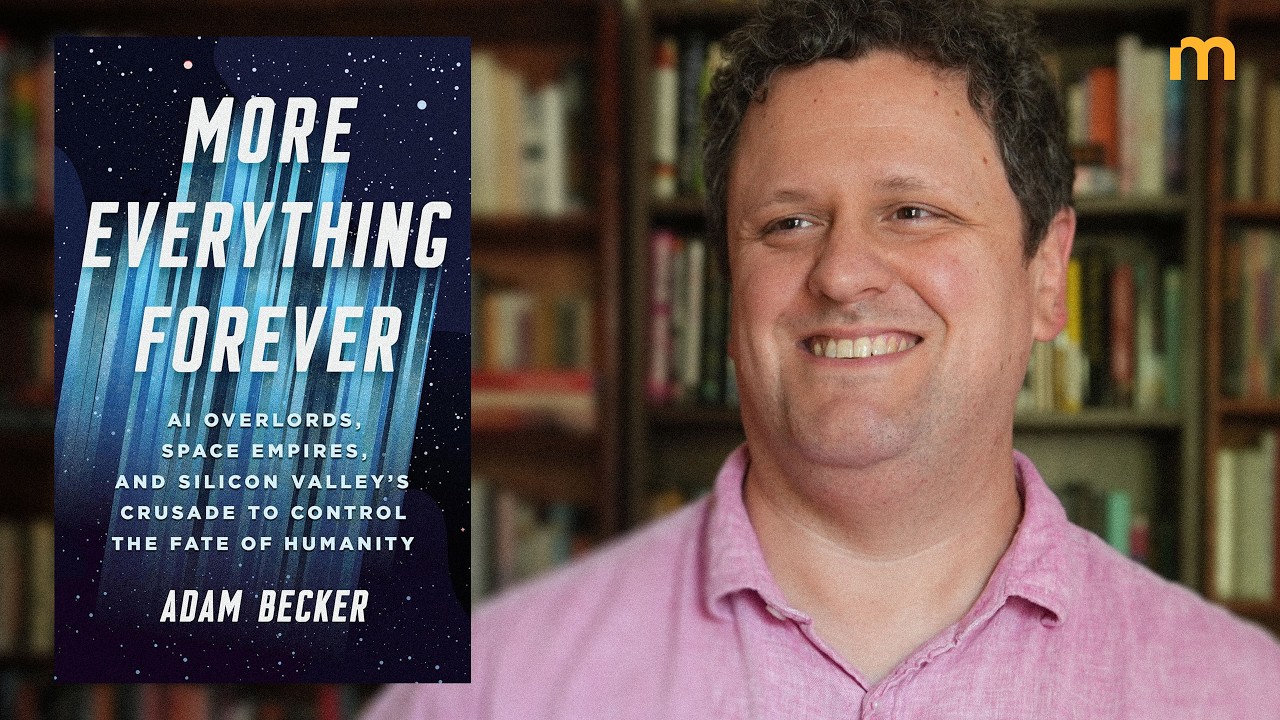
Adam Becker, an astrophysicist and author of More Everything Forever, systematically dismantles prevalent techno-utopian and doomsaying narratives propagated within Silicon Valley. He argues that influential concepts such as the 2045 singularity, mind uploading, Mars colonization, and the AI apocalypse are largely evidence-free and primarily serve a growth-centric agenda driven by tech billionaires. Becker’s critique is rooted in fundamental scientific principles and a deep understanding of historical and social contexts often overlooked by technology’s proponents.
The Illusion of Infinite Growth and Physical Limits
Becker challenges Ray Kurzweil’s “law of accelerating returns,” which posits an unending exponential increase in technology and complexity. He contends that Kurzweil’s evidence is based on “cherry-picked” data, and importantly, “the one thing that you can always say about any exponential trend… is that they end.” Drawing an analogy from Kurzweil’s own lily pad example, Becker highlights that growth is always constrained by physical limits. He further illustrates this with Jeff Bezos’s ambition for perpetual energy growth, demonstrating that even with hypothetical faster-than-light travel, humanity would “boil the oceans” within centuries and exhaust the observable universe in under 4,000 years, an impossibility. The underlying motivation for such growth narratives, Becker suggests, is often a fear of death, both individual and collective, seeking an escape from physical limitations.
The Uninhabitable Cosmos and Embodied Existence
The allure of space colonization, particularly Mars, is critically examined. Becker asserts that “the stars are simply too far away,” and the challenges of interstellar travel, even at a fraction of the speed of light, are insurmountable due to radiation and vast distances. Mars, despite being the “next most hospitable place” after Earth, is a “horrifying place” characterized by high radiation, low gravity, no air, and poisonous dirt. He powerfully states that “the day the dinosaur-killing asteroid hit Earth was still nicer than any day on Mars.” The idea of terraforming Mars is dismissed as technologically unfeasible, noting that if such capabilities existed, Earth’s climate crisis would be easily solvable. Becker concludes that humanity is fundamentally “not leaving the solar system” and that Earth is our “only home.”
He extends this critique to the concept of mind uploading, which he sees as a form of “functionalism” that falsely abstracts human consciousness from its embodied reality. Against the Silicon Valley tendency to view humans as “systems of pure information” or “patterns in our brains,” Becker emphasizes that “we are our bodies in our environment.” He argues that current science does not support the idea that consciousness can be detached from its physical substrate, which is far more complex than the nodes in a neural network. Removing an individual from their environmental context fundamentally changes who they are.
AI: Calculators for Language, Not Conscious Entities
Becker characterizes Large Language Models (LLMs) as “pocket calculators for language,” capable of sophisticated statistical pattern recognition but fundamentally different from human cognition. He argues that “hallucination is the model doing exactly what it always does,” a normal function rather than an error state, implying that unless there’s a “fundamental breakthrough,” human supervision will remain necessary.
He critically addresses the “AI psychosis” of anthropomorphizing LLMs, which he attributes to human pareidolia and the tendency to attribute agency to systems that mimic language. This, he says, exploits human cognitive biases and creates a “feedback loop” where systems “regurgitate the user back to themselves,” serving as a “mirror” (Shannon Vallor).
The “intelligence explosion” argument, championed by figures like Eliezer Yudkowsky and Nick Bostrom, is also dismantled. Becker points out that it rests on problematic assumptions: intelligence as a “single valued thing” that can be quantified and bought with compute, and the concept of “instrumental convergence” where any AI goal will inevitably lead to power-seeking and destructive outcomes. He argues that intelligence is far more complex and not always conducive to achieving all goals (e.g., happiness). This “simplistic worldview” overlooks the multifaceted nature of intelligence and the diversity of goals in the natural world. Recursive self-improvement, a related concept, similarly relies on these weak premises.
True Believers, Growth Narratives, and the Broken Ethics Discourse
Becker believes that many proponents of these techno-utopian and doomsaying ideas, including Yudkowsky, Bostrom, and many effective altruists, are “true believers” rather than cynical grifters. However, he argues they become “useful idiots” for a venture capital ecosystem that demands a narrative of perpetual growth. This systemic dynamic, not a conspiracy, arises from a shared “sci-fi growth narrative” that aligns with the tech industry’s need for expanding capital and power. This context, Becker asserts, is critical for understanding why these ideas gain traction and funding.
He criticizes the utilitarian and “longtermism” approaches within effective altruism, particularly how the “AI risk” narrative became central. While acknowledging the sincerity of figures like Peter Singer and Will MacAskill, Becker highlights that abstracting ethics into quantifiable utility functions can lead to “brain worms” – a pleasingly compact but ultimately flawed view of the world. This abstraction, particularly in longtermism, can devalue present-day human concerns by prioritizing hypothetical future quadrillions of beings.
Becker identifies a significant “impedance mismatch” in the AI ethics discourse. He notes that the rationalist/EA community often ignores crucial social sciences (political science, sociology, anthropology, history) and entertains problematic ideas like “human biodiversity” (a discredited, eugenics-rooted concept). He highlights that concepts like measuring “intelligence” as a single-valued trait and IQ tests have historical ties to eugenics and racism, leading to deep offense and mistrust when these issues are raised by critics like Timnit Gebru. Becker’s “sympathies lie significantly more” with those who demand historical and social context in these discussions, recognizing that “not paying attention to it can be a form of racism” and “certainly a form of privilege.”
Becker’s Prescription: Regulate, Tax, and Take Social Problems Seriously
Becker’s prescription is unequivocal:
- Take social problems seriously: Recognize that many of the world’s biggest challenges (like climate change) are social and political, requiring social solutions, not just technological ones.
- Regulate the tech industry aggressively: The industry must be reined in, not just AI, despite potential pushback from “tech titans.”
- Tax billionaires out of existence: He argues that immense wealth concentration is unjust, creates “massive power imbalances,” and “erodes at the fabric of our democracy,” making societal harmony impossible.
He concludes with a note of hope, believing that public sentiment and growing resistance to the tech industry’s unchecked power, coupled with potential financial bubbles, could lead to necessary changes. The future, he emphasizes, “isn’t written yet,” and informed choices can still shape it away from these destructive narratives.
- Tags:
- LLMs
- Feature
- Ray Kurzweil
- Functionalism
- Embodied Cognition
- Effective Altruism
- Elon Musk
- Tech Regulation
- Singularity
- Mind Uploading
- Mars Colonization
- AI Apocalypse
- Jeff Bezos
- Rationalism
- Longtermism
- Eliezer Yudkowsky
- Nick Bostrom
- Artificial General Intelligence (AGI)
- Intelligence Explosion
- Billionaire Taxation
- Social Sciences
- Eugenics
- Human Biodiversity
- Science Fiction Tropes