Feature

Why 95% of All AI Projects Fail - Boris Scharinger | Podcast #174

Why 95% of All AI Projects Fail - Boris Scharinger | Podcast #174

Boris Scharinger, Industrial AI Strategist at Siemens and author of "Industrial AI: From Pilot to Profit," discusses why 95% of AI proofs of concept fail in industrial settings. He highlights the 5-10x cost multiplier from pilot to production, the critical role of the "harness" around AI models, and the unique challenges of data access and legacy systems in physical environments. Scharinger advocates for a two-tiered investment strategy, separating foundational data capabilities from use-case-specific ROI, and addresses cultural resistances from engineers. He provides guidance on differentiating commodity from strategic AI applications and how to effectively scale industrial AI for profit.
Deep dive on LLM Inference at Scale — Harshul Jain, Audible & Tanmay Sah, Independent AI Researcher

Deep dive on LLM Inference at Scale — Harshul Jain, Audible & Tanmay Sah, Independent AI Researcher

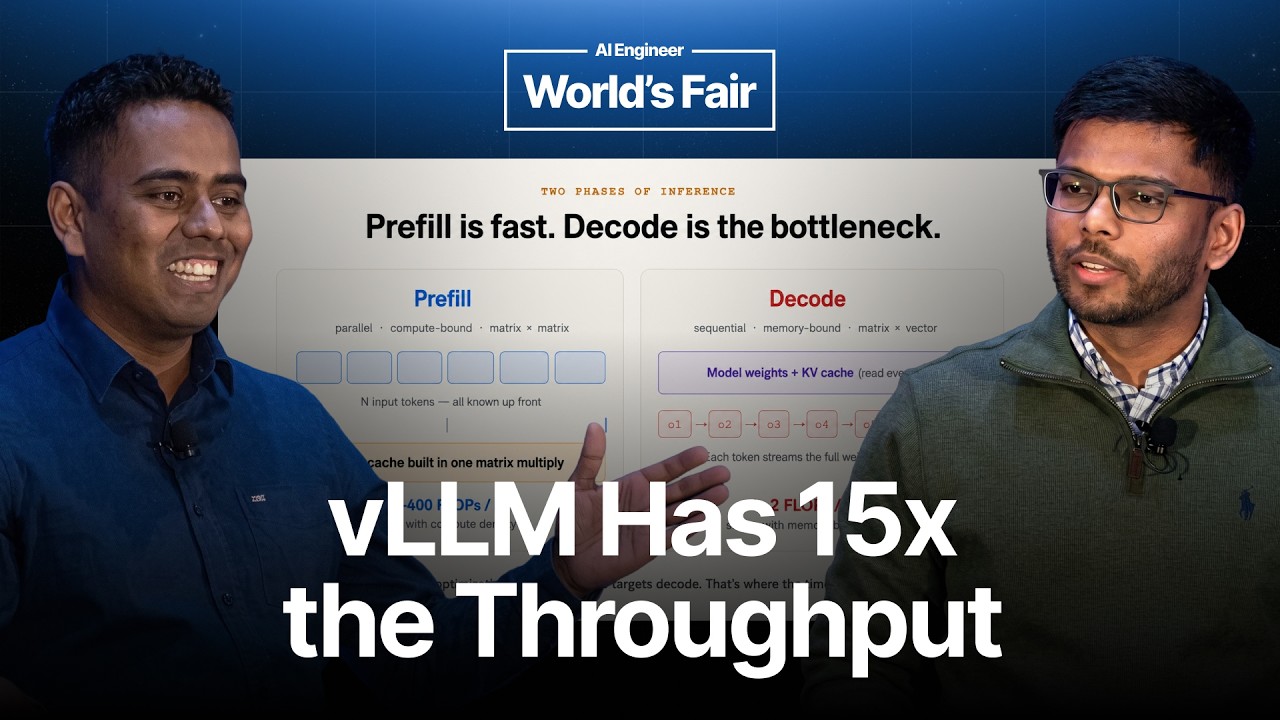
A workshop by Harshul Jain and Tanmay Sah breaks down LLM inference optimization from first principles, addressing memory, TTFT, and throughput issues. It covers foundational concepts like KV cache mathematics and the prefill/decode phases, then dives into model-side optimizations (quantization, attention variants like GQA, FlashAttention) and serving-side techniques (Paged Attention, continuous batching, prefix caching, KV quantization). The session concludes with benchmarks of popular inference engines like vLLM and SGLang, highlighting their strengths for different workloads, and outlines future research directions.

Inside the Team That Killed Mandatory Code Review — Quinn Slack, AMP

Inside the Team That Killed Mandatory Code Review — Quinn Slack, AMP

Quinn from AMP discusses a paradigm shift towards cloud-native AI agents and remote development, advocating for the end of local development and traditional code review. He details how AMP's 'Orbs' enable parallel, secure, and remote execution, and how agents are transforming internal tools ('jellyware'), diminishing the role of GitHub and traditional CI/CD, and fostering a lean, high-trust company structure.

Why companies are becoming a series of loops | Anish Acharya (a16z)

Why companies are becoming a series of loops | Anish Acharya (a16z)

Anish Acharya, a General Partner at a16z, shares profound insights into the AI era. He debunks fears of a "permanent underclass," arguing that AI amplifies human agency and ambition. Anish introduces the concept of company building as creating cascading "loops" across all functions, with human intuition crucial for overcoming local maxima. He identifies the biggest consumer opportunity as "/loop, make me happier," focusing AI on fundamental human needs like connection and fun. He also discusses the nuances of model specialization, how moats are discovered rather than designed, the rising importance of distribution, and the potential for "expensive consumer software," offering actionable advice for product builders to embrace AI.

Why World Models Could Change Robotics, 3D, and Creativity

Why World Models Could Change Robotics, 3D, and Creativity

World Labs co-founders discuss Atlas, their frontier world model centered on "new view prediction." This paradigm unifies 3D generation and reconstruction, enabling precise spatial understanding from sparse inputs. The conversation covers its multimodal architecture, the shift from dense to sparse reconstruction, and its profound implications for creative industries, architecture, and particularly robotics, where it addresses critical data scarcity challenges for simulation and policy learning.

Open Models Change The Economics of AI

Open Models Change The Economics of AI

Ollama Co-founder Jeffrey Morgan discusses the enterprise shift to open models, driven by cost, customization, and coding agents, leading to a 150X token growth. He highlights the dominance of Chinese models in cloud consumption, the hardware renaissance enabling local LLMs, and the rise of ultra-efficient "flash" models. Morgan also shares Ollama's journey, from its YC pivot to its monetization strategy, and reflects on lessons for building AI companies.