Feature

Build AI Systems for Discernment, Not Approval - Angel Ortmann Lee, Duolingo

Build AI Systems for Discernment, Not Approval - Angel Ortmann Lee, Duolingo

The talk addresses the critical flaw in human-in-the-loop AI: humans often surrender cognitive effort, leading to "automation bias" rather than true discernment. Through a Duolingo English Test case study and various interaction design examples, it demonstrates how engineering the human-AI interface—rather than just the model or oversight—can elicit critical thinking, generate high-quality data, and foster a virtuous cycle of AI improvement.


Software in the Age of Agents | The a16z Show

Software in the Age of Agents | The a16z Show

This conversation explores the shift in enterprise software as AI agents become primary users, moving towards 'headless' architectures where data and logic, rather than UIs, hold key value. It delves into the enduring stickiness of systems like SAP, driven by deep business process codification, and highlights that 'exception handling' is central to enterprise complexity. The discussion identifies new startup opportunities arising from AI, focusing on enhancing existing systems and bridging organizational functions rather than direct competition.

Inside Zipline's Autonomous System: 140M Miles, Zero Incidents

Inside Zipline's Autonomous System: 140M Miles, Zero Incidents

Zipline co-founder Keller Rinaudo Cliffton and Eric Watson discuss how their autonomous logistics system evolved from addressing critical needs in Rwanda to becoming the largest commercial autonomous system globally. They highlight that the drone is only 15% of the solution, emphasizing the deep integration of software, vertical hardware design, advanced safety protocols like compute failover, and extensive testing required. The discussion also covers the immense market potential for autonomous delivery, the impending cost-effectiveness over traditional methods, and the necessary transformation of air traffic control to support a future of pervasive aerial autonomy.

The Pipeline Is Dead - Iris ten Teije, Sky Valley Ambient Computing

The Pipeline Is Dead - Iris ten Teije, Sky Valley Ambient Computing

This talk fundamentally challenges the long-standing 'frozen artifact' model of software distribution, arguing it's obsolete due to the collapsing cost of software changes (driven by AI) and persistent demand for personalization. Iris ten Teije introduces Differ's vision of 'adaptive software' using a 'stem and divergences' architecture, where each user runs a unique, live-adapted version. The presentation delves into the complex architectural, testing, and coordination challenges of this new paradigm, emphasizing the need for robust infrastructure to manage user-specific, mutable software safely.

SWE-Marathon: Evaluating Coding Agents at Billion-Token Scale - Rishi Desai, Abundant AI

SWE-Marathon: Evaluating Coding Agents at Billion-Token Scale - Rishi Desai, Abundant AI

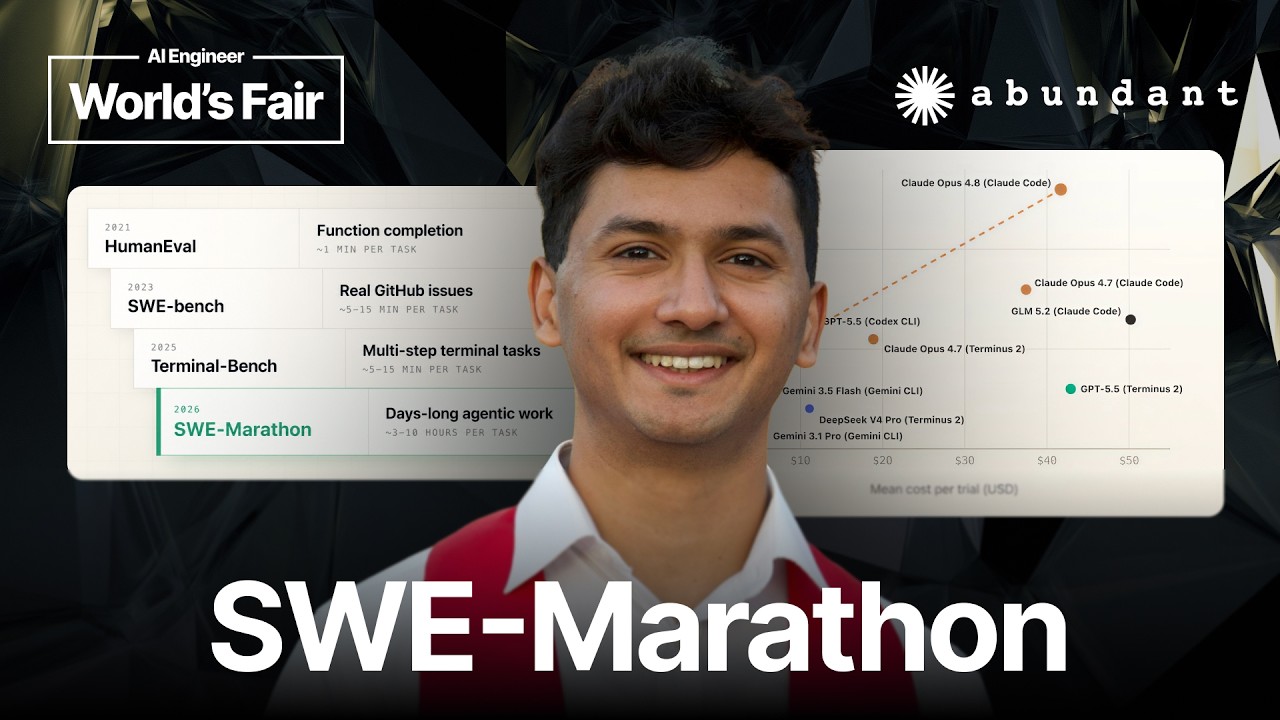
SWE-Marathon introduces a benchmark for long-horizon autonomous software engineering, pushing coding agents from bug fixes to full project ownership. It highlights the critical need for robust, multi-layered verification and anti-cheat mechanisms to prevent reward hacking in tasks spanning hundreds of millions of tokens, revealing that current agents achieve only a 26% success rate.

Session on Inclusive AI: Data, Models, Evaluation

Session on Inclusive AI: Data, Models, Evaluation

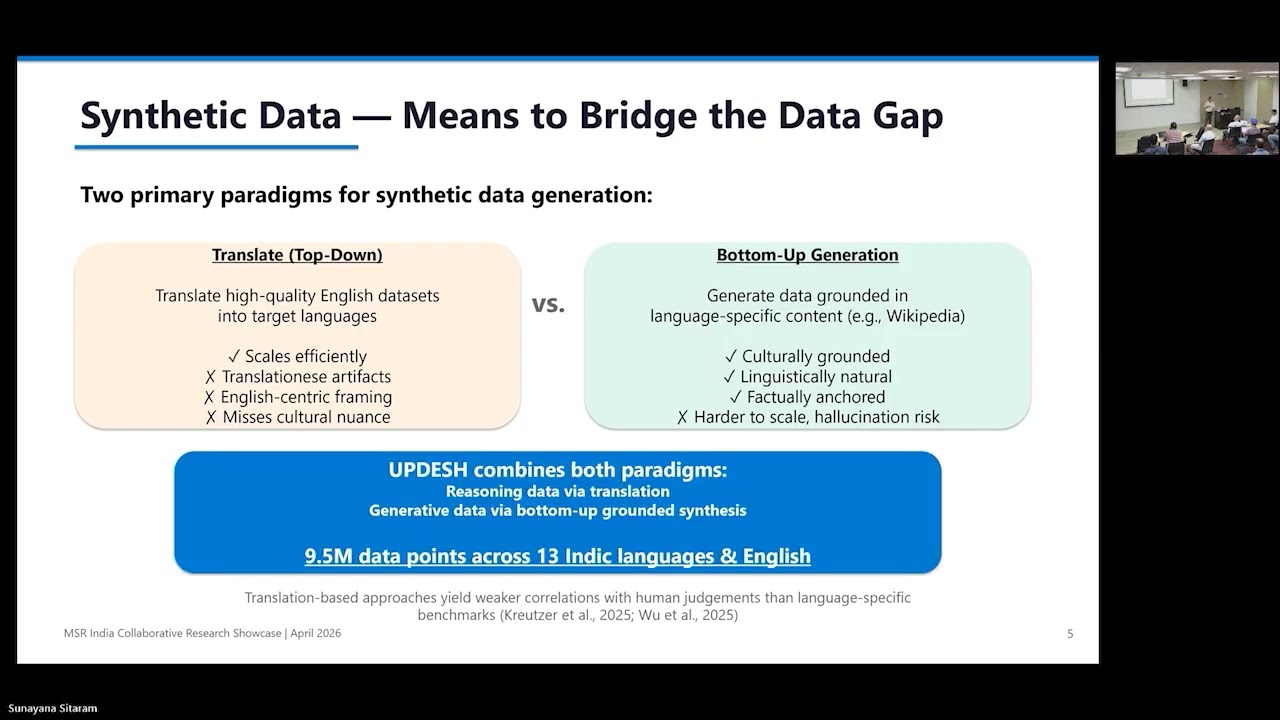
The Microsoft Research India Academic Research Summit 2026 session on "Inclusive AI" explored critical challenges in developing AI that serves diverse linguistic and cultural contexts. Speakers Niloy Ganguly, Danish Pruthi, Sunayana Sitaram, Anoop Kunchukuttan, and Ashutosh Modi addressed data gaps, model biases, and evaluation shortcomings, emphasizing the need for equitable and culturally relevant AI. Key themes included the use of synthetic data for low-resource languages, the impact of tokenization on model performance, geographical disparities in generative AI, and the application of AI for social good in legal and accessibility domains. The discussions underscored the importance of community involvement, open data, and designing AI for multilinguality from the outset, rather than as an afterthought.