Cryptography

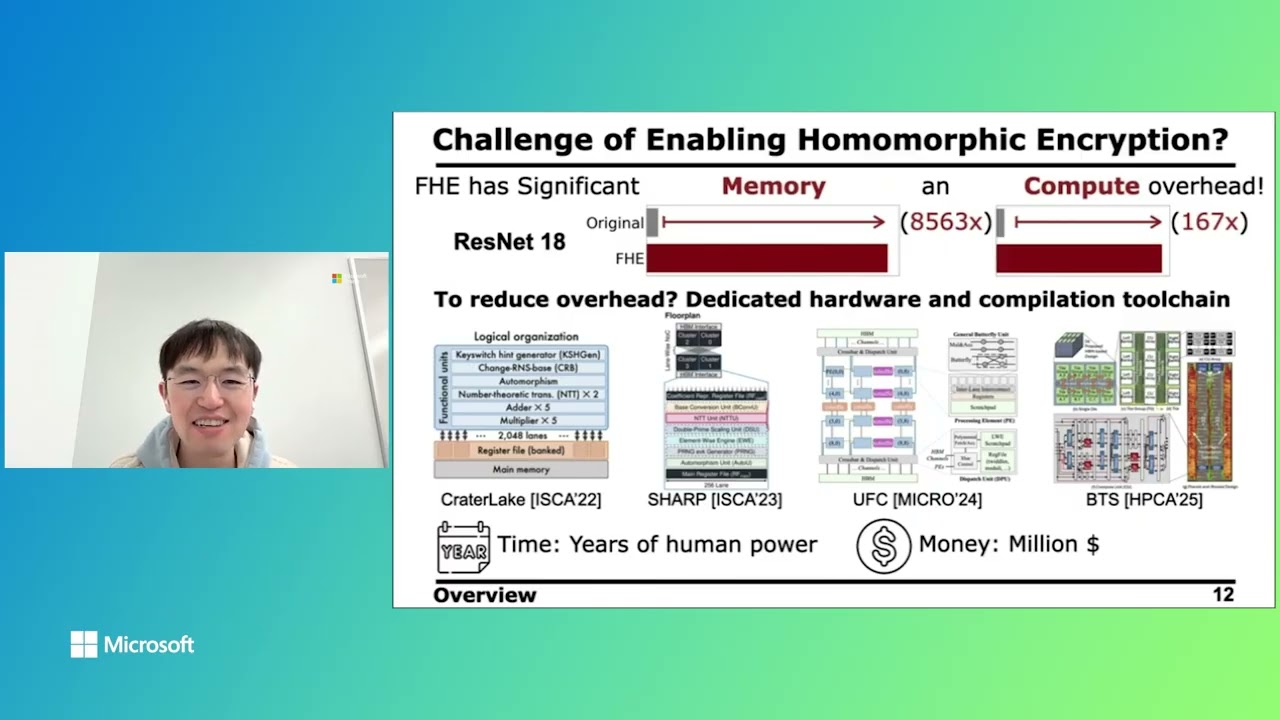
CROSS — Leveraging AI ASICs for Homomorphic Encryption

CROSS — Leveraging AI ASICs for Homomorphic Encryption

The talk presents CROSS and Morph, two compiler frameworks that enable existing AI accelerators, like Google's TPUs, to efficiently execute cryptographic workloads. CROSS focuses on Homomorphic Encryption (HE) and Morph on Zero-Knowledge Proofs (ZKP), demonstrating how to transform high-precision modular arithmetic into low-precision matrix operations that TPUs excel at, thereby achieving state-of-the-art performance and energy efficiency without any hardware modifications.
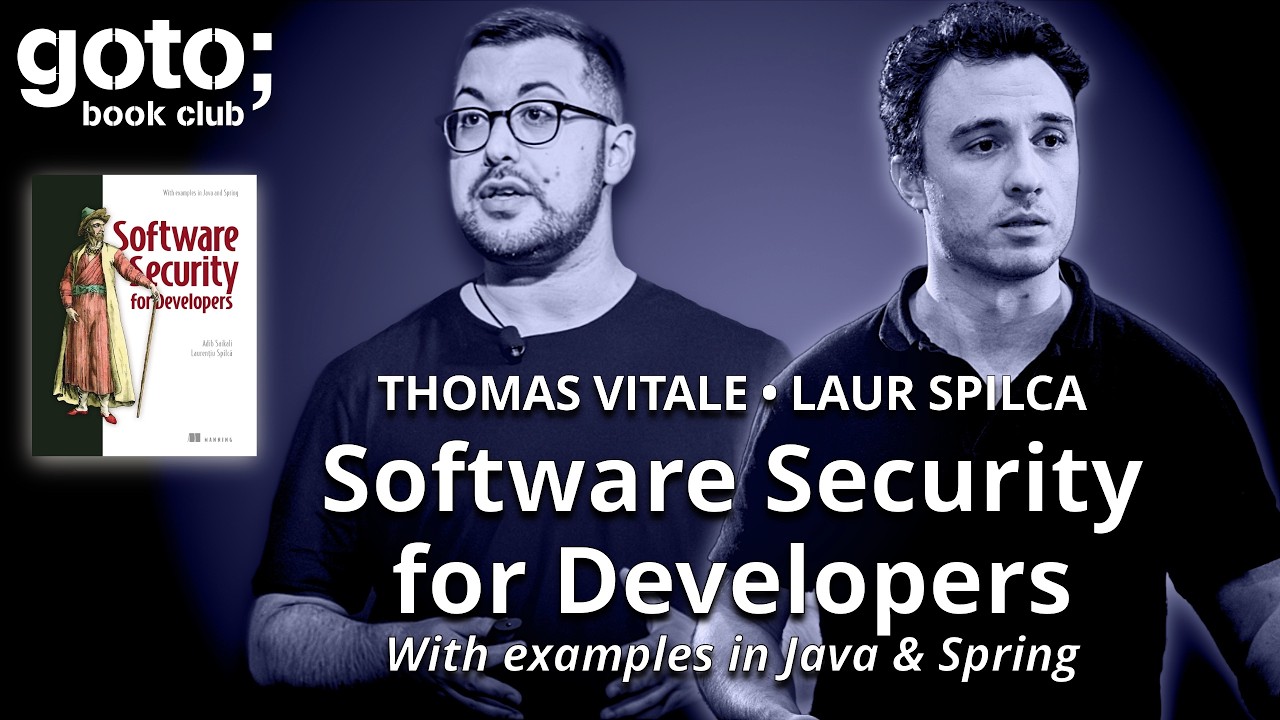
Software Security for Developers • Laur Spilca & Thomas Vitale • GOTO 2026

Software Security for Developers • Laur Spilca & Thomas Vitale • GOTO 2026

Author Laurentiu Spilca discusses his book 'Software Security for Developers', covering why developers avoid security, the dangers of reinventing standards like OAuth 2.0, the growing risks of AI-generated code, and the critical need to understand foundational concepts like encryption, hashing, and PKI.

Efficient Homomorphic Integer Computer from CKKS

Efficient Homomorphic Integer Computer from CKKS

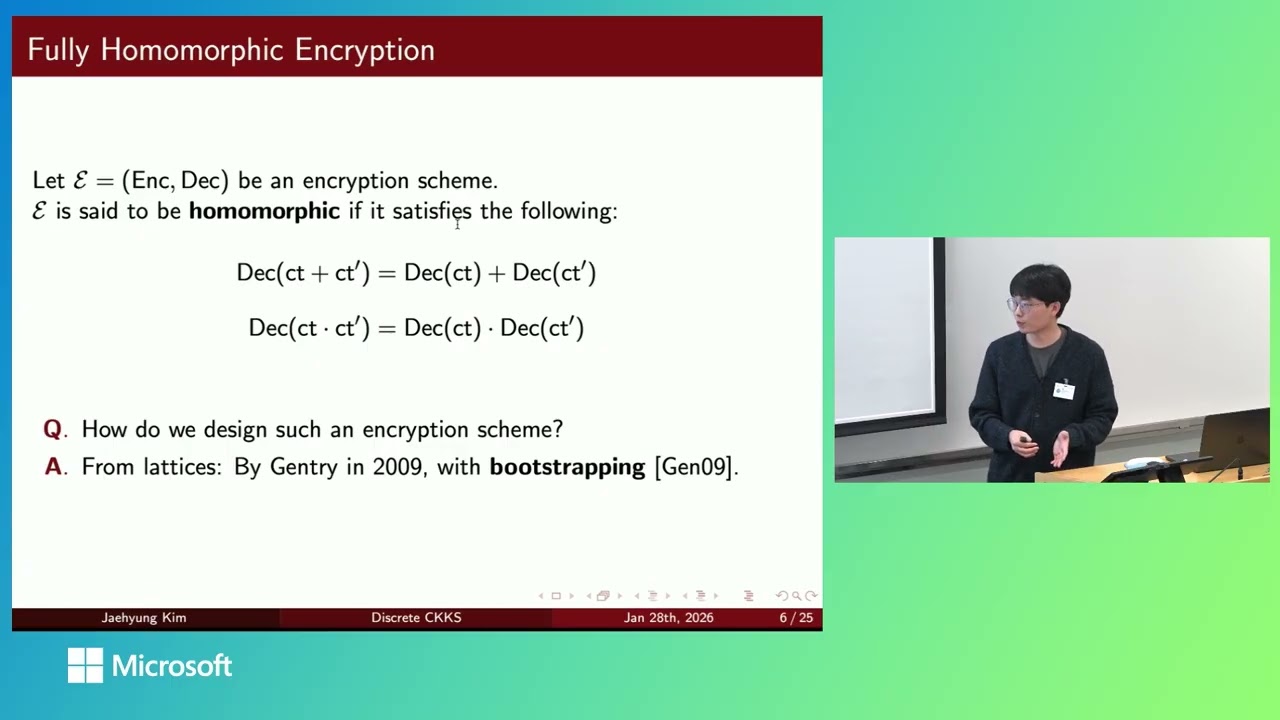
This talk introduces Discrete CKKS, a framework that extends the approximate FHE scheme CKKS to support exact integer arithmetic. It achieves this through a hybrid bootstrapping technique that both cleans noise and raises the modulus, enabling a high-throughput, vectorized engine for general-purpose discrete computations on encrypted data.

Hardware Realization and Implementation Security Evaluation of HQC, A NIST PQC Standard

Hardware Realization and Implementation Security Evaluation of HQC, A NIST PQC Standard

This talk by Sanjay Deshpande from Northwestern University explores the critical transition to Post-Quantum Cryptography (PQC) in response to the threat quantum computers pose to current public-key algorithms. It provides a deep dive into the Hamming Quasi-Cyclic (HQC) algorithm, a code-based candidate for NIST standardization. The session focuses on the challenges and innovations in creating efficient and secure hardware implementations of HQC, covering performance optimization for polynomial multiplication and countermeasures against side-channel attacks.

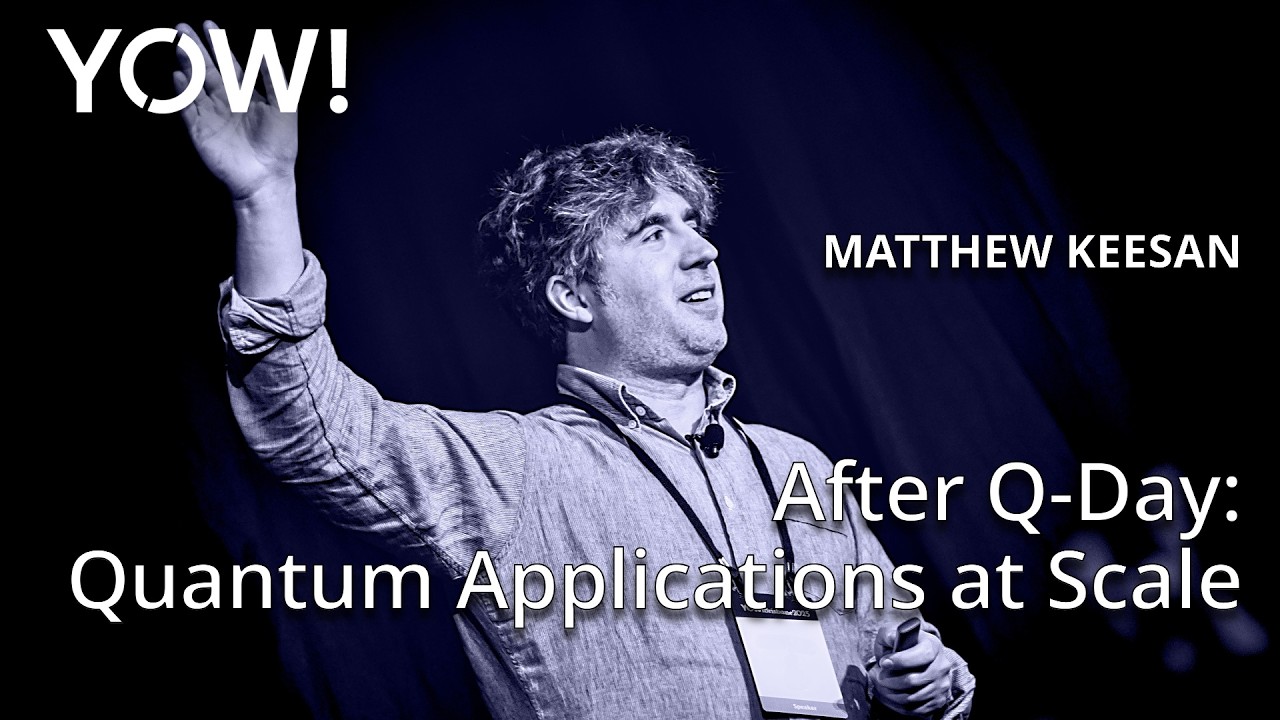
After Q-Day: Quantum Applications at Scale • Matthew Keesan • YOW! 2025

After Q-Day: Quantum Applications at Scale • Matthew Keesan • YOW! 2025

Matthew Keesan from IonQ discusses the imminent arrival of "Q-Day"—the moment quantum computers will break current public-key encryption. He explains the fundamentals of quantum computing, including superposition and entanglement, details the hardware roadmap that places this threat within the decade, and explores the promising applications of this new computing paradigm in AI, drug discovery, and materials science, issuing a call to action for software engineers to get involved.

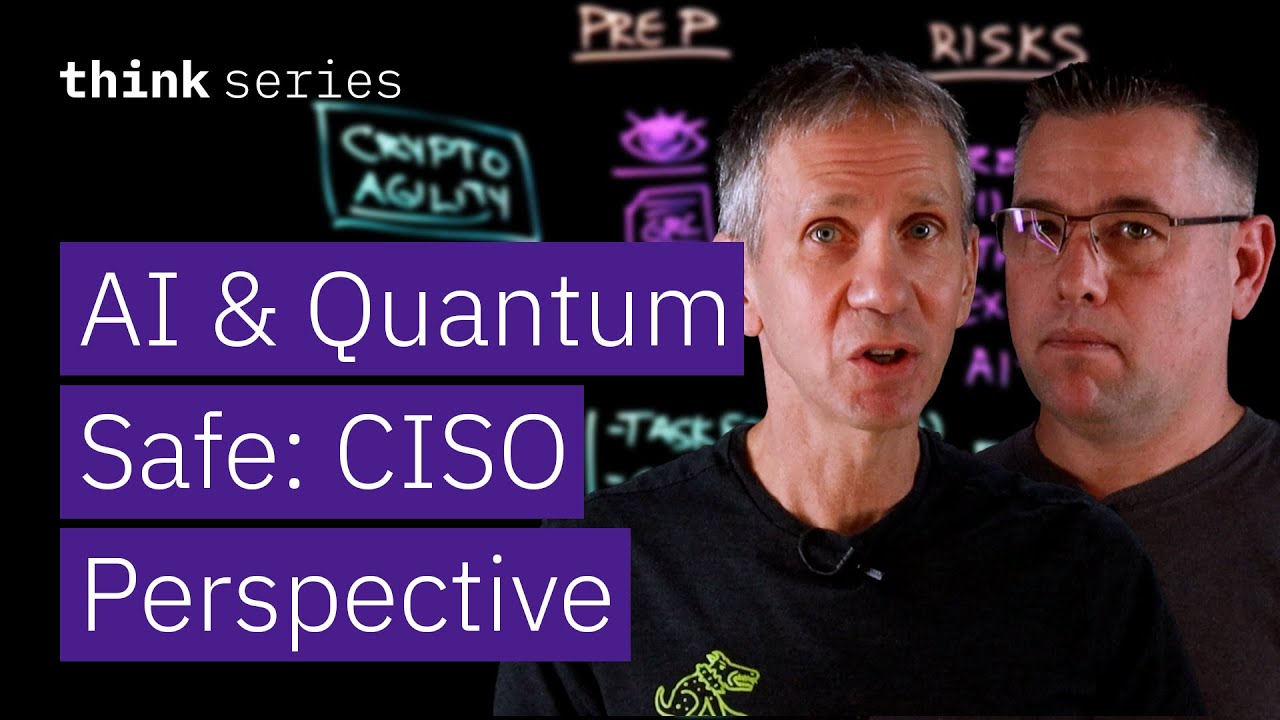
Securing AI for the Quantum Era: A CISOs Cyber Security Guide

Securing AI for the Quantum Era: A CISOs Cyber Security Guide

Explore the significant security risks posed by Agentic AI and quantum computing, from data breaches of sensitive information to the breakdown of modern cryptography. Learn proactive strategies for governing AI and preparing for a quantum-safe future.