Agent memory

Data Architecture for AI: From Training Pipelines to Agent Memory

Data Architecture for AI: From Training Pipelines to Agent Memory

Alan Kourev, co-founder and CTO of VAST Data, explains how AI workloads (training, inference with KV cache offload, RAG, and agents) access data in fundamentally different ways, and presents a disaggregated, shared-everything architecture, shaped in part by work with CoreWeave, that serves all of them from one unified platform.

Giving AI Agents Memory That Learns — Jake Broekhuizen, LangChain

Giving AI Agents Memory That Learns — Jake Broekhuizen, LangChain

Jake Broekhuizen of LangChain Labs argues that observability alone does not make agents improve. Using a financial services agent whose tone drifted from advisory to pushy, he shows how traces only become useful memory when a filtered lesson is written back as durable context the agent reads on its next run. The talk covers semantic, episodic, and procedural memory, the working versus long-term memory distinction, the read-write cycle, and how LangSmith and Context Hub support capture, analysis, and updates, along with lessons about keeping only signal, caching, and human review of procedural changes.

Why Bigger Context Windows Won't Save Your Agent — Elizabeth Fuentes Leone, AWS

Why Bigger Context Windows Won't Save Your Agent — Elizabeth Fuentes Leone, AWS

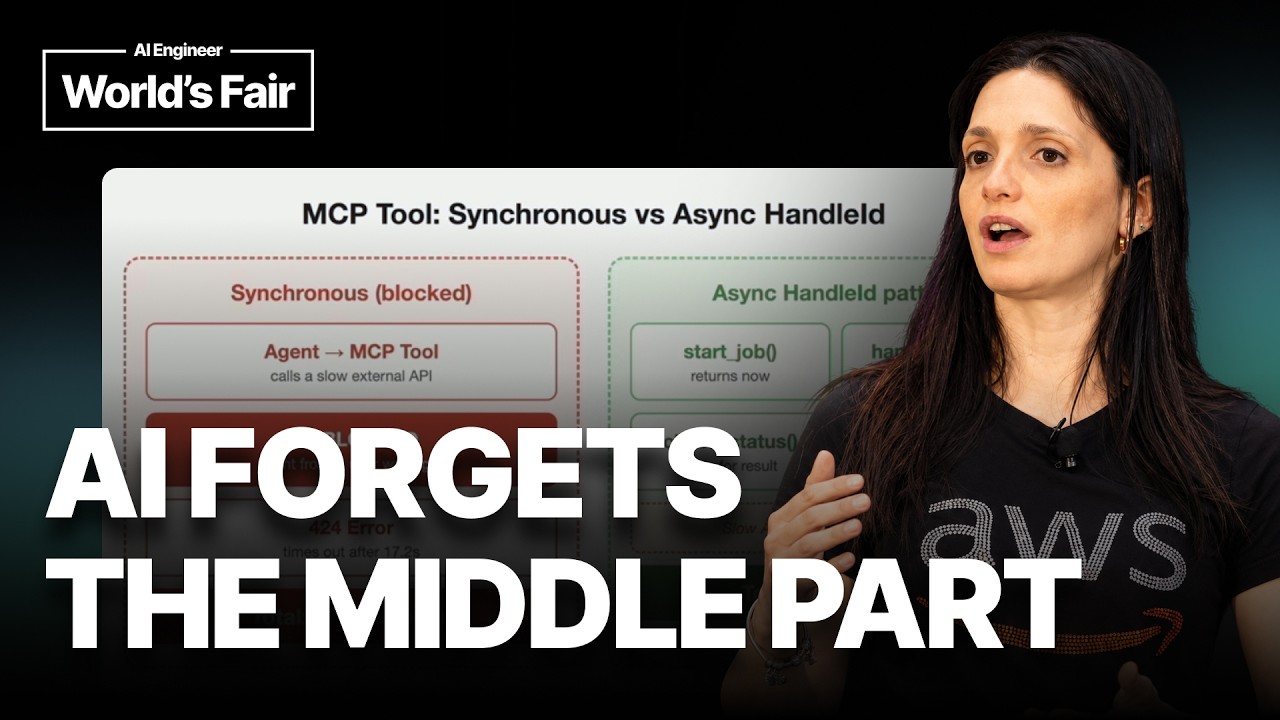
Elizabeth Fuentes Leone, developer advocate at AWS, explains why agents break when tools return huge outputs, why bigger context windows do not fix the problem because models lose the middle of long contexts, and how four context engineering strategies (externalize, select, compress, isolate) can be implemented with the open-source Strands Agents framework.

Agent Memory Is Solved. Agent Learning Isn't. — Karthik Ranganathan, Yugabyte

Agent Memory Is Solved. Agent Learning Isn't. — Karthik Ranganathan, Yugabyte

Karthik Ranganathan of Yugabyte discusses the critical challenge of shared learning among AI agents, arguing that while per-agent memory is solved, true collective intelligence is not. He details Yugabyte's struggles in building agentic systems, highlighting the "lost context" problem and debunking five common misconceptions about agent memory. Ranganathan introduces Meko, an agent-native persistence layer designed to provide shared, governed, and traceable context through "data packs," drastically improving RAG pipeline faithfulness while reducing context size and token costs. Heather Downing demonstrates Meko's resumability and sharability features, showcasing its ability to foster collaborative learning and capture tribal knowledge across agents.

Long-Horizon Agents Need Experiments, Not Just Prompts — Erina Karati

Long-Horizon Agents Need Experiments, Not Just Prompts — Erina Karati

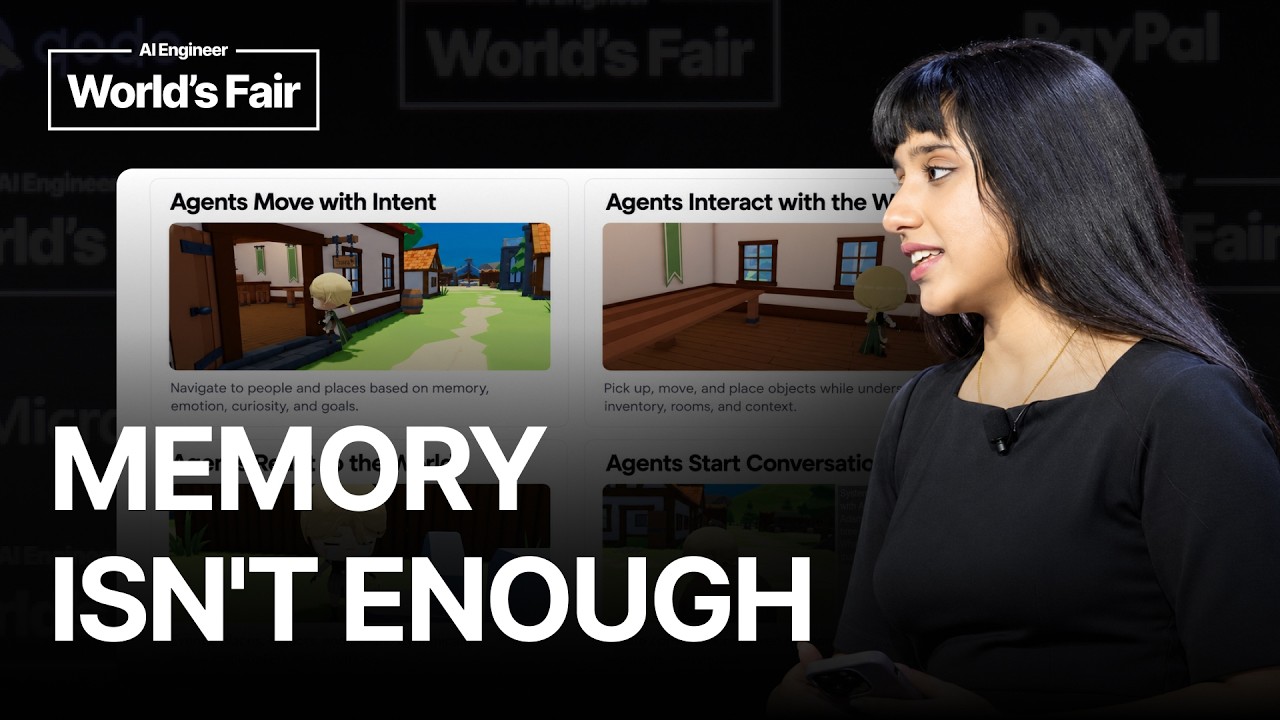
Erina Karati and Arunachalam Manikandan describe Project Paradox, a Supercell framework for game agents with per-agent memory, emotions and trust scores, and how they wrapped it in an autoresearch loop to fix long-horizon failures such as lost rumor sources and hardened uncertainty. The talk covers controlled scenario suites, a balanced scorecard, a small frozen policy surface, rollback discipline, and lessons applicable to support, research, coding and personal assistant agents.

Total Recall: Agent Memory and Harness Engineering — Ignacio Martinez, Oracle

Total Recall: Agent Memory and Harness Engineering — Ignacio Martinez, Oracle

Ignacio Martinez's workshop delves into agent harness engineering, emphasizing that while LLMs are a 'frozen' reasoning core, the surrounding harness is where control and reliability are established. He outlines a seven-layer architecture for building robust agent harnesses, covering critical aspects like hybrid storage solutions, advanced memory engineering (including in-database embeddings and context card management), the semantic layer (Umwelt), agent loops, and context engineering. The session also explores continual learning through 'skill promotion' and addresses practical challenges like managing vast tool sets and optimizing model interactions.