Agent evaluation

Beyond the Benchmark: How Parallel Web Systems Builds Reliable Web Agents

Beyond the Benchmark: How Parallel Web Systems Builds Reliable Web Agents

Parallel Web Systems engineer explains how the company moved beyond academic web-research benchmarks to a fully automated evaluation flywheel that samples production questions, generates reference answers with an oracle agent, judges with tool-equipped agents, and masks components to diagnose failures, along with the open challenges of evaluating subjective and infrastructure-dependent quality.


Your LLM Judge Is a Confident Liar: Building Better Verifiers — Browserbase

Your LLM Judge Is a Confident Liar: Building Better Verifiers — Browserbase

Browserbase and Microsoft Research unveil their Universal Verifier for computer-use and web agents, addressing the critical flaw of inaccurate LLM-as-judge benchmarks that yield "confident liars." They detail its four guiding principles, demonstrating how it drastically cuts false positives and provides high agreement with human evaluations, leading to better training data. An auto-research experiment highlights the synergy between AI and human expertise in developing robust evaluation systems.

Long-Horizon Agents Need Experiments, Not Just Prompts — Erina Karati

Long-Horizon Agents Need Experiments, Not Just Prompts — Erina Karati

Erina Karati and Arunachalam Manikandan describe Project Paradox, a Supercell framework for game agents with per-agent memory, emotions and trust scores, and how they wrapped it in an autoresearch loop to fix long-horizon failures such as lost rumor sources and hardened uncertainty. The talk covers controlled scenario suites, a balanced scorecard, a small frozen policy surface, rollback discipline, and lessons applicable to support, research, coding and personal assistant agents.

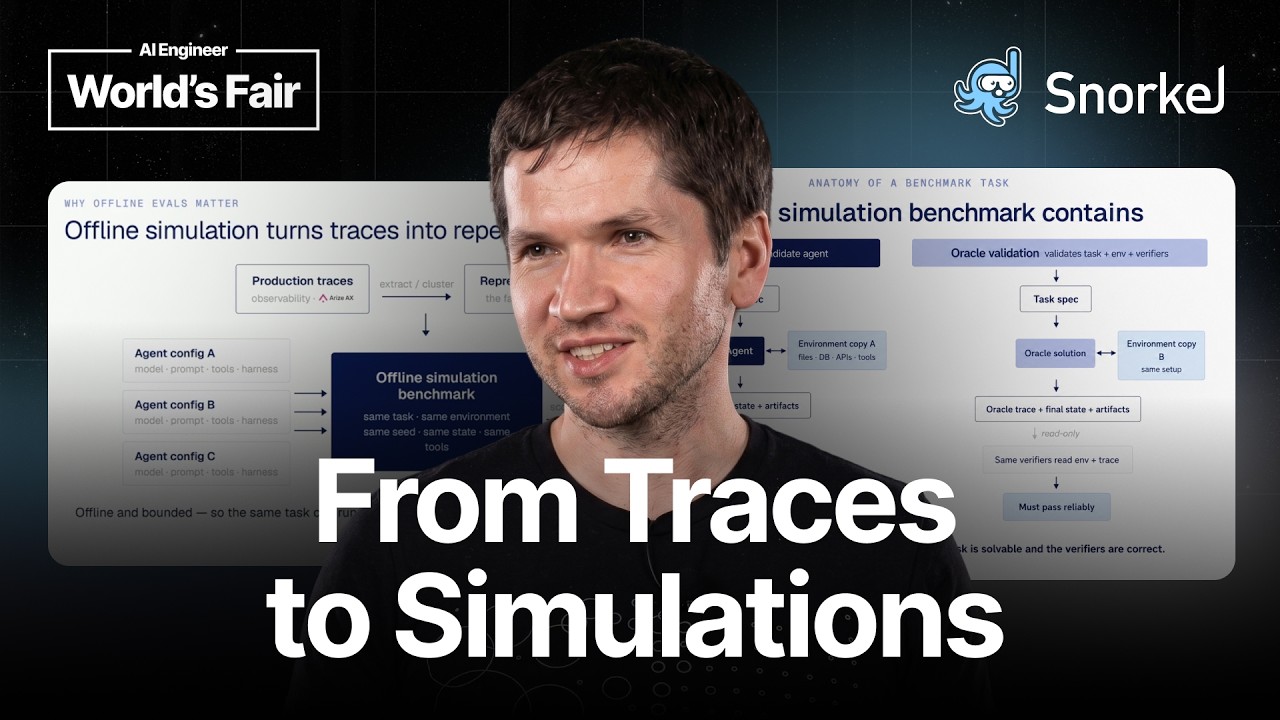
From Agent Traces to Agent Simulations — Rustem Feyzkhanov, Snorkel AI

From Agent Traces to Agent Simulations — Rustem Feyzkhanov, Snorkel AI

Rustem Feyzkhanov discusses the critical need for companies to build private, production-aligned benchmarks for AI agents. He explains how to turn agent traces into repeatable simulations, why public benchmarks are insufficient, and how a CI pipeline for agents, integrating observability and experimentation, can ensure reliable evaluation, continuous improvement, and effective release management, moving beyond simple pass rates to measure cost, latency, and policy adherence.

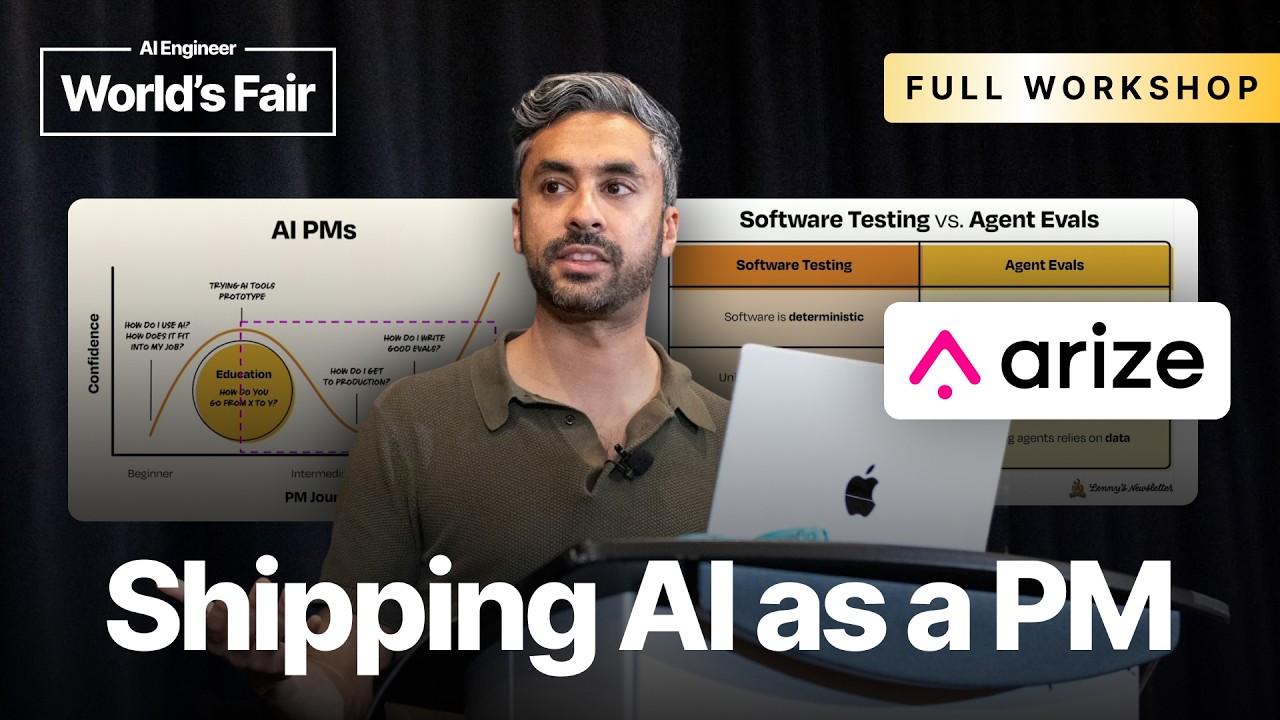
Shipping AI That Works: An Evaluation Framework for PMs – Aman Khan, Arize

Shipping AI That Works: An Evaluation Framework for PMs – Aman Khan, Arize

This talk provides a practical framework for product managers to move beyond simple "vibe checks" to implement rigorous, data-driven evaluation for LLM-powered products. Using a live demo of a multi-agent AI trip planner, the speaker breaks down essential methodologies, including human feedback, code-based checks, and LLM-as-a-judge systems, and demonstrates how to iterate on both prompts and the evals themselves to ensure consistent quality and build user trust.