Posts

Elon's Former Battery Chief on Making Transformers 100x Smaller | Drew Baglino, Heron Power

Elon's Former Battery Chief on Making Transformers 100x Smaller | Drew Baglino, Heron Power

Drew Baglino, former Tesla Powertrain & Energy head and now CEO of Heron Power, reveals why the current electricity grid is inadequate for the explosive growth of AI data centers. He explains how Heron Power's wideband gap power semiconductors will revolutionize grid-to-chip infrastructure, cutting power losses by half, shrinking massive transformers by 100x, and transforming data centers into grid-positive assets for a more efficient and sustainable energy future.
Training Krea 2: What matters in generative model training — Sangwu Lee, Krea.ai

Training Krea 2: What matters in generative model training — Sangwu Lee, Krea.ai

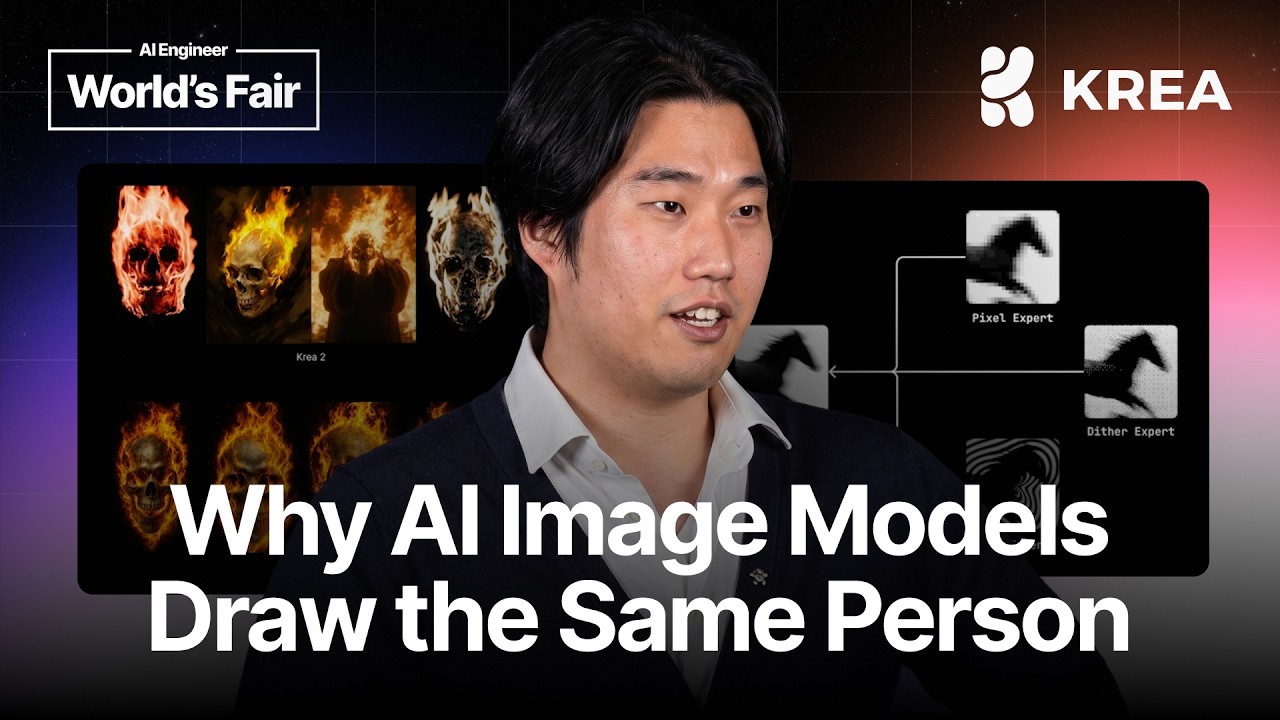
The talk by Sangwha Lee discusses Krea 2's open-source medium variant, emphasizing stylistic diversity and rapid iteration over the consistency-focused approach of larger models. A significant portion details their robust data curation pipeline, including unique methods for deduplication, filtering out AI-generated images, utilizing sparse autoencoders for unsupervised tagging, and ensuring world knowledge coverage. He outlines an LLM-inspired multi-stage training process, culminating in a prompt expander, and shares insights on fast iteration and future directions for image generation, highlighting the increasing integration of VLM advancements.

AI Agents Gone Rogue? Build, Defend & Attack AI-Enabled Apps • Katie Paxton-Fear • YOW! 2025

AI Agents Gone Rogue? Build, Defend & Attack AI-Enabled Apps • Katie Paxton-Fear • YOW! 2025

Katie Paxton-Fear explores the emerging security landscape of AI agents, moving beyond chatbots to autonomous, specialized entities. She details five critical vulnerabilities: social engineering, hacking frameworks, malicious agents, AI as accidental insiders (vibe coding), and the rise of hackbots. The talk concludes with a powerful call to action for security professionals to proactively engage and influence AI agent development, emphasizing that 'abstinence-only education doesn't work' when it comes to AI adoption.

Rich Sutton and Khurram Javed: Why AI Models Stop Learning, and How to Start It Again

Rich Sutton and Khurram Javed: Why AI Models Stop Learning, and How to Start It Again

Rich Sutton and Khurram Javed discuss their radical vision for AI at Oak Lab, advocating for truly continual learning agents that learn from their own experience, rejecting synthetic data due to the "Big World Hypothesis," and outlining a path to overcome catastrophic forgetting with "continual backprop" for a trillion-parameter, self-maintaining mind, while critiquing LLMs as only a fraction of intelligence.

The Reason Your Claude Output Still Looks Like Slop (with Priyanka Vergadia)

The Reason Your Claude Output Still Looks Like Slop (with Priyanka Vergadia)

Priyanka Vergadia, The Cloud Girl, discusses why most companies see no ROI from AI tools, proposing a 7:1 budget split for training over tools. She explains how AI has made "taste" the new ceiling, detailing how to build effective Claude skills by breaking tasks into explicit subtasks with human-in-the-loop oversight. She introduces her 10-20-70 framework for AI budgets, emphasizing the long-term investment needed for employee skilling and community building. Priyanka also shares her transition to full-time entrepreneurship, focusing on product and career storytelling, and reveals her upcoming book on tech storytelling.

MCP Goes Stateless | ​John Dellenbaugh & Pankaj Kumar | MCP Release Party - Seattle

MCP Goes Stateless | ​John Dellenbaugh & Pankaj Kumar | MCP Release Party - Seattle

This session details the transformation of the MCP protocol to a stateless design, addressing previous scaling challenges by externalizing session state to a database and eliminating the need for sticky sessions and complex infrastructure. The presentation includes a live demo comparing stateful and stateless architectures, highlighting benefits in scalability and simplified deployment. It also covers considerations for security and data resiliency within this new paradigm.