Elon's Former Battery Chief on Making Transformers 100x Smaller | Drew Baglino, Heron Power
Drew Baglino, former Tesla Powertrain & Energy head and now CEO of Heron Power, reveals why the current electricity grid is inadequate for the explosive growth of AI data centers. He explains how Heron Power's wideband gap power semiconductors will revolutionize grid-to-chip infrastructure, cutting power losses by half, shrinking massive transformers by 100x, and transforming data centers into grid-positive assets for a more efficient and sustainable energy future.
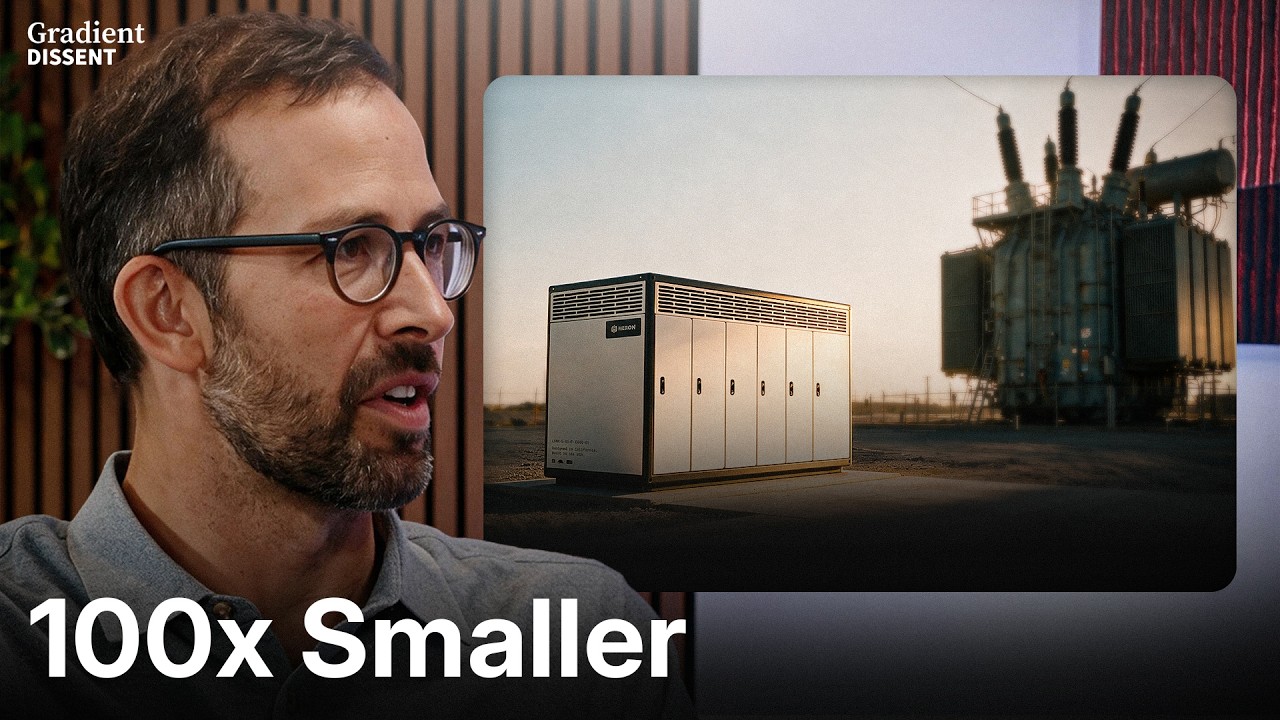
The conversation features Drew Baglino, founder and CEO of Heron Power, discussing the energy demands of AI data centers and the necessary overhaul of power infrastructure. Baglino, a Tesla alum, draws on his extensive experience to highlight the shortcomings of the current power grid and present Heron Power’s innovative solutions.
Tesla Career & Leadership Lessons
Baglino recounts his 18-year tenure at Tesla, starting as a junior engineer after meeting JB Straubel at Stanford. His early projects involved converting analog control systems to embedded DSPs for the Roadster, providing immediate, tangible feedback—a key factor that “hooked” him on the work.
He shares insights from early interactions with Elon Musk, particularly regarding Model S battery cell requirements. Musk’s strategy of setting “impossible targets” (e.g., “It can’t be more than 7200 cells” vs. 8000-8800 projected) forced the team to innovate across the board, pushing for more efficient motors, improved aerodynamics, and higher energy density cells from Panasonic. Baglino notes that this approach, while intense, drove significant results by “loading everybody’s back equally” and extracting “agame” performance.
He emphasizes the importance of engineers decoupling their ego from their work product to “fail fast” and respond to new information, citing “Production Hell” during Model 3 ramp-up. A vivid example is the “fluffer bot”—a problematic robot installing a flimsy desiccant bag—which was ultimately removed after a rapid analysis process revealed its redundancy and inefficiency. This demonstrated how questioning every component could lead to significant process improvements.
Baglino’s management philosophy, influenced by mentors like JB Straubel and Craig Carlson, centers on humility, transparent communication, and hiring people “better than you.” He advocates for aggressively pushing timelines, a trait learned from his electrical engineer father, but with pragmatism. He acknowledges that while hardware projects have some incompressible timelines (e.g., stamping tools), executives must constantly challenge “long pole” excuses to prevent team complacency and foster continuous improvement. He contrasts this with software projects, where short deadlines are crucial to “cut scope” and maintain focus, something learned from the hard deadlines of physical product launches at Tesla.
Automotive Insights
Baglino briefly touches on luxury cars, noting that perceived “quality” often comes from added mass and cost for “creature comforts” like sound dampening (NVH package) or door thunk. Despite his long career at Tesla, he doesn’t consider himself a “car guy” but appreciates the responsiveness and quietness of electric vehicles.
Regarding autopilot, Baglino, initially focused on physics-based control systems, describes the shift towards vision-only autonomy after Elon Musk’s experience with Mobileye. He recalls Musk’s constant “Can it be next week?” question for complex engineering challenges, illustrating the “reality distortion field.” While he eventually moved to Tesla Energy, he commends the current Tesla Autopilot team for their “incredible” progress from “pixels to actuators.”
Grid Modernization & Heron Power’s Solution
Baglino explains that the US electricity grid experienced stagnant load growth from the 1970s to the 2010s due to energy efficiency gains. This “calcified” the utility supply chain, making it uncompetitive and stifling innovation, as utilities were incentivized by rate-of-return on capex rather than electricity sales. However, electrification (EVs, heat pumps, AI data centers) is now driving 3-5% annual load growth, necessitating a “tripling” of electricity generation for a sustainable energy economy.
California’s high power rates are attributed to wildfire abatement costs, inflating component prices due to the calcified supply chain, extensive rural distribution lines, and the historical net energy metering (NEM) policy for solar, which reduced the “denominator” (served kilowatt-hours) for fixed costs, driving up per-unit rates. Recent load growth from electrification and NEM changes are expected to stabilize or even reduce rates.
Heron Power addresses this by developing “software and silicon-based solutions” to replace the “largely mechanical, passive solutions” dominating the grid. Their core technology uses wideband gap power semiconductors (Silicon Carbide, GaN) to create much more efficient and compact power conversion systems.
He explains that traditional semiconductor devices are for logic (ones and zeros), while power semiconductors are for optimally conducting and interrupting high-voltage electricity. Wideband gap materials allow for physically smaller devices that can block more voltage, are more thermally conductive, and switch much faster (hundreds of kilohertz vs. 60 Hz). This enables:
- Reduced Losses: Cutting “grid to chip” power losses by a factor of two. For a gigawatt data center, this means “35 megawatts more useful compute.”
- Smaller Transformers: The “Heron Link” transformer is “100 times smaller volumetrically per unit power” because high-frequency switching dramatically reduces the size needed for galvanic isolation. This replaces massive, oil-filled, flammable transformers with solid-state, non-moving components.
- Integrated Functions: The new devices can natively interrupt electricity flow, eliminating the need for separate mechanical switchgear, simplifying infrastructure build-out for factories and data centers.
Data Centers and Future Energy
Baglino argues that properly designed data centers can be “grid positive.” They are ideal “base load” customers, using a high percentage of their allocated capacity (e.g., 800MW of a 1GW connection) compared to residential customers. This makes the grid more affordable for everyone. Furthermore, integrating energy storage into data centers allows them to support grid stability (absorbing training ripples, peak load support, frequency/voltage stabilization), transforming them from potential liabilities (historical flicker problems, mass disconnections) into assets. He predicts data centers will ultimately lead to lower electricity rates in states with high penetration.
On renewable energy, Baglino supports nuclear power, citing its safety with proper engineering and the potential for more affordable construction, as seen in Asia. He is also a “big geothermal plan fan,” believing it will compete strongly with nuclear for “affordable base load 24x7 renewable power.” While solar plus batteries can provide base load, its life cycle cost of energy (LCOE) can be higher depending on climatic conditions and asset quality.
Finally, he explains that Heron’s approach simplifies electrical infrastructure. Instead of cascading series of transformers and switchgear for different voltage conversions (e.g., 300kV to 13kV to 480V to 208V), their power electronics allow for elegant, multi-stage conversion in “one stage,” doing “more with less.” He uses the analogy of tiny consumer electronics chargers (like a 70W GaN adapter switching at 1 million times per second) as the principle Heron is scaling to megawatts for industrial applications. He concludes with the “parking lot problem” analogy to explain the limitations of lithium-ion battery charging speed.