How Nuclear Will Unlock Energy Abundance with Valar Atomics Founder Isaiah Taylor
Valar Atomics, led by Isaiah Taylor, is redefining nuclear energy by building and iterating advanced reactors, including powering an NVIDIA Blackwell chip directly with a live nuclear reactor for a website. This episode delves into Valar's hardware-first approach, their navigation of regulatory pathways, and their vision for how cheap, abundant nuclear power, especially with AI-driven demand, will lead to 'hyper-technoindustrialism' and vastly improve human quality of life.
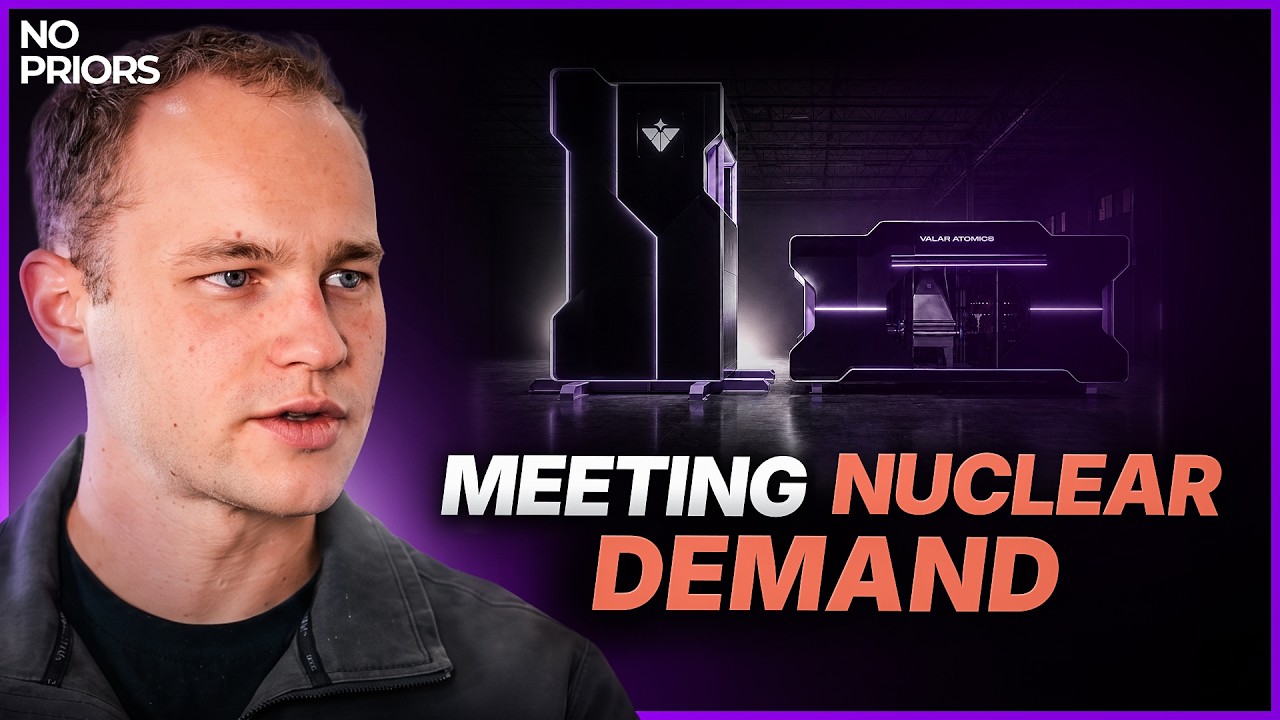
Isaiah Taylor, founder and CEO of Valar Atomics, outlines his company’s mission to revolutionize nuclear energy by focusing on hardware iteration, manufacturing, and scalability to make energy 10 times cheaper for humanity. He believes nuclear fission is an “entirely unsolved problem” that has not yet had its “Ford moment.”
The Stagnation of Nuclear and Valar’s Solution
Taylor explains that the US stopped building nuclear reactors after the 1979 Three Mile Island incident. Although the incident resulted in no deaths or injuries, it fostered public fear and mismanaged optics. Concurrently, the US shifted from large-scale civil infrastructure to advanced manufacturing capabilities. Valar Atomics recognizes this shift, advocating for Small Modular Reactors (SMRs) built with a manufacturing mindset rather than as traditional civil engineering projects.
Crucially, Valar addresses the regulatory “chicken and egg” problem (the need for operational data to satisfy regulators, which requires an operating plant) that has plagued the industry. While most nuclear startups rely on modeling and simulation, creating “paper reactors,” Valar leveraged a little-known Department of Energy (DOE) pathway. This pathway, originally designed for nuclear R&D (as the Energy Research and Development Agency, ERDA) and revived by the Trump administration’s Executive Order 14301, allowed Valar to perform real-world hardware iteration and gather empirical data. This approach is exemplified by their War 250 reactor, which generates 100 kW of power by splitting 10^17 atoms per second.
War 250: Demonstrating Intrinsic Safety and Pace
The War 250 reactor, the first advanced reactor to make power by a startup and outside a national laboratory, showcases Valar’s core philosophy. Unlike traditional light-water reactors, which require continuous active cooling post-shutdown to prevent meltdown (as seen in Fukushima and Three Mile Island), Valar’s design is intrinsically safe. This passive safety is demonstrated by its ability to undergo a “scram” (emergency shutdown) and have all electrical supply cut, with decay heat managed solely by passive circulation in its RCCS panels. This physics-driven safety, independent of active controls or operator intervention, is foundational for mass production.
Taylor challenges common misunderstandings about nuclear safety, noting that it is empirically the safest energy source, even safer than solar when accounting for installation-related fatalities. Valar’s safety philosophy diverges from traditional nuclear’s focus on reducing the odds of an incident. Instead, they emphasize reducing the consequence, designing plants that remain safe even if every system fails. This allows for greater speed and scalability.
The Valar Operating Model: Speed, Simplicity, and Vertical Integration
Valar views nuclear as a “hardware execution problem.” They prioritize building, running, and scaling simple, cheap, and safe reactors, akin to producing a “Toyota Camry” rather than a “Lamborghini.” Their internal metric, “tick rate,” measures the speed of iteration—the time between criticalities and new reactor deployments—with a goal of reducing it to minutes, eventually allowing a new reactor to turn on every few minutes.
Their commitment to speed and simplicity is evident in their vertical integration strategy. For instance, the modular citadel, a pre-cast concrete bio-shield, is manufactured in Valar’s own factory. This innovative design, featuring a “tortuous path” to prevent radiation leakage without rebar or grout, reduced construction time from three months to 42 hours. This was achieved by two young engineers (21 and 23), demonstrating Valar’s ability to innovate foundational components.
Another example of vertical integration is their Reactor Protection System (RPS), the reactor’s “brain.” When quoted $5 million and a 2.5-year timeline by a vendor, Valar’s team developed their own RPS in six weeks for $400,000. This highlights what Taylor describes as “fake costs” and the “anemic” nature of a traditional industry that has stopped building. Valar’s willingness to internalize complex manufacturing is a key competitive advantage.
AI-Driven Demand, Venture Capital, and a Gigasite Strategy
Taylor acknowledges the increasing power demand from AI compute as a tailwind but asserts that cheap energy inherently creates its own demand. By making energy 10 times cheaper, Valar aims for a fundamentally “infinite market.” Demonstrating this synergy, Valar recently powered an Nvidia Blackwell chip directly with their reactor to host the world’s first nuclear-powered website (nuclearbyte.com), which even tracks atoms split per page view.
Valar’s business model is backed by venture capital, leveraging the US’s “risk-on equity capital environment” to underwrite the technical execution risk of building reactors. This allows them to build reactors on an equity balance sheet, proving their technology years ahead of competitors relying on traditional, risk-averse project financing. Their “gigasite strategy” involves building large-scale power plants and then attracting customers (e.g., data centers) to the abundant, cheap power, rather than negotiating complex, slow deals with existing infrastructure.
The Future: Abundant Energy and Hyper-Technoindustrialism
Taylor envisions a future where nuclear fission makes energy 1,000 times cheaper, fundamentally improving the quality of human life. He coins the term “hyper-technoindustrialism,” where the cost of all manufactured goods will converge to the cost of energy, enabled by AI and robotics. This future, where “basically everything free,” could unlock transformative advancements, from daily intercontinental travel to enabling ambitious projects like space exploration and lunar colonization.