⚡️Every product of the future will be a living system — Ronak Malde, Trajectory.ai
Ronuk Malde, CEO of Trajectory.ai, discusses his journey from building AI coding agents at Windsurf to his current focus on continual learning for enterprise AI. He shares insights on leveraging real-world user data, the unique challenges of model acquisition, and how Trajectory.ai's platform, powered by innovations like scaled SDPO and a novel training stack, enables dynamic, always-learning AI models for diverse industries from legal to finance.
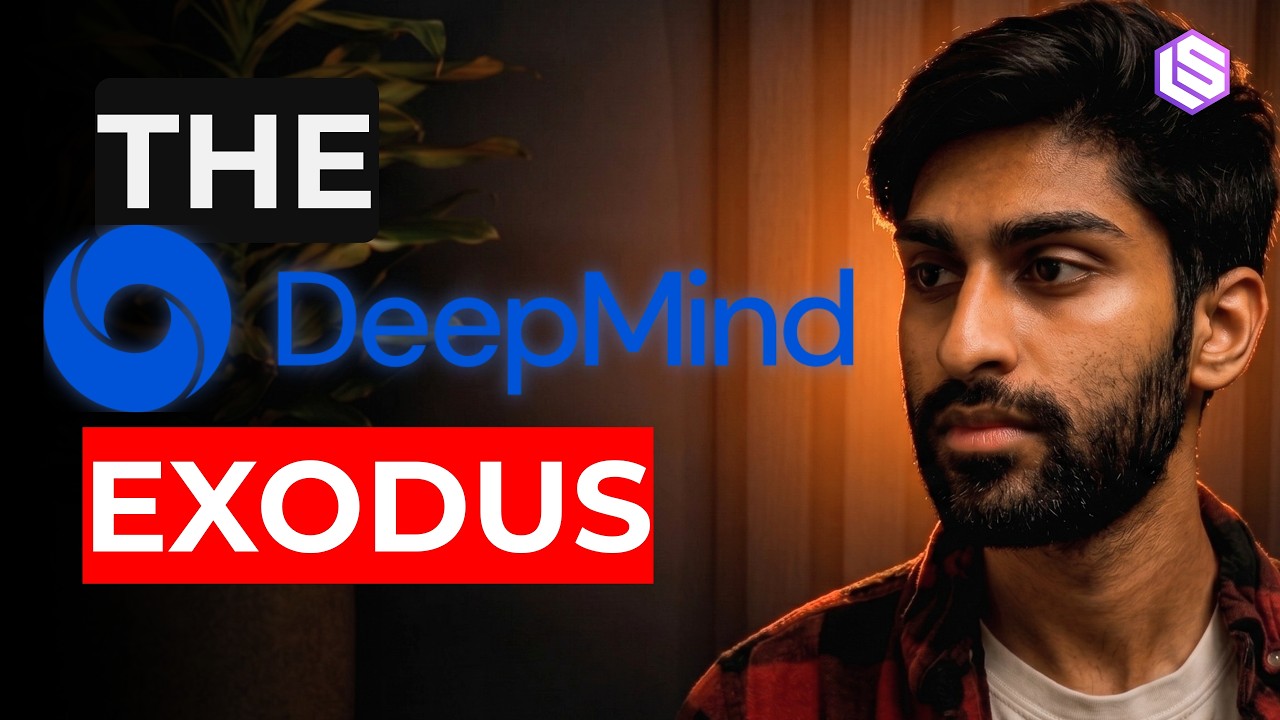
Ronuk Malde, CEO of Trajectory.ai, shares his journey from early AI coding agents at Windsurf to building a platform for continual learning in enterprise AI. His experience highlights the rapid evolution of AI and the critical need for systems that learn continuously from real-world user interactions.
The Genesis: Windsurf, AI Coding Agents, and the DeepMind Acquisition
Ronuk’s journey into cutting-edge AI began at Kodium (later Windsurf), where he joined with a thesis that structured information, particularly coding, would drive the next AI leap. He observed the groundbreaking capabilities of early AI agents, such as generating the 2048 game from a simple prompt, which was a “magical” experience at the time.
Windsurf focused on building AI coding agents, initially developing autocomplete models. A pivotal realization came from observing vast user signals – not just code acceptance but how users modified and directed agent output. This led to the creation of their own foundation model, sui 1, which leveraged this real-world user data to achieve frontier-beating performance.
The success culminated in a rapid acquisition by Google DeepMind. Ronuk recounts the surprise, expecting an OpenAI acquisition, only to find Demis Hassabis and the DeepMind team involved. The acquisition highlighted Google’s understanding that beyond stellar models, closing the loop with real-world user signal was crucial. At DeepMind, Ronuk contributed to projects like Anti-gravity and Gemini 3, reinforcing the insight that AI needs to learn from actual user behavior, not just offline benchmarks or human-labeled data, especially for real-world applications.
Trajectory.ai: The Vision for Continual Learning
Motivated by the static nature of current AI models – where “the model you used yesterday… will be making the same mistakes tomorrow” – Ronuk founded Trajectory.ai with his Stanford co-founders, Michael (ex-DeepMind Robotics) and Arjun (ex-Apple Vision Pro). Their shared experience in AI’s interaction with the real world (coding, robotics, AR/VR) converged on the idea of continual learning as the “ultimate paradigm” for building intelligence that constantly grows.
The core thesis for Trajectory.ai is to bring the “compounding loop” of continual learning, previously seen in coding, to every enterprise, spanning domains like legal, healthcare, and finance.
Approach to Continual Learning: From Customer Pain to Technical Solution
Trajectory.ai approaches continual learning from the customer’s perspective, exemplified by their work with Harvey, a legal AI company. In fields like law, 80% accuracy is often equivalent to 0% due to the critical nature of tasks. The key “useful signal” for continual learning comes from expert users correcting agents’ attempts.
Trajectory.ai’s platform is designed to:
- Ingest all data, expert traces, and agent interactions, distilling them into a standardized “trajectory” format.
- Generate the necessary evals, judges, and environments for training.
- Provide a self-serve, end-to-end platform to optimize agents, models, and harnesses, starting with the model.
Technical Innovations: NeMoTron 3 Super and Scaling SDPO
A significant achievement shared was their partnership with Harvey and Nvidia to train NeMoTron 3 Super. This model achieved frontier-level performance for Harvey’s critical legal workflows (e.g., issue spotting, analysis, citation), while being drastically cheaper and faster than comparable models. Ronuk notes the increasing quality of Western open-source models like NeMoTron, which is vital for regulated industries. The platform’s efficiency has drastically improved, reducing model training time from three months to under a week for new customers.
To address the unique challenges of continual learning data, Trajectory.ai developed strategies for data curation. They distinguish between agent actions (e.g., tool calls) and crucial user modifications/corrections, which provide directional feedback rather than noisy binary signals like “thumbs up/down.” An “auto-research pipeline” transforms these user vectors into usable judges, evals, and environments for training.
A core algorithmic innovation is the scaling of Self-Distillation Policy Optimization (SDPO). Unlike traditional RL (e.g., PPO) that relies on a single reward signal, SDPO uses self-distillation to guide the model with richer, textual feedback. The student model learns from a “teacher” that is made “smarter” by providing it with “privileged information” or “hints” (e.g., the correct output from production). This allows the model to learn from specific corrections, rather than just a binary “good” or “bad” signal. Trajectory.ai has demonstrated SDPO’s effectiveness on benchmarks like Apex agents, showing significant gains and faster convergence.
Building a Research-Led Product Company and Open-Sourcing Infrastructure
Trajectory.ai, now a team of 11, operates as both a product company and a research lab, recognizing that true continual learning requires both cutting-edge algorithms and intuitive interfaces. They’ve assembled a diverse team from top AI labs (OpenAI, Meta, DeepMind) and product-focused companies (Stripe, Figma).
To facilitate continuous training, Trajectory.ai has open-sourced a training stack for continual learning in conjunction with Sky RL and Anyscale, dubbed “Continuous Laura” (Conti-Lora). This addresses the limitations of traditional linear training jobs by enabling concurrent, non-linear training. Instead of sequential jobs, Conti-Lora uses dedicated pools for sampling and training, allowing multiple jobs to run in parallel. This significantly reduces wall-clock time for multiple concurrent experiments and is designed for dynamic workloads where data streams continuously. Ronuk draws parallels to operating systems scheduling, emphasizing the shift from training as a research problem to a production engineering challenge.
The Future: Enterprise AI and True Continual Learning
Trajectory.ai’s roadmap includes:
- Legibility and Control: Providing customers with advanced observability and abstraction layers for evals, empowering product managers to directly influence model improvements.
- Market Expansion: Moving from AI-native partners (Clay, Harvey, Rogo, Dakugon, Mor) to tech incumbents (e.g., AirTable, Notion), and eventually targeting Fortune 500 companies.
- True Continual Learning: For Fortune 500, this means an “observability layer” that detects manual processes, identifies patterns, and automatically builds agents and models tailored to specific workflows, allowing any product to dynamically learn and update from user interactions.
Tactically, while starting with models, Trajectory.ai aims to expand to improving the agent’s harness, skills, and memory layers, recognizing the complex interplay of these components in achieving a holistic continual learning solution. Ronuk believes “now is the time of continual learning,” with enough real-world test cases to drive this paradigm shift.