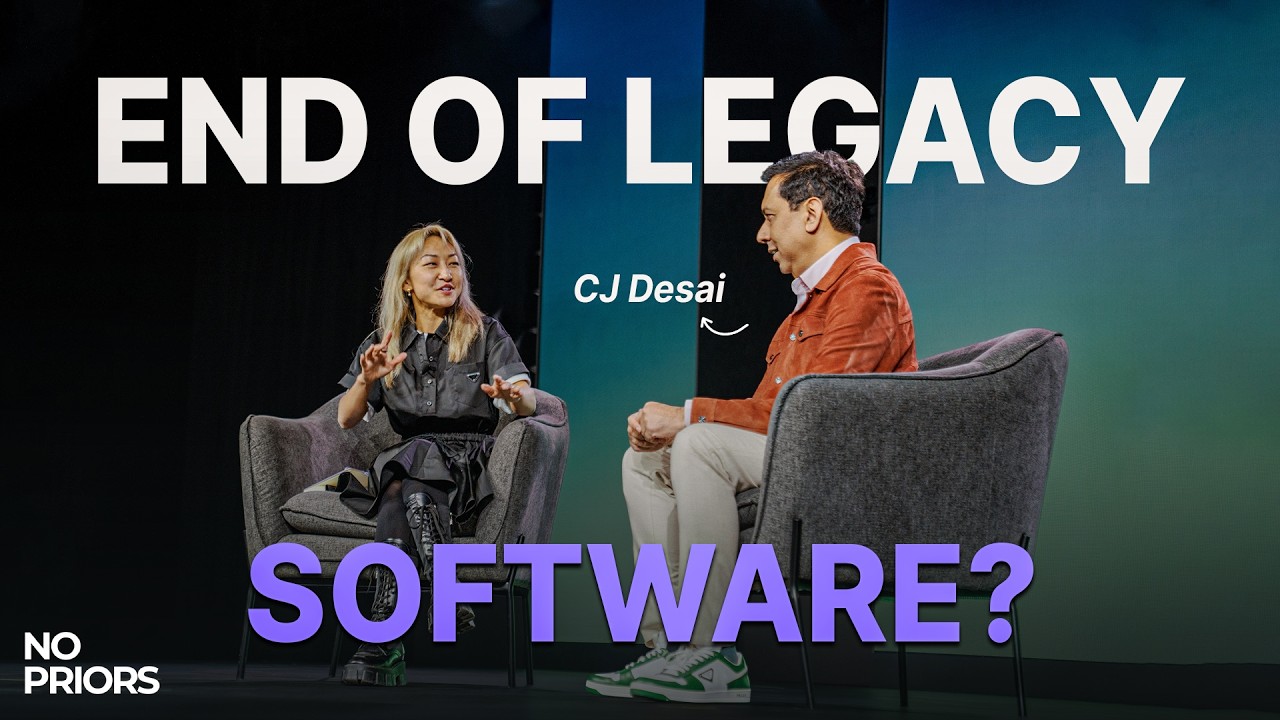
No Priors Live: Building Durable Software in the AI Age with MongoDB President & CEO CJ Desai
CJ Desai, CEO of MongoDB, discusses why platforms, not products, are the key to long-term success in the software industry, especially in the age of AI. He explores the shifting landscape of enterprise software, the reality of AI adoption in Fortune 500 companies, and what truly constitutes a "moat" when software can be generated on demand.
The future of software and its fundamental value are in question, a pivotal moment for the entire stack. Since the rise of generative AI in 2022, both investors and customers are re-evaluating where durable value lies. The “bear thesis” that the terminal value of some software is zero, however, is likely overblown. In this new landscape, two layers of the stack are constant: the LLM and agentic framework, and the data layer. Everything else is subject to evolution. For application-layer companies to succeed, they must demonstrate an incredible “speed to value” and deliver capabilities that were impossible with legacy SaaS, focusing intently on specific, high-impact use cases.
Platforms vs. Products: The Foundation of Durability
The primary reason there are only a handful of pure-play software companies with over $10 billion in revenue is that platforms are rare and difficult to build.
- Products are Replaceable: A product can serve as a “wedge” to enter a market, but if the entry point was easy, the exit will be similarly easy. A competitor can always build a better, faster, or cheaper tool. As Frank Slootman used to say, “tools are for fools.”
- Platforms are Sticky: A true platform consists of multiple products working in unison, deeply integrated into a customer’s ecosystem. This stickiness isn’t just about customer relationships; it’s about technological dependency. When a large bank builds 300 critical applications on MongoDB, integrating them with their 9,000 other systems, the platform becomes part of their core infrastructure fabric. The more a customer builds on the platform, the harder it is to remove.
Redefining “Moats” in the Age of AI
While distribution channels and customer relationships are valuable, the most critical moat in an era of rapid technological transition is speed and adaptation.
- Pivoting Fast: The key to survival and growth is the ability to pivot quickly to leverage major platform shifts, whether it was the internet, mobile, or now, AI. Companies that fall behind will constantly face questions about their future.
- Strengthening the Core with AI: For incumbent platforms, the path forward is to use AI to strengthen their existing moat. This means leveraging AI to innovate faster, create additional products for new use cases, and re-accelerate growth. Innovation without a corresponding increase in sales is a potential red flag for investors.
Enterprise AI Adoption: A Reality Check
Based on conversations with dozens of Fortune 500 and Global 2000 customers, AI adoption is still not moving as fast as the hype suggests.
- Productivity Tools: Early experiments with office productivity co-pilots have yielded unclear or disappointing results regarding tangible value.
- Coding Assistance: The clear breakthrough has been in coding assistance, which took off in a meaningful way in 2024. Feedback is overwhelmingly positive, with customers reporting improved innovation velocity and security.
- Replacing Systems of Record: Large enterprises are cautiously evaluating AI-native startups for functions like customer support. They are asking a critical question: is this new tool an “and” (a layer on top of our existing system of record) or an “or” (a full replacement)? Many leaders are surprisingly open to a full replacement if a startup can prove it is cheaper, faster, better, and offers a disruptive, value-based pricing model. This indicates a willingness to absorb the pain of migration for a transformative gain.
The Enduring Role of the Data Layer
The database market is a large, durable Total Addressable Market (TAM). In this space, MongoDB has been a rare disruptive force in a market that has been stable for nearly 50 years. The platform is uniquely positioned for the AI transition for two key reasons:
- Cloud Transition: The migration of enterprise applications to the cloud is still ongoing.
- AI Transition: The AI wave is just beginning. AI applications inherently deal with messy, unstructured data and require high velocity and sophisticated search capabilities—architectural principles that have been core to MongoDB since its founding. A flexible, scalable data layer is a “must-have” component of the modern AI stack.
Leadership Through Technological Shifts
Navigating massive technology transitions is primarily a challenge of change management, requiring leaders to push their organizations out of their comfort zones.
“You cannot be a great products and engineering person unless you speak to customers all the time. Okay, all the time. Because that will allow you to not only do a pattern match but see around the corner.”
Engaging directly with customers provides critical insights into their pain points, deployment challenges, and business strategy. This customer intimacy is what allows a product leader to understand the market deeply and build what is truly needed. During a technological shift, it is imperative that leadership ensures the organization is leaning in, even if the timeline for maturation is uncertain. Intellectual honesty is paramount; a company must be truthful about the real drivers of its business rather than attributing success to hype.