The New Application Layer - Malte Ubl, CTO Vercel
Malte Ubl, CTO of Vercel, posits that AI engineering is the successor to web development, arguing that AI agents will expand, not shrink, the software market. He explores practical agent archetypes being built today and discusses the profound shift required in infrastructure and security as agents become both the builders and primary users of software, concluding that the true innovation and value will lie in the application layer built by AI engineers, independent of the commoditizing foundational models.
AI engineering is the legitimate successor to web development, representing a mainstream discipline that will define the next decade. We are facing an unprecedented disruption in both how we build software (with AI) and what we build (AI and agents). This creates a pivotal moment for the engineering community to come together and reflect on our profession.
The Expanding Software Universe: More Work, Not Less
A common anxiety is whether there’s a place for engineers in an AI-driven future. The answer is an emphatic yes. The next generation of engineers, growing up in this new paradigm, will be naturally more adept. More importantly, the software market itself is not shrinking; it’s expanding.
Agents make it economically viable to automate tasks that were previously too expensive to tackle with traditional software. This means a vast new category of software that should exist can now be built. We are currently “speed running an experiment in the economics of how elastic the software market is.” The core thesis is simple: the cheaper it is to make software, the more software we will make. This, in turn, increases the demand for software engineers.
We are also witnessing a shift in the “build vs. buy” debate, sometimes called the “SaaS-copocalypse.” More companies are opting to build their own solutions with the help of AI, further fueling the demand for more custom software and the engineers to create it.
Practical Agent Archetypes in Production Today
While coding agents are powerful, there is immense low-hanging fruit in building other types of agents that can provide massive value without overhauling existing business processes.
- 24/7 Operations: The most straightforward application is automating roles that are traditionally constrained by human hours, like support agents. This allows businesses to operate continuously.
- Compressed Research: Many business processes involve a sequence of: 1. A business event occurs, 2. A human does research, 3. The human makes a decision. An agent can be deployed to automate the research phase, dramatically speeding up the process without changing the fundamental workflow or increasing the risk profile. At Vercel, agents pre-process “Contact Sales” inquiries and abuse reports by gathering context (checking LinkedIn, googling the company) before a human makes the final decision.
- Surfacing Existing Information: In every company, valuable information exists but is often inaccessible—in Slack messages, meeting recordings, or outdated issue trackers. Agents can be built to find, process, and surface this information, making the organization more efficient. For instance, an agent could automatically keep an issue tracker updated based on developer conversations.
- Eliminating Boring Work: A powerful way to identify agent use cases is to ask employees, “What do you hate most about your job?” Vercel built an in-house support agent that now handles 90% of incoming queries. This led to a massive spike in job satisfaction for the support team, as they could now focus on complex, interesting cases instead of repetitive toil like handling rejected credit cards.
A Paradigm Shift: When Agents Become the Users
The disruption isn’t just in how we build; it’s also in who—or what—uses our software. At Vercel, this future is already here.
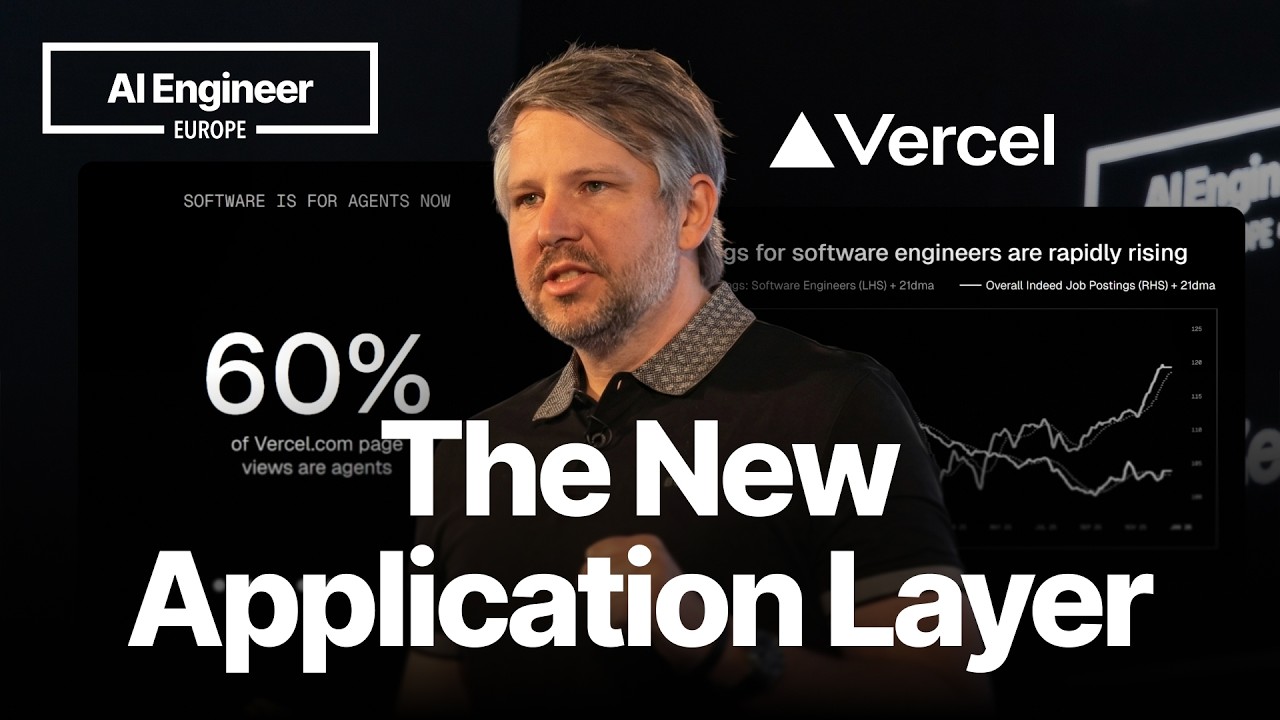
In the last 7 days, over 60% of page views on vercel.com were AI agents. Humans are now in the minority.
This trend necessitates a fundamental shift in focus:
- From UI to API/CLI: As agents become the primary users, the emphasis moves from graphical user interfaces to robust, automatable APIs and command-line interfaces.
- Infrastructure for Agent-Written Code: When an engineer doesn’t write the code themselves, they have a different relationship with how it runs. Infrastructure must adapt to a world where most software is written by an agent and is simply expected to run flawlessly.
- New Security Models: We are marching into a security nightmare that feels like 1999, “where really everything can be hacked.” A critical architectural flaw in many current agent harnesses is that they run the agent’s control logic in the same environment as the code the agent generates. This is a significant vulnerability that requires a paradigm shift, such as physically separating the harness from the execution environment.
The Future: A Commoditized Model Layer and a Thriving Application Layer
As AI engineers, we are building a stable application layer that can thrive independently of the underlying models. We don’t have to work at a major AI lab to drive innovation. In fact, Europe is showing surprising leadership in AI engineering with projects like the Vercel AI SDK, Pi, and Open Interpreter.
Two potential futures lie ahead:
- The Labs Win: A few large model labs dominate. AI remains expensive, all value accrues to them, and we become “forward deployed engineers” for the winning company.
- The Models Commoditize: This is the more likely scenario. Models from OpenAI, Anthropic, and Google become increasingly interchangeable and cheap. In this world, the power shifts to the AI engineers.
In a commoditized world, the business value is created by the agents we build. The application layer is where the real innovation happens—it’s where the next Open Interpreter is invented and the next paradigm of AI engineering is discovered.