He Raised $70M to Cure Every Disease With AI
Samuel Rodriques, founder of Edison Scientific, shares his journey from physics to building an AI scientist named Kosmos. He discusses how AI agents are already making novel discoveries, including a potential cure for blindness, and are poised to revolutionize drug discovery. The conversation dives into AI's strengths in high-throughput reasoning, the critical bottlenecks in clinical trials, proposed reforms for the US medical system, and whether human scientists will still be needed in an age of hyper-intelligent AI.
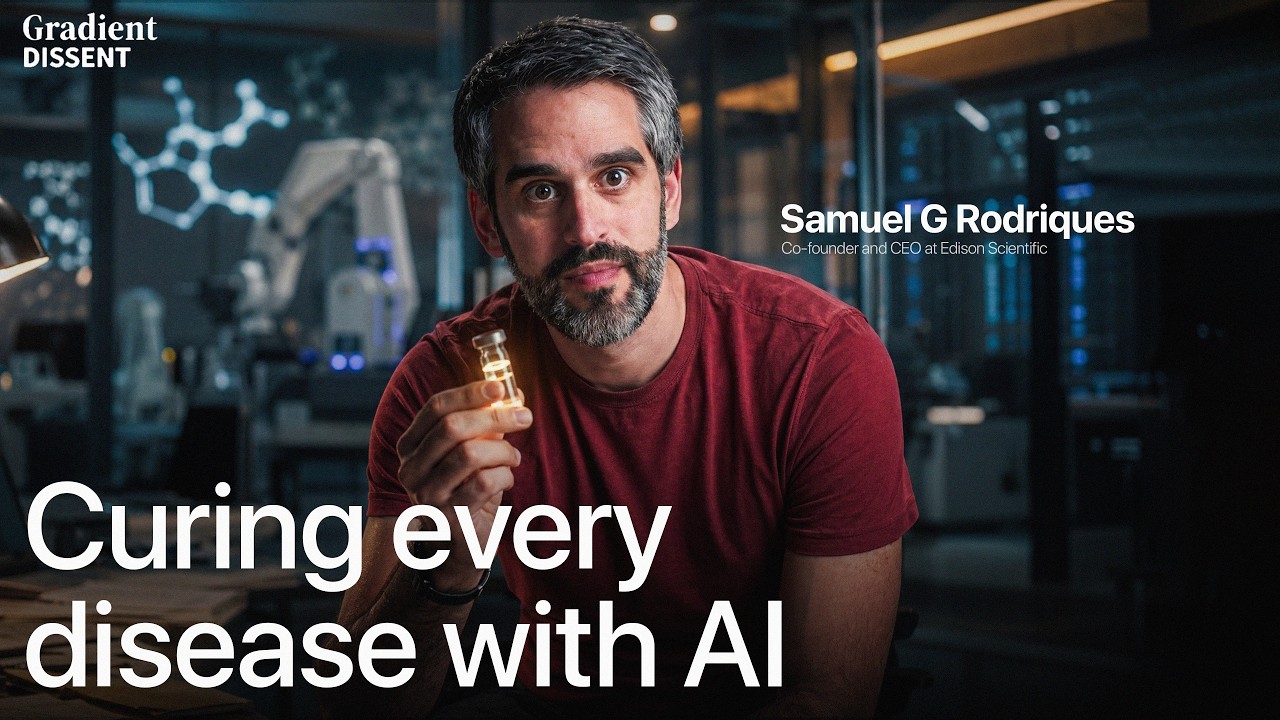
Samuel Rodriques, founder and CEO of Edison Scientific, discusses his journey from theoretical physics to biology and AI, driven by the insight that talent, not capital or logistics, is the primary bottleneck in science. His goal is to scale scientific talent using AI to address monumental challenges like curing all diseases, understanding the brain, and solving aging.
The AI Scientist: From Nonprofit Research to Commercial Application
Rodriques initially co-founded Future House as a nonprofit in 2022 to pursue the basic research of building an “AI scientist.” He believed the timeline for commercialization was 5-10 years away. However, the rapid advancement of AI led to the development of powerful AI scientist agents within two years.
This progress began with a multi-agent system called Robin, which demonstrated the full loop of scientific discovery: hypothesis generation, experiment planning, data analysis, and iteration. Robin’s first major success was proposing a novel hypothesis to treat dry age-related macular degeneration, a form of blindness. This finding was subsequently validated in lab and animal experiments and published in Nature.
The successor to Robin is a more advanced agent named Kosmos. Kosmos features a self-orchestrating architecture and a sophisticated “world model” for context management, allowing it to build an integrated understanding of a scientific field over hundreds of runs. Since its launch, users have leveraged Kosmos to generate tens of thousands of novel scientific findings.
The unexpected success and high demand from pharmaceutical companies for these agents necessitated the creation of a for-profit spinout, Edison Scientific, to scale the technology.
Where AI Excels and Struggles in Science
AI’s strength lies in two main areas:
- Verifiable Tasks: Problems where correctness can be easily checked (e.g., coding, math).
- High-Throughput Tasks: Problems requiring the synthesis of vast amounts of information.
While science is verifiable in principle, the feedback loop through experiments is often long and expensive, especially in medicine. The ultimate test, a human clinical trial, can take years.
Where AI currently shines is in “high-throughput reasoning.” Rodriques gives the example of a project to cure autoimmune diseases by studying how parasites manipulate the human immune system. The AI agent analyzes every protein in parasite genomes to identify candidates that could modulate immune reactions, a task impossible for a human to perform at that scale. The AI generates a short list of proteins for experimental validation, dramatically accelerating the hypothesis-generation phase.
Revolutionizing Drug Discovery
Rodriques envisions a future where pharma companies are much leaner and can pursue significantly more drug programs in parallel. AI is set to revolutionize both early-stage discovery (hypothesis and molecule generation) and the operational side of development (managing clinical trials, preparing regulatory documents).
Despite the potential for AI in hypothesis generation, Rodriques argues the fundamental bottleneck remains the operational execution of human clinical trials. “If you want to accelerate the process of coming with medicine, you need to make those experiments faster,” he states. This is where the primary commercial and scientific value lies.
Reforming the Clinical Trial Process
Rodriques is critical of the current U.S. clinical trial system, which he describes as slow and onerous due to its centralized FDA approval process. He notes that many U.S. biotechs conduct early-stage trials in Australia or China, where decentralized approval systems foster efficiency. He proposes two key reforms:
- Decentralize Approval: Allow individual research centers to approve early-stage trials, creating competition and driving efficiency.
- Relax Efficacy Requirements: For initial approval, require drugs to be proven safe but not necessarily effective. Efficacy could then be determined through robust, large-scale, real-world evidence post-launch, which AI can help analyze.
This perspective also informs his skepticism towards the biohacker movement’s use of unvetted peptides. Knowing “what can go wrong,” he emphasizes the hidden risks, the power of the placebo effect, and the lack of systematic tracking for adverse events outside of rigorous, controlled trials.
The Future of AI Models and Human Scientists
Edison Scientific’s competitive advantage lies in developing specialized models trained for specific scientific reasoning tasks. Rodriques argues that a specialized model, fine-tuned on proprietary customer data, will consistently outperform generalist frontier models from major labs like OpenAI or Anthropic. This specialization provides pharma companies with a sustainable, proprietary edge.
On the question of whether AI will replace human scientists, Rodriques believes humans will remain essential for a “substantial amount of time.” Science is fundamentally a non-verifiable process in the short term, and it relies on human taste and intuition to select the most important problems to solve. While AI will become superior at generating testable hypotheses, the guiding hand of human researchers in directing the inquiry will remain critical. As he puts it, when choosing between asking a Nobel laureate like Frances Arnold or a model for ideas, “there’s no question right that Francis is going to have better ideas.”