Running AI Engineer with AI — swyx
Swyx, co-founder of the AI Engineer conference, reveals how his "tiny team" of nine people leverages AI agents like Cognition's Devin and Town Assistant to manage a multi-million dollar business and organize large-scale events. He shares practical examples of how agents have transformed their workflow, from converting Figma designs to pixel-perfect websites to managing complex conference schedules and even performing personal research tasks, arguing for a future focused on "Agent Experience" (AX).
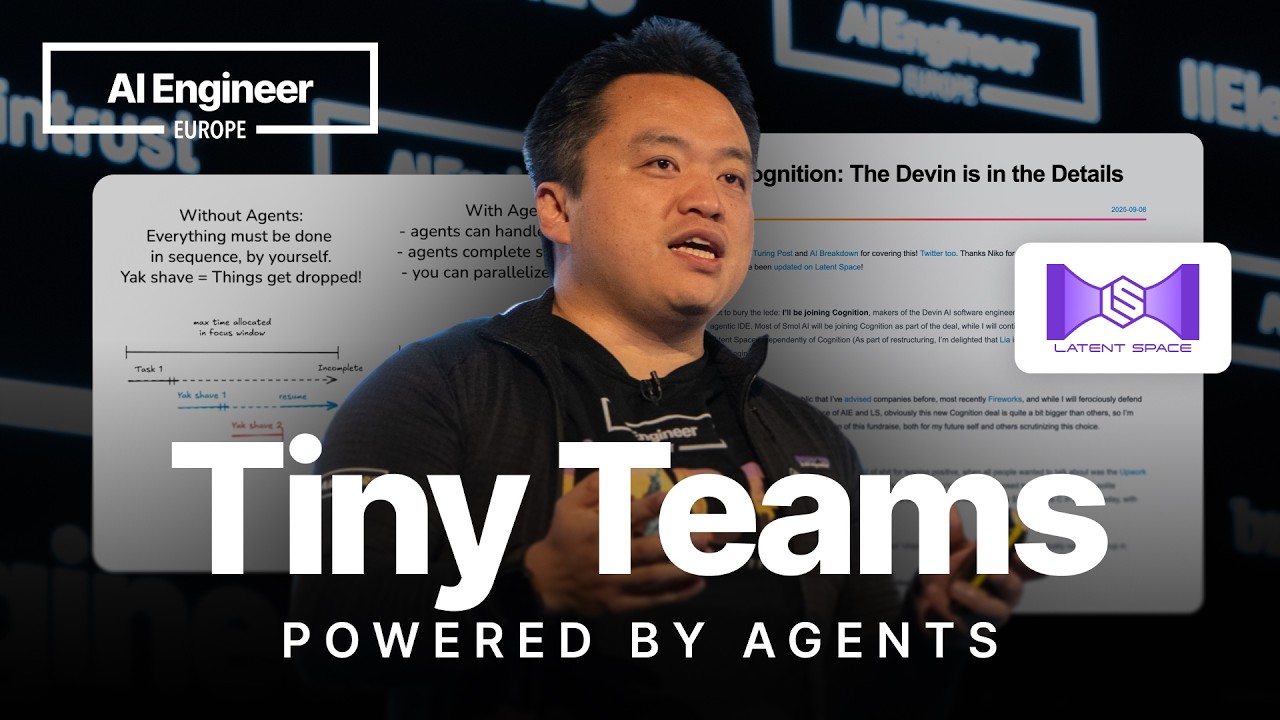
Swyx, a co-founder of the AI Engineer conference, explains how his organization embodies the “tiny team” ethos—a team with more millions in revenue than employees. With just nine full-time staff generating over $9 million in business, their operational efficiency relies heavily on the recent adoption of AI agents.
From Figma to Live Site: The First “AGI Pill” Moment
Initially, the conference’s tech stack was ironically non-AI, consisting of tools like Figma, React, and Google Sheets. The turning point came with the integration of Cognition’s coding agent, Devin, into their Slack workspace.
The first major test was converting a new website design from Figma into a functional site. A task that would typically take weeks was completed rapidly by the agent, producing a pixel-perfect result that surprised even the speaker. This initial success highlighted a key, underappreciated benefit of agents: the elimination of “yak shaving.”
“Anytime there’s like random yak shaving… all the dependency tree crawling of like, ‘Oh, no, I have to do that first’… I think one underappreciated benefit of agents is that they save you the yak shaves.”
Agents excel at handling tedious setup and dependency management, allowing developers to focus on higher-level tasks and enabling greater parallelism.
The Ripple Effect: Increased Engagement and Creativity
After the initial success, agent usage within the team “exploded.” A non-technical designer in a different time zone began interacting directly with Devin, providing feedback with red-line annotations on screenshots—a natural, human-like way of collaborating that required no special training.
This new workflow had a profound impact on team morale and output.
- Unlocking Creativity: The team began tackling fun, non-critical projects, such as implementing a website Easter egg or building a new design aesthetic inspired by a viral tweet. These were tasks they would have previously skipped.
- Boosting Human Productivity: The speaker emphasized that the biggest gain wasn’t just in lines of code, but in the increased productivity and engagement of his human employees. By removing bottlenecks and shortening feedback loops, the team found their work more enjoyable and produced more polish and animations than ever before.
“I am getting more work out of my employees because they enjoy doing it. Because the feedback cycle for them… is gone. They just literally they have the idea, they go do it.”
Agents for Everything Else: Beyond Coding
The team’s success with web development prompted them to apply agents to other business challenges, moving into the realm of “agents for everything else.”
- Data Management as Code: The entire conference schedule, a massive data management problem involving 130 speakers and dozens of sponsors, is now managed by Devin. Instead of a traditional CMS, they committed the data to code and let the agent handle updates. A speaker change request can be fulfilled simply by forwarding an email to the agent. This workflow enables their small team to manage a thousand-person conference and plan for a 6,000-person event without increasing headcount.
- ETL and Automation: Agents are used for boring, routine ETL tasks, like syncing data from a vendor’s API to ensure a single source of truth.
- Personal and Business Research: In a practical example of personal automation, the speaker used Devin to research and find a local vendor for a lobster claw machine for the conference, a task that might otherwise fall to an executive assistant.
The Bigger Picture: The Rise of Agent Experience (AX)
Swyx argues that these examples point to a broader industry trend where coding agents are “breaking containment” and becoming general-purpose knowledge work tools. This leads to two significant shifts:
- AI Replacing SaaS: He shared his internal discussions about replacing existing SaaS tools by building bespoke solutions with agents, acknowledging the “psychosis” required to champion this but also the practical path of systematically addressing team concerns.
- The Shift to Agent Experience (AX): Citing speakers from Vercel and Modal, Swyx noted that the primary user for many platforms is shifting from humans to bots and agents. This means that dashboards and UIs are becoming less important than APIs, CLIs, and other programmatic interfaces. The focus must shift from User Experience (UX) to Agent Experience (AX), designing systems with agents as the first-class user.
The core message is that agents for knowledge work are here, and professionals should actively integrate them into their workflows to unlock new levels of productivity and creativity.