How Forward Deployed Engineering is done at Ramp — Leo Mehr
Leo Mehr, Director of Engineering at Ramp, outlines two critical principles for Forward Deployed Engineering (FDE): "Always Be Scoping" to ensure the delivery of the right product by deeply understanding customer needs and context, and "Scale with Tokens" by strategically integrating AI agents into FDE workflows. He highlights Ramp's success in automating request intake and spec generation using AI, emphasizing the need for both human judgment and AI-driven efficiency to thrive in the future.
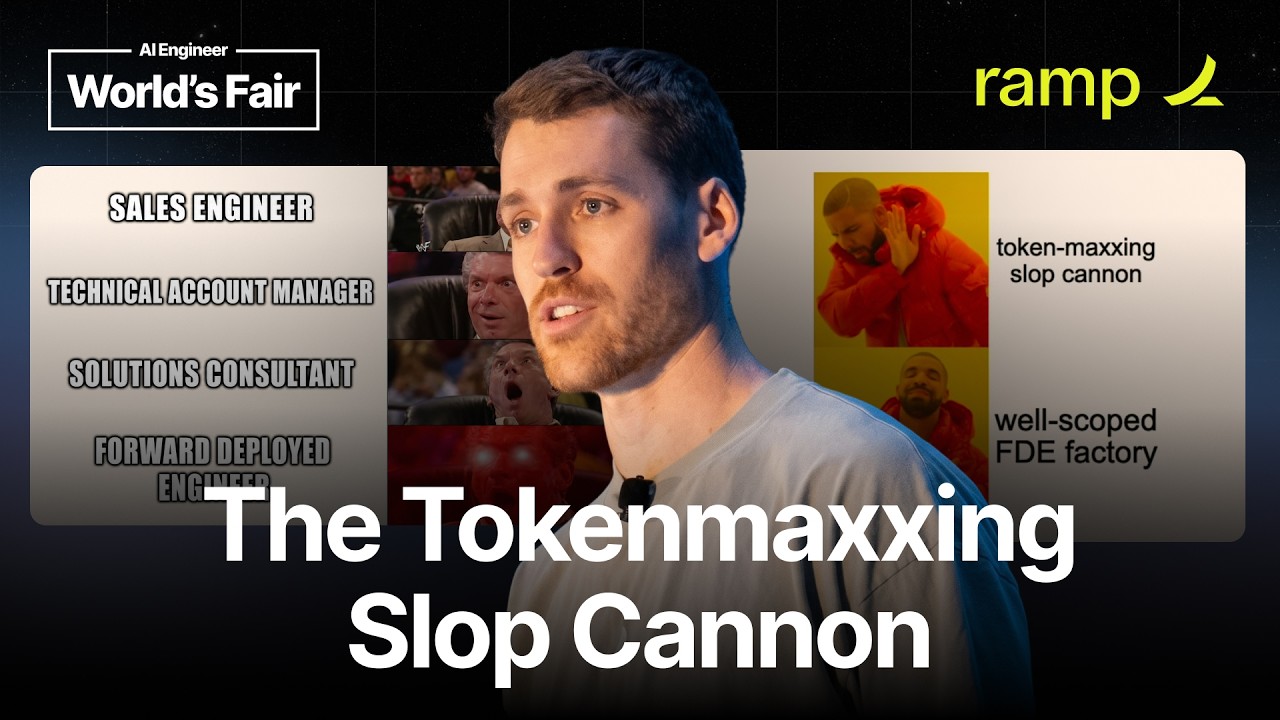
Leo Mehr, Director of Engineering at Ramp, introduces the Forward Deployed Engineering (FDE) function at Ramp, which operates within the engineering organization. Its primary goal is to help Ramp acquire and retain large enterprise customers by adapting core products and developing “agentic features” tailored to their complex needs. Mehr emphasizes that FDE at Ramp differs from a typical technical go-to-market role, focusing instead on deep technical engagement to solve customer-specific challenges.
Principle 1: Always Be Scoping
Mehr argues against the common misconception that an FDE’s job is simply to say “yes” to every customer request. Blindly acceding to demands without proper evaluation can lead to inefficient solutions, likened to “horses with like rockets strapped to their legs.” The true objective is to deliver high-quality, relevant software by building the right thing, which necessitates rigorous scoping.
The SAP S/4HANA Integration Example
Mehr illustrates this with a scenario: a sales rep urgently requests an SAP S/4HANA integration to close a strategic deal. A typical engineering reflex might be to immediately search for API documentation. However, a well-trained FDE would first pause and gather critical context:
- Urgency drivers: Is the urgency genuine customer need or an internal sales quota deadline?
- User impact: Who will actually use this integration?
- Alternatives: Have workarounds or manual processes been exhausted?
- Customer capabilities: Can the customer leverage Ramp’s APIs themselves, reducing the need for custom development?
- Broader applicability: Will this integration benefit other prospects or customers in the pipeline?
By asking these questions, FDEs can avoid building bespoke solutions that might not serve long-term customer needs or broader product strategy.
The Painful Mobile Reimbursement Feature Lesson
Another impactful anecdote involves a large enterprise customer needing a mobile reimbursement feature. Despite the mobile team being swamped, FDEs took the initiative to learn iOS and Android development to deliver the feature on both platforms. However, they later discovered the customer’s employees were mandated to use only iOS devices, rendering the Android development effort completely wasted. This experience underscored the critical importance of validating even the most basic assumptions through thorough upfront scoping.
Principle 2: Scale with Tokens
While mastering scoping is essential, Mehr contends that it’s no longer sufficient in today’s rapidly evolving tech landscape. Organizations must also “scale with tokens,” meaning leveraging AI models and agents to automate knowledge work and prevent falling behind “agent-native competitors.” This involves constantly reinventing workflows by identifying stages in the FDE pipeline that can be handled by AI agents.
Automating the FDE Pipeline: Request Intake Example
Ramp successfully applied this principle to automate the intake of FDE requests. Previously, account managers, solutions engineers, and sales reps would submit varied requests via an internal Slack channel, ranging from brief one-liners to detailed Notion documents. FDEs would then manually read, clarify, and scope these requests, often involving extensive back-and-forth.
The Agent’s Evolution
Ramp developed a Notion-based AI agent to streamline this process. Initially, the V1 agent simply took a request and asked a couple of clarifying questions. The impact was immediate: response latency dropped from hours or days to mere seconds, and account reps quickly began engaging with the agent directly. The latest iteration, featuring a “cute penguin” interface, conducts several rounds of back-and-forth questioning with the submitter until it gathers enough information to generate a comprehensive specification. This automation has saved approximately 20% of the time FDEs previously spent on scoping these requests.
Future Directions for Agent-Powered FDE
This intake automation is just the first step. Mehr envisions an “agent factory” where AI agents progressively handle more stages of the FDE pipeline, from spec generation to contributing to implementation. He acknowledges that while “Frontier models can one-shot medium-size features,” the “middle part” of translating a well-defined spec into a working product remains a complex,