The Silent Failure in Every Multi-Agent System (with Vijoy Pandey)
Vijoy Pande, SVP and GM of Cisco's incubation engine Outshift, argues that multi-agent AI systems fail silently because connected agents do not share meaning. He presents data showing cognitive failures in every multi-agent session analyzed, introduces the open-source SCOPE platform with ACCORD and CONCORD protocols for keeping agents aligned, describes a quantum network run on New York City fiber, and makes the case for hardware that computes on probabilities rather than bits.
Connection Is Not Cognition
Agents from different vendors, clouds, and organizations can now exchange perfectly valid messages, yet they routinely fail to agree on what those messages mean. The core problem is semantic: a “roll back” means a configuration revert to a site reliability engineer, but a full software version rollback to a software engineer agent. This is a grounding problem, and it is only one of several cognitive failures that emerge once agents start exchanging meaning rather than data.
The failures are silent. Standard observability stacks built on OpenTelemetry tell you whether agents are up, responsive, and reasoning normally, but they say nothing about whether two agents share intent. Dashboards stay green while multi-agent systems produce wrong outcomes.
What the Failure Data Shows
The team analyzed multi-agent sessions from its own production deployments across digital surveillance, network configuration, cloud platform engineering, and medical diagnostics, along with public traces from ChatDev sessions and MMLU probes. Every multi-agent session contained at least one cognitive failure. The failures compound:
- One failure: roughly 98% output accuracy
- Two failures: about 83%
- Three failures: about 16%, roughly the same as random selection
The systems become more consistent over time through these failures without becoming more correct. This is the central risk: a system can look stable while drifting steadily away from the outcome it was built for.
A Three-Layer Model of Alignment
The framework treats alignment as a sequence of steps that build on one another:
- Shared intent and grounding: agents discover unfamiliar terms, resolve terminology conflicts, and lock in what the goal actually is.
- Coordination and negotiation: agents, like human teams, each arrive with local optima and local incentives, and must compromise toward a global optimum.
- Verification: a semantic-level check confirms the goal was met, similar to a performance review at the end of a financial year.
This stack is what Outshift calls the Internet of Cognition. The historical analogy is deliberate: individual intelligence developed over hundreds of thousands of years, then language around 70,000 years ago produced a cognitive revolution that shifted humanity toward collective intelligence. Current agentic systems are at the individual-intelligence stage, now connected but not yet able to share reasoning and meaning.
Keeping Agents in Their Lane
The open-source observability and explainability platform, now named SCOPE (System for Cognitive Observability, Provenance & Explainability), functions like lane-assist in a car. It passively reads OpenTelemetry traces and looks for alignment drift, coordination drift, and verification drift. Normal traffic is left alone: agents keep using gRPC, MCP, or A2A as they already do. Only when drift appears does the system intervene.
Two protocols have shipped so far:
- ACCORD produces a locked, shared intent contract that all agents commit to before work begins.
- CONCORD is a consensus protocol that resolves decision conflicts and divergence during a live task.
The protocols can be deployed as a skill inside an agent, through a sidecar (Envoy or eBPF based), or through bindings to A2A, MCP, and SLIM. SCOPE works by default in any cloud-native stack that already emits OpenTelemetry traces. Even without acting on the results, SCOPE is useful as a measurement tool for characterizing cognitive failures in an existing system.
The interoperability layer is converging. A2A, MCP, and agntcy sit under the Linux Foundation and share a common stack for discovery, description (the AI Catalog work), identity and access control, and messaging through SLIM. What remains missing is the semantic layer. Networking infrastructure of the past forty years was built to connect data endpoints; the next layer must connect intelligence endpoints and exchange meaning.
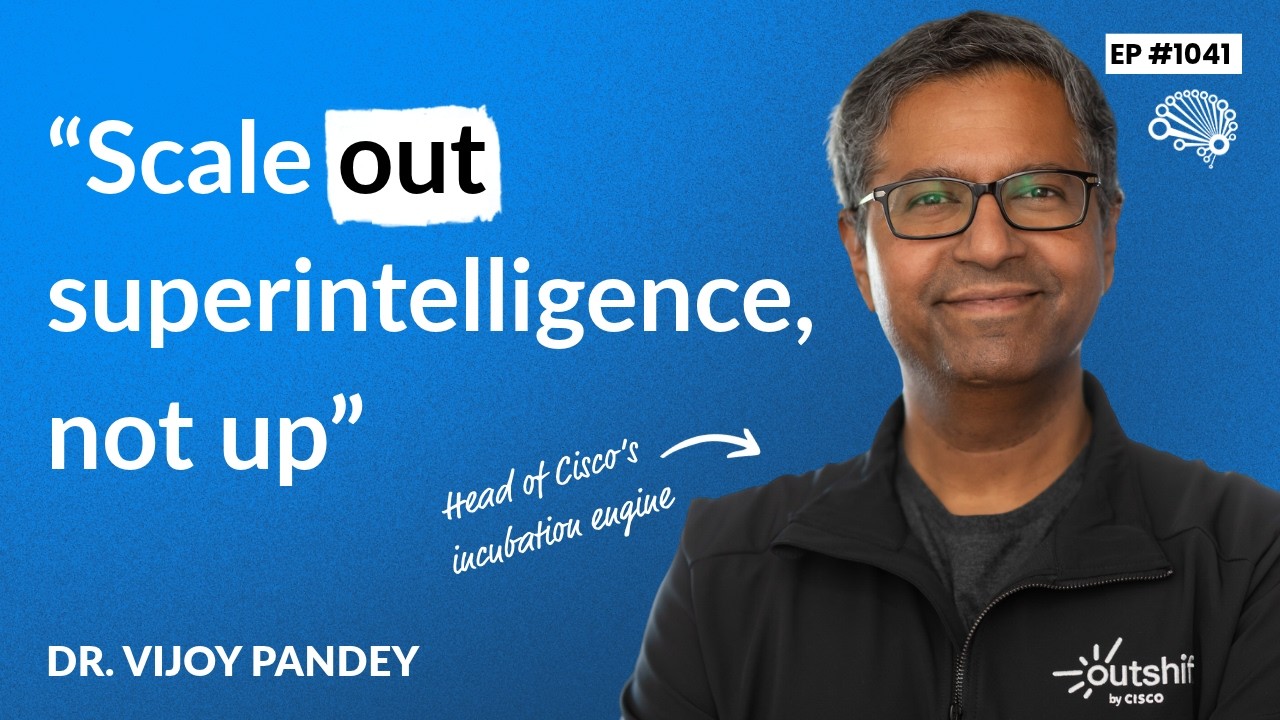
Scaling Out, Not Up
Cisco’s position is that computing scales along three axes: algorithmic improvement, vertical scaling (bigger models and bigger machines), and horizontal scaling. Other vendors pursue the first two. Cisco’s contribution is horizontal scaling, building secure, observable networks that distribute computation. The same thesis extends to quantum computing and to embodied robotics, where handoffs between physical agents will face the same semantic failures as software agents, with more dangerous consequences.
Quantum Networking on Real Fiber
In February, Cisco ran an experiment across 17.6 kilometers of New York City fiber, from Manhattan to Brooklyn and back, with partners QC and QTD and New York University. The route passed through 60 Hudson, one of the busiest carrier hotels in the world. The team demonstrated entanglement swapping at rates reported as 5,000 times better than comparable lab results.
The central architectural challenge is that quantum networks cannot use store-and-forward. A quantum state cannot be inspected or copied without destroying it, so routing decisions must be made without reading the qubit. Entangled photons must still travel physically over fiber at the speed of light, after which the state can be teleported between nodes. Once in the quantum domain, the network can treat distributed nodes as a single system. The goal is to connect hundreds of thousands-of-qubit-scale machines, roughly 100,000 to a million physical qubits, from current best-case systems of around a thousand, by linking many smaller quantum computers into one logical machine.
Probabilistic Software on Deterministic Hardware
The workload has moved from deterministic to probabilistic. Agentic systems take non-deterministic inputs and return answers with a confidence attached. The substrate underneath still performs binary matrix multiplication on GPUs. The workload is a dimmer switch; the hardware is an on-off switch, and every approximation costs energy, money, and space.
Quantum computing is one answer, tracing back to Feynman’s argument that nature is quantum and that problems like drug discovery, materials, weather, and logistics are search problems over vast state spaces. Other approaches are classical-physics based and operate on distributions rather than bits:
- Thermodynamic computing (Extropic): silicon that settles into low-energy states, with the outcome being the state where the system lands, often a local rather than global optimum.
- Oscillator-based computing (Unconventional AI): coupled oscillators that align to a pattern, with the pattern encoding the answer.
In each case the result is a local optimum that is good enough given the time and resources available. There is rarely a single best drug, only the best one for now.
Recommended Directions
The conceptual thread running through the conversation draws on Michael Tomasello’s work on the evolution of human intelligence, which many researchers now use to frame agent collaboration. The speaker has moved from books to arXiv papers as the primary reading source for frontier research.