GLM-5.2: The real security risk? Plus: Vibe hunting, the end of CVSS and updates on Lightwell
This podcast explores the implications of open-weight AI models like GLM-5.2 for cybersecurity, CISA's new four-variable vulnerability prioritization model, the rise of AI-assisted 'vibe hunting,' and the commercial launch of IBM and Red Hat's Lightwell for securing open-source software. It highlights the tension between AI capabilities for attackers and defenders, the challenges of rapid vulnerability remediation, and the need for new "trust infrastructures" in the AI era.
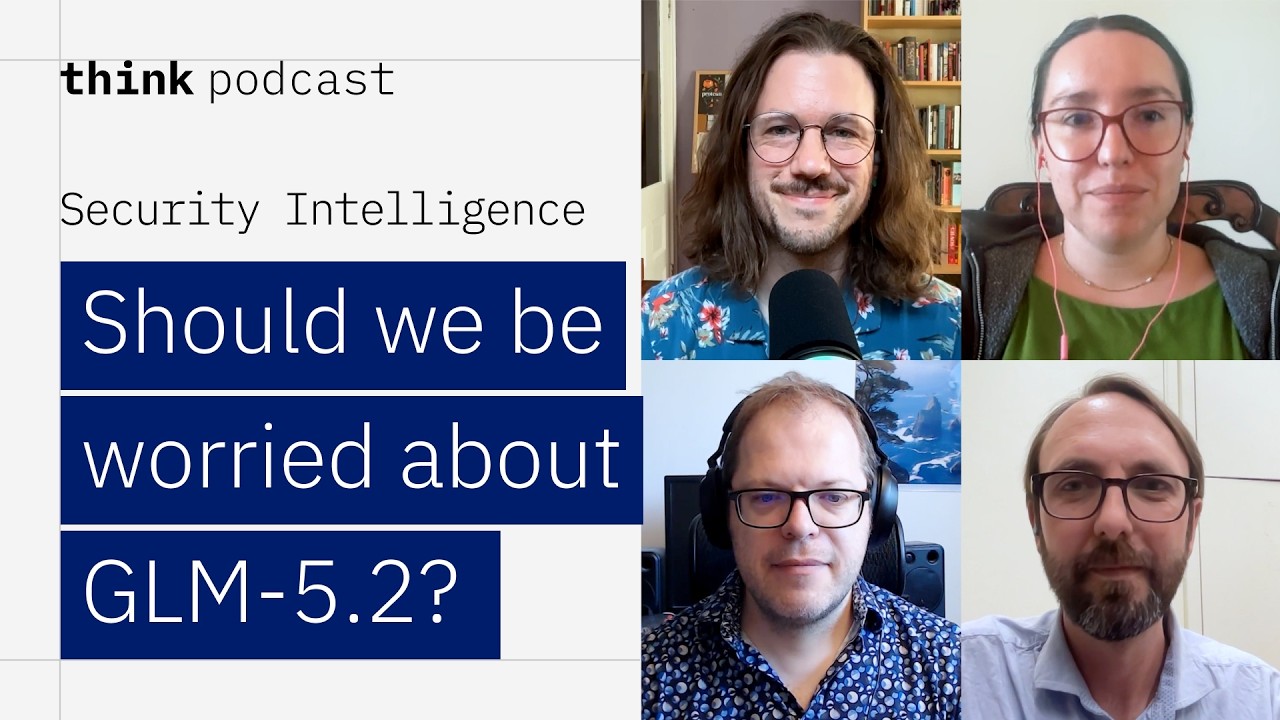
This episode of IBM’s “Security Intelligence” podcast delved into critical developments in cybersecurity, focusing on the interplay of artificial intelligence with vulnerability management and open-source software security. The discussion covered the rise of powerful open-weight AI models, CISA’s new approach to vulnerability prioritization, the concept of AI-assisted threat hunting, and the commercial launch of IBM and Red Hat’s Lightwell initiative.
Open-Weight AI Models and Their Cybersecurity Impact
The panel first addressed the emergence of open-weight AI models, such as Z.ai’s GLM-5.2, which are reportedly achieving “Mythos level capabilities” in vulnerability discovery. This phenomenon, highlighted by Joshua Sacks’ article “GLM 5.2 not mythos is the real security emergency,” presents a significant challenge: while proprietary frontier models are heavily safeguarded, attackers gain access to unlocked open models, creating a dangerous imbalance. As Sacks puts it, “The problem isn’t to put the AI genie back in the bottle, it’s to make the genie ubiquitous across defender networks, hardening our positions before the cyber attack world has its own clawed code automation moment.”
Dustin “Evil Mog” Haywood noted that while GLM-5.2 initially requires substantial compute (e.g., 8 H100s), quantization techniques allow it to run on smaller systems. The real threat, he argued, comes from “obliterated models and the extracted models with the modified weights that make this deadly because if you disable its refusal techniques, then it’s going to be more evil.” Ian Malloy added that even smaller, creatively prompted models can find vulnerabilities, and the growing ability to distill offensive capabilities into compact, easily deployable models (like Qwen or Qwethos) is a major concern. Claire Nunez characterized this as an “AI space race,” where if a capability is possible, someone will eventually replicate it. Mog further emphasized the inevitability, stating, “They’ve already got it… there is no putting this genie back in that bottle,” and that restrictions on proprietary models might inadvertently push legitimate defenders towards open-weight alternatives. The panel concluded that defenders must “use AI to combat AI” as the industry is “on this ride whether we like it or not.”
CISA’s New Model for Vulnerability Prioritization
CISA’s BOD 26-04 directive for federal agencies was discussed, introducing a new four-variable model for prioritizing vulnerabilities, signaling a potential shift away from the traditional CVSS scoring system. The four variables are:
- Public Exposure: Is the vulnerability reachable from outside the agency network?
- Active Exploitation: Is the vulnerability being exploited in the real world?
- Automated Exploitation: Can the exploitation be automated?
- Total Control: Does exploitation grant total control of the affected system?
Based on these variables, remediation timelines can range from a critical three-day window to waiting until a system upgrade for less severe cases. Claire Nunez suggested this simplified model could improve communication of risk to executives and potentially accelerate patching if widely adopted. However, Mog expressed skepticism, citing the historical issues with CVSS, including its misuse and lack of timely updates, which has rendered the entire CVE ecosystem “a mess.” He doubted whether a new model would succeed without addressing fundamental problems in data enrichment and continuous updates. Ian Malloy worried that distilling prioritization to merely “four bits” might be too coarse-grained, potentially overlooking aggregated risks from chained low-to-medium severity vulnerabilities or the rapid pace of weaponization.
A significant concern raised was that the new model, while attempting to refine prioritization, fails to address the underlying “resource allocation problem” within organizations. Mog challenged the practicality of autonomous AI patching, and panelists highlighted the immense difficulty of achieving a three-day turnaround for both patching and comprehensive forensics for critical vulnerabilities.
The Emergence of “Vibe Hunting”
The podcast explored “vibe hunting,” an AI-assisted approach to threat hunting, drawing parallels to “vibe coding.” This involves humans outlining a plan, which AI then executes. Ian Malloy viewed vibe hunting as potentially “very, very useful” for accelerating threat hunting processes and enabling deeper investigations that humans might lack time for. He cautioned, however, that a “false sense of security” could arise if AI agents are not sufficiently capable or miss subtle signals, also noting the high cost.
Mog framed vibe hunting as an “advanced assistant” rather than a fully autonomous solution. He explained how an LLM could help gather information, combine data points, and test hypotheses, significantly streamlining triage and enrichment. This allows human analysts to dynamically shape their hunts and focus on higher-level analysis instead of repetitive manual tasks. Claire Nunez expressed reservations about the proliferation of “vibe everything,” emphasizing that while AI can automate, the core skills of a human threat hunter—detail orientation, knowing what to query, and identifying potential misses—remain indispensable. She concluded that vibe hunting is most effective when used by experienced hunters to automate specific tasks, rather than replacing human expertise entirely. The discussion also touched on whether reliance on AI leads to skill atrophy or, if applied intelligently, can actually enhance human capabilities, drawing an analogy to how typing replaced cursive, losing one skill while gaining another.
Lightwell’s Commercial Launch: Securing Open-Source Software
Brent Holden from Red Hat provided an update on the commercial launch of Lightwell Network and Lightwell Clearing House Premiere, evolving from Project Lightwell. He used an industrial analogy: the Lightwell Network serves as a “warehouse” for validated and remediated open-source libraries (e.g., Java, Python). “Validated libraries” are aligned with upstream communities, while “remediated libraries” are patched versions of older, commonly used components.
The Lightwell engine, currently under rapid development, functions as the “assembly line.” It automates (99% with AI assistance) the process of taking raw library reports and producing secure artifacts for the Network. This initiative is central to building a “trust infrastructure” for open-source software in the AI era. Holden detailed the complexity of this, including managing vulnerability reporting, disclosure, and embargo through a “clean room” operation that validates and anonymizes vulnerabilities.
A significant challenge lies in integrating with various “clearinghouse efforts” (e.g., Accuritas, European Central Bank, US government), necessitating clear rules of interaction, engagement, and jurisdiction. Holden highlighted the increasing pressure on customers to quickly patch and remediate vulnerabilities, with timelines compressing from six months to often just 72 hours. He stressed the importance of robust policies for library versions, rapid patch deployment, and managing legacy applications, positioning Lightwell as a crucial partner in navigating these complex, accelerating security demands. This aligns with earlier discussions in the podcast regarding accelerating patch timelines and the role of AI in vulnerability management. The overall message underscores the urgent need for new approaches to secure the pervasive open-source components that underpin modern IT infrastructure.