Patrick Collison: "What If You Succeed?"
Patrick Collison, co-founder of Stripe, discusses the enduring value of human cognitive abilities in the age of AI, shares his unique perspective on dropping out of college, and explains Stripe's unconventional launch strategy. He critically examines the "lean startup" methodology in an AI-driven world and highlights how Stripe's data indicates an unprecedented boom in new businesses, faster growth, and a decentralized, prosperous future, challenging common fears about AI's centralizing impact.
The Evolving Landscape of Learning and Entrepreneurship in the AI Era
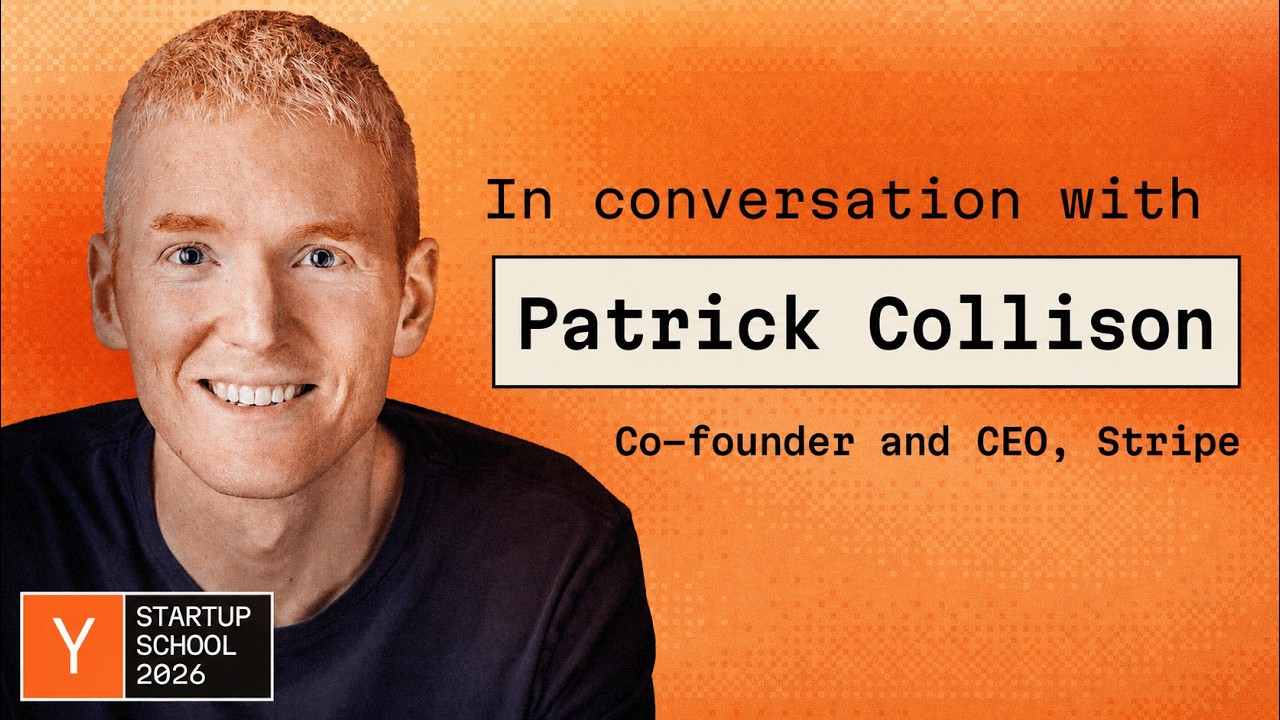
Patrick Collison, in conversation with Harj Taggar at Startup School 2026, shares profound insights into the foundational skills necessary in an AI-dominated world, the strategic decisions behind Stripe’s genesis and growth, and the surprising trends revealed by Stripe’s vast dataset regarding the current startup ecosystem.
The Enduring Value of Human Cognition
Collison addresses the contemporary debate on whether to outsource complex tasks to AI or to master them oneself. Drawing an analogy to Jeff Dean’s “numbers every programmer should know” and the concept of CPU cache levels (L1, RAM, network), he posits that “neuronal lookups will be much faster” than relying on AI agents for information retrieval or computation. While AI models demonstrate monumental feats, their output, especially in creative or nuanced domains like writing, often lacks the interpersonal quality and “sensible reasoning in the multi-dimensional space of reality” that humans possess. He personally eschews AI-generated text, highlighting that companies still place an “enormous premium on cognitive ability.”
Reassessing the College Dropout Decision
Reflecting on his unique experience of dropping out of MIT twice (once for a company with Taggar, and later for Stripe), Collison advises current students. He stresses that dropping out isn’t a “trapdoor” and one can always return. While he felt an “unnecessary” urgency due to a “general kind of haste” and a fear of “ephemeral and fleeting” opportunities in Silicon Valley, he now believes this was “poor intuition” as Silicon Valley consistently offers a “surfeit of opportunities.” For those who don’t enjoy college, he notes that the “costs of doing so are de minimis,” as “nobody has ever cared” about a dropout status. He also dismisses the “millinarian” fear that students must start a company now or be “trapped in the permanent underclass,” comparing it to historical overreactions to technologies like aviation.
Stripe’s Contrarian Path: From “Squirrels in a Trench Coat” to Industry Leader
The genesis of Stripe, conceived during a walk after Startup School in 2009, stemmed from a simple observation: “nobody liked the existing ways” of online payments. Despite the obvious market need, starting a financial services business as “two kids” felt audacious in an era before “fintech” was even a term. They were often met with skepticism, feeling like “proverbial squirrels in a trench coat.” However, the concrete user problem—the visceral pain of managing online payments—was their “saving grace.”
Stripe’s development notably diverged from the “launch early, launch quickly” mantra, taking two years from initial code to public launch. This extended pre-launch phase was essential due to the high stakes of security, partner integration, and infrastructure reliability inherent in financial services. Crucially, they mitigated the delay by onboarding “production users almost from the very beginning,” starting with Ross Buché in January 2010. This allowed for “just in time development,” where features like dashboards, refunds, and payouts were built in direct response to user needs, providing a constant “stream of grounding” in reality.
The Evolving “Lean Startup” Playbook in the AI Era
Collison questions the continued universality of the “lean startup” doctrine. In the age of AI, the traditional approach of finding small niches and iteratively expanding might be “much more competitive.” He suggests a shift towards “more aggressively decorrelate,” pursuing “really divergent starting points where nobody else is trying to occupy that territory.” He points out that many highly successful companies of the last decade, including prominent AI labs, adopted “anti-lean startup” strategies, embracing “much more aggressive and ambitious things up front,” a feasibility now amplified by AI’s ability to spin up complex organizations more easily.
The Unforeseen Rewards: Beyond “Schlep Blindness”
While every venture involves “schleps”—unrewarding tasks like payroll setup—Collison reflects on Stripe’s deeper intellectual rewards. He urges founders to consider not just “what if you fail,” but “what if you succeed?” Will the long-term work remain engaging? For him, Stripe has been “the opposite of the blindness instinct.” The company offers a unique vantage point, partnering with “the world’s most interesting and innovative companies,” from nascent startups incorporated via Stripe Atlas (25% of Delaware corporations) to giants like Shopify and OpenAI. Each business presents an “applied theory” or a “contrarian thesis,” making the experience intellectually stimulating.
A Decentralized, Prosperous Future Driven by AI and Startups
Collison addresses the widespread concern that AI will foster a “hegemonic, centralizing, totalizing force.” While acknowledging the capabilities of major AI labs, he draws parallels to historical fears about large tech companies like Google, which despite immense resources, couldn’t “do all the things.”
Crucially, Stripe’s internal data paints a highly optimistic picture:
- Boom in Startups: “Many more businesses getting started now than a year ago,” with a nearly “2x year-over-year” increase in new businesses on Stripe, the largest relative jump observed.
- Improved Success Rates: The “median business is doing better this year than a year ago.” The probability of reaching significant revenue thresholds ($1M, $5M, $10M) is “getting better,” and the “time to revenue for new companies incorporated with Atlas is declining.”
- Startup Advantage: Businesses are now “more springloaded to adapt” due to a “terror of being left behind.” The “risk of the status quo is actually extremely high,” making enterprises more willing to adopt solutions from new startups. Consumers also show a “predisposition and an openness to experimenting with the new.”
Based on these trends, Collison foresees “many thousands of winners” in the AI economy, leading towards “a more decentralized world and one with more broad-based prosperity,” countering fears of centralization. He concludes by stating that “it seems to be a better time than ever to start a business.”