Morgan Stanley's ALPHALAB: Multi-Agent Research Across Optimization Domains — Brendan Rappazzo
Morgan Stanley's AlphaLab is an open-sourced multi-agent system designed to automate quantitative research. Initially, AlphaLab 1.0 automated code generation, backtesting, and experimentation. Facing challenges, AlphaLab 2.0 evolves to prioritize building robust, verifiable environments, which serve as reinforcement learning signals, enabling the system to meta-optimize itself. This shift redefines the human role from performing research to designing these critical environments.
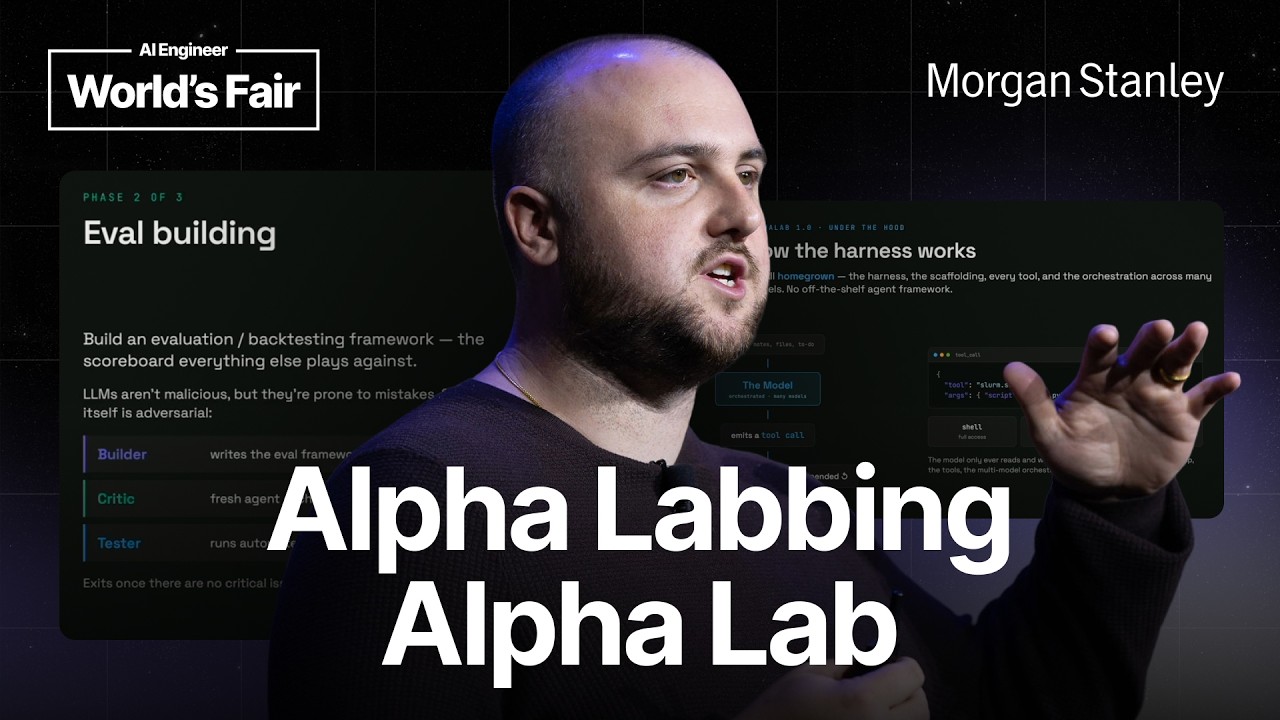
Morgan Stanley’s 30-person AI research group recognized a significant opportunity to automate quantitative research, driven by the need to optimize existing algorithms, transfer models across domains, and introduce machine learning to new trading desks. The catalyst was the emergence of advanced coding agents like Opus 4.5 in late 2025, which made long-horizon tasks feasible.
AlphaLab 1.0: Design and Workflow
AlphaLab 1.0, released with a 40-page tech report and open-sourced code, was built to maximize P&L and deployable algorithms. Its design focused on seamless integration with existing infrastructure, full-spectrum operation (from new datasets to refining existing models), model agnosticism, future-proofing, and encoding Morgan Stanley’s enterprise knowledge.
AlphaLab functions as an agentic harness with three main phases:
- Research Phase: The system builds context by generating a “to-do list” (e.g., Python environment setup, data loading, statistical testing) and taking notes in Markdown. It leverages web search (arXiv, technical blogs) to gather state-of-the-art information, typically taking 3-4 hours.
- Eval Building Phase: To ensure robust evaluation, AlphaLab uses a multi-agent framework. A “builder” agent writes evaluation code, which is then scrutinized by two “critic” agents—one for high-level conceptual errors and information leakage, and another for programmatic checks (unit/integration tests). This loop continues until all agents deem the evaluation sound.
- Mass Experimentation Phase: Structured like a Jira board, this phase is the core of the harness. A “strategist” agent, informed by all prior context, proposes experiments. These proposals are implemented by “worker” agents, who write code, configure and submit Slurm jobs to the GPU cluster, monitor progress, analyze training curves and evaluation results, and provide post-mortem analyses back to the strategist. This feedback loop allows the strategist to learn and adapt its experimental strategy. Users can steer the process by canceling/adding cards or chatting with the strategist. A continuously updated leaderboard displays best-performing models.
Morgan Stanley opted for a custom-built harness, largely coded by Claude, to ensure maximum flexibility and provider agnosticism. Key tools include full shell access for code execution, web search for public knowledge, and abstract Slurm integration for GPU cluster management.
Initial Results of AlphaLab 1.0
AlphaLab 1.0 demonstrated promising capabilities:
- Academic Benchmarks: It found better training configurations for LLMs than a single-agent Karpathy-style approach on academic datasets (e.g., CUDA kernels, traffic time series).
- Kaggle Competition: Achieved a top 12% ranking in an Nvidia competition for fine-tuning NeMo Tron, despite limited iterations.
- Internal Impact: For existing internal models, AlphaLab identified “meaningful improvements” now moving into production.
AlphaLab 2.0: Challenges and Vision
Despite successes, AlphaLab 1.0 faced failures, prompting questions about the robustness of its achievements and the arbitrariness of its design choices. The team realized that meta-optimization—where an LLM improves the harness itself—and encoding Morgan Stanley’s expertise were essential.
The solution for AlphaLab 2.0 centers on robust, verifiable evaluations and environments:
- Good Evals are Paramount: Adopting a strict, Kaggle-like format, AlphaLab 2.0 takes data and descriptions as inputs, produces containerized models, and provides feedback via public and private leaderboards.
- Environments as RL Signals: By building 10-20