🔬Max Welling: Materials Underlie Everything
Max Welling connects the dots between quantum gravity, equivariant neural networks, and diffusion models, explaining how these concepts from theoretical physics are now powering a new generation of AI for materials discovery to tackle climate change. He introduces the concept of a "Physics Processing Unit" and details the architecture of his startup, CuspAI.
The intellectual thread connecting seemingly disparate fields is often physics. My career has evolved from pure, curiosity-driven research in areas like two-dimensional quantum gravity to a focus on making a tangible, positive impact, particularly in addressing climate change. This has led to the founding of CuspAI, a venture that combines deep scientific problems in material science with the goal of creating real-world solutions.
The Vision: A Physics Processing Unit (PPU)
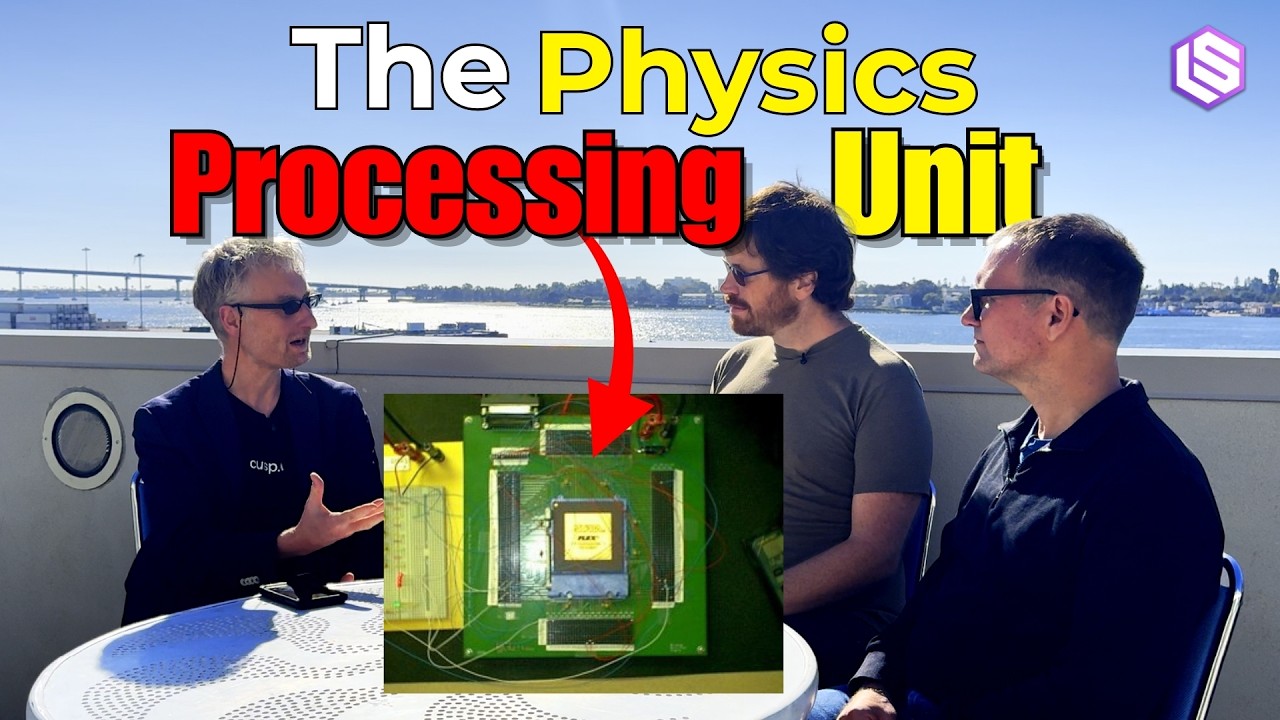
A core vision is to reframe how we view experimentation. We can think of nature itself as a form of computation. I call this a “Physics Processing Unit” (PPU), a counterpart to the digital processing units (DPUs) in a data center.
- Nature as a Computer: A physical experiment is a computation. In fact, it’s the “fastest computer known possible.”
- Integrated Workflow: The goal is to create a seamless system where computations in a data center and “computations” performed by nature in a lab work together. An AI model can propose a new material, and the PPU (the lab) can run the computation (the experiment) to validate it.
- Empowering Scientists: This vision is not about replacing chemists or material scientists with a “superintelligence.” It’s about automating the discovery process and providing an incredibly powerful tool—akin to a search engine for all possible materials—to accelerate their work.
The Unifying Role of Physics in AI
Physics provides the deep mathematical tools and concepts that can be applied to build better machine learning algorithms.
- Symmetry and Equivariance: My work with Taco Cohen and others on equivariant neural networks was directly inspired by the fundamental role of symmetries in particle physics and general relativity. By building symmetries like rotation and permutation into the architecture of a neural network, the model requires far less data to generalize. If you train it on an object in one orientation, it understands it in all orientations. This is a powerful inductive bias.
- Diffusion Models and Stochastic Thermodynamics: There is a deep mathematical identity between the frameworks used for diffusion models in generative AI and the field of stochastic thermodynamics, which describes out-of-equilibrium physical systems. This connection, which is the subject of my upcoming book, Generative AI and Stochastic Thermodynamics, allows for a cross-fertilization of ideas. We can take theorems from physics to build better AI algorithms, and we can use our AI models to help physicists do better science.
AI for Science: An Exploding Field
The discipline of “AI for Science” is currently exploding, moving from an emerging field to one attracting billions in investment. This is driven by two key factors:
- Major Successes: Breakthroughs like AlphaFold for protein folding and the success of machine learning inter-atomic potentials (force fields) have demonstrated the power of applying modern AI tools to scientific problems.
- A Moment of Opportunity: We are at a “cusp” where the tools are mature enough to move the needle on critical scientific challenges. This has created a “green field” opportunity, attracting talent and capital looking to make an impact beyond traditional tech applications like advertising.
The Primacy of Materials
While the software layer, like Large Language Models (LLMs), gets much of the attention, the physical layer is where the most fundamental bottlenecks and opportunities lie.
“Underlying almost everything is a material.”
Even an LLM relies on a GPU, which is fundamentally a materials problem. Manufacturing a cutting-edge GPU involves depositing novel materials onto a silicon wafer. Progress is now gated by material innovation. Likewise, solving the energy transition depends entirely on discovering new materials for batteries, more efficient solar panels (e.g., perovskites), and fuel cells. The goal is to transform material discovery from a slow, hypothesis-driven process into a fully automated search problem across the vast space of possible molecules.
CuspAI: An AI-Powered Materials Platform
CuspAI was founded with the mission to develop technology for carbon capture, a critical and unsolved problem for mitigating the worst effects of climate change. We have built a platform to accelerate the discovery of new materials for this and other challenges.
The architecture consists of several key components:
- Generative Models: To generate novel candidate molecules and materials.
- Digital Twin: A multi-scale, multi-fidelity simulation pipeline. It allows us to rapidly screen millions of candidates, starting with cheap, low-fidelity tests to weed out non-starters before moving to more computationally expensive and accurate simulations like DFT (Density Functional Theory) for the most promising ones.
- Agentic Systems: We are increasingly using AI agents to automate and orchestrate the discovery workflow. This includes agents that search chemical literature for insights, manage the complex chain of computations, and eventually will help drive automated “self-driving” labs.
Our strategy is to build this platform by starting with humans in the loop. We first build tools that empower our chemists, who then manually execute a workflow. As we understand the process, we gradually automate it, piece by piece. The vision is not a “dark lab” with no human oversight, but an increasingly powerful tool in the hands of domain experts.