Sustainable Augmented Development • Kent Beck • YOW! 2025
Kent Beck's presentation at YOW! Australia 2025 explores the transformative impact of augmented development ('the genie') on software engineering. He argues that AI shifts programming into an exploratory phase, requiring a re-evaluation of traditional practices. Beck introduces the concept of 'resting between the notes' to foster optionality over mere feature churn, and makes a compelling case for the increased value of junior developers as AI tools become powerful learning aids, emphasizing that 'nobody knows' the future but we must 'take our time' to adapt effectively.
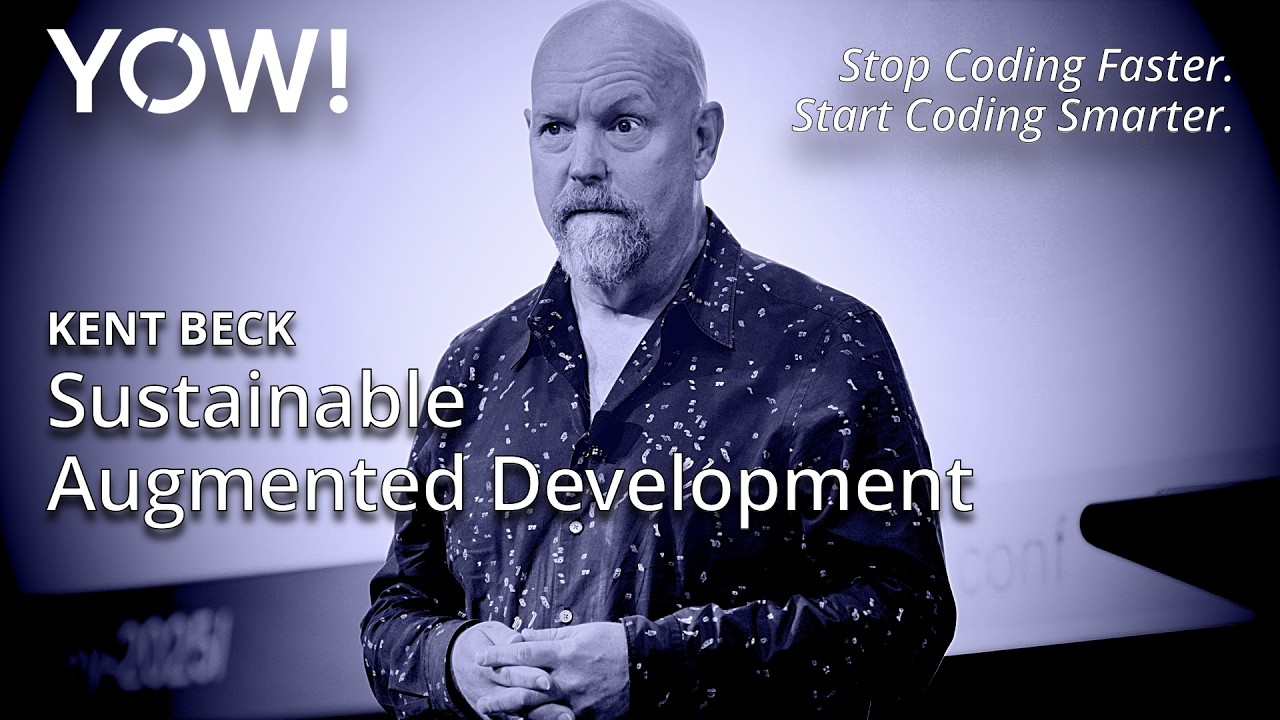
Kent Beck addresses the profound changes augmented development, or “the genie,” brings to software engineering, emphasizing that “nobody knows” the definitive answers yet. He frames this uncertainty as an opportunity for exploration rather than fear.
The Shifting Landscape of Programming
Beck notes that programming has fundamentally remained in an “extract” phase (well-understood, predictable workflows) since Smalltalk-80. The advent of AI has abruptly thrust all programmers into an “exploration” phase, a new territory where old certainties are obsolete. This shift naturally causes anxiety, but he argues it is a necessary adaptation, akin to the transition from assembly language to C, which devalued some skills while elevating others.
The Cello Story: Resting Between the Notes
Drawing a parallel to the apocryphal story of cellist Pablo Casals, who claimed to “rest between the notes” while playing complex passages, Beck advocates for intentional pauses in development. Just as Casals didn’t play a continuous stream, programmers shouldn’t merely churn out features without reflection. This metaphor underpins the core message: “take your time” because it’s your most valuable asset.
The 3X Model and the Genie
Beck’s 3X model describes three phases of development: Explore, Expand, and Extract. He explains how the “genie” interacts with each:
- Exploration: The genie is a powerful assistant here. It dramatically shortens the gap between an idea and a working prototype, enabling rapid experimentation and variable reinforcement, which Beck admits is “addictive.”
- Expansion & Extraction: The genie’s utility diminishes and can even be detrimental in these phases. It prioritizes quick results (what Beck calls the “finger guns” moment) over long-term stability, clean code, or deep understanding, leading to subtle, expensive mistakes and a lack of context. It’s not designed to “clean the kitchen as it cooks.”
Feature Drag vs. Optionality
Beck illustrates the common problem of “feature drag,” where continuously adding features without improving the underlying structure leads to diminishing returns and eventual stagnation (“going solid” – losing all control). This happens because each new feature reduces “optionality” – the ease and cost-effectiveness of making future changes. When options run out, teams are stuck in a “feature saw,” constantly battling maintenance with minimal progress.
The Proposed Alternative: Instead of a continuous feature push, Beck suggests an “upward trajectory.” After implementing a feature, developers should consciously pause to reflect and increase optionality. This involves asking: “Was there a structure that would have made that feature easier?” or “What should the structure be so the next feature is easier?” This might involve improving tests, tooling, or design. This intentional investment creates a system where subsequent features become easier to implement, leading to sustainable growth.
The Junior Developer Opportunity
Contrary to the fear that AI makes junior developers obsolete, Beck argues they are more valuable than ever. He believes treating development as a “learning process” rather than a pure “production process” (measured by Jira tickets) allows juniors, aided by the genie, to learn much faster. The genie can act as an “endlessly patient, endlessly creative, usually right tutor.” By investing in their learning and fostering a culture of curiosity, companies can see a quicker return on investment from juniors, retain them longer, and build a stronger, more adaptive engineering organization. Seniors have a moral and ethical obligation, as well as a business incentive, to teach and mentor.
Actionable Advice for Professionals
- Accept Uncertainty: Recognize that the old certainties are gone. Embrace the feelings of anxiety and accept that everyone is now an explorer.
- Experiment: Engage with AI tools at your own pace. Find “cheap experiments” to discover their capabilities and limitations.
- Leverage “10%” Skills: Focus on high-leverage skills that AI doesn’t easily replicate: picking the right projects, setting clear milestones, maintaining awareness of the genie’s decisions, and cultivating deep curiosity. The ability to ask “I wonder how that works?” becomes paramount.
- Value Stream Mapping: Don’t just generate more code. Understand the entire value chain of software delivery. Identify bottlenecks and improve the flow to ensure that increased coding speed translates into increased value delivered.
- Teach and Mentor: Actively teach juniors. Encourage them to learn deeply, asking “why” something was done, rather than merely completing tasks. Foster “geek joy” in discovery and understanding.