Jensen Huang – Will Nvidia’s moat persist?
Nvidia CEO Jensen Huang discusses the company's core strategy, which he defines as transforming electrons into tokens by orchestrating a vast supply chain. He details how Nvidia's true moat lies in its ecosystem and its ability to manage supply bottlenecks. Huang contrasts Nvidia's versatile 'accelerated computing' platform with competitors like TPUs, arguing programmability via CUDA is key to AI innovation. He also presents a strong case against broad AI chip export controls on China, warning it could backfire by forcing the creation of a competing tech stack. Finally, he explains why Nvidia invests in the ecosystem rather than becoming a hyperscaler itself.
Nvidia’s Core Philosophy: From Electrons to Tokens
Jensen Huang frames Nvidia’s mission as transforming electrons into valuable tokens, guided by the principle of doing “as much as necessary and as little as possible.” This means focusing on the uniquely difficult challenges of building the accelerated computing platform, which he believes no other company would undertake, while partnering with a vast ecosystem for everything else. This ecosystem spans the entire supply chain, from upstream component makers to downstream computer companies, application developers, and AI model creators.
Supply Chain Strategy and Nvidia’s Moat
Nvidia’s competitive advantage, or “moat,” is not merely its chip designs but its deep integration and orchestration of the entire supply chain. This is built on:
- Massive Commitments: Nvidia has billions in explicit purchase commitments for foundry services, memory, and packaging. More importantly, it has implicit commitments where supply chain CEOs invest in capacity based on the confidence Jensen instills through his vision and forecasts.
- Ecosystem Alignment: Nvidia’s ability to command this upstream investment stems from its massive downstream demand. Events like GTC are strategically used to bring the entire ecosystem together, allowing upstream suppliers to see the downstream demand firsthand and align their roadmaps. This creates a powerful “supply chain flow.”
- Proactive Bottleneck Management: Huang views supply chain bottlenecks like CoWoS packaging or EUV machine availability as 2-3 year problems that can be solved with a clear demand signal. For instance, the CoWoS shortage was addressed by swarming it with attention and investment, turning it from a specialty component into a mainstream technology. Nvidia now proactively invests in and invents technologies (e.g., in silicon photonics with TSMC) to pre-empt future bottlenecks. The most challenging bottlenecks, he argues, are downstream issues like energy policy and a shortage of skilled labor.
Competition: Accelerated Computing vs. Specialized ASICs (TPUs)
Huang draws a sharp distinction between Nvidia’s versatile “accelerated computing” platform and specialized ASICs like Google’s TPUs.
- Programmability and Innovation: While TPUs are optimized for matrix multiplication, Huang argues that AI’s rapid advancement comes from algorithmic innovation, which requires a programmable platform like CUDA. Creating new architectures like Mixture-of-Experts (MoE) or fusing different model types is only possible on a flexible system. This is how Nvidia achieves order-of-magnitude performance gains between generations (e.g., 50x from Hopper to Blackwell), which far outpaces Moore’s Law.
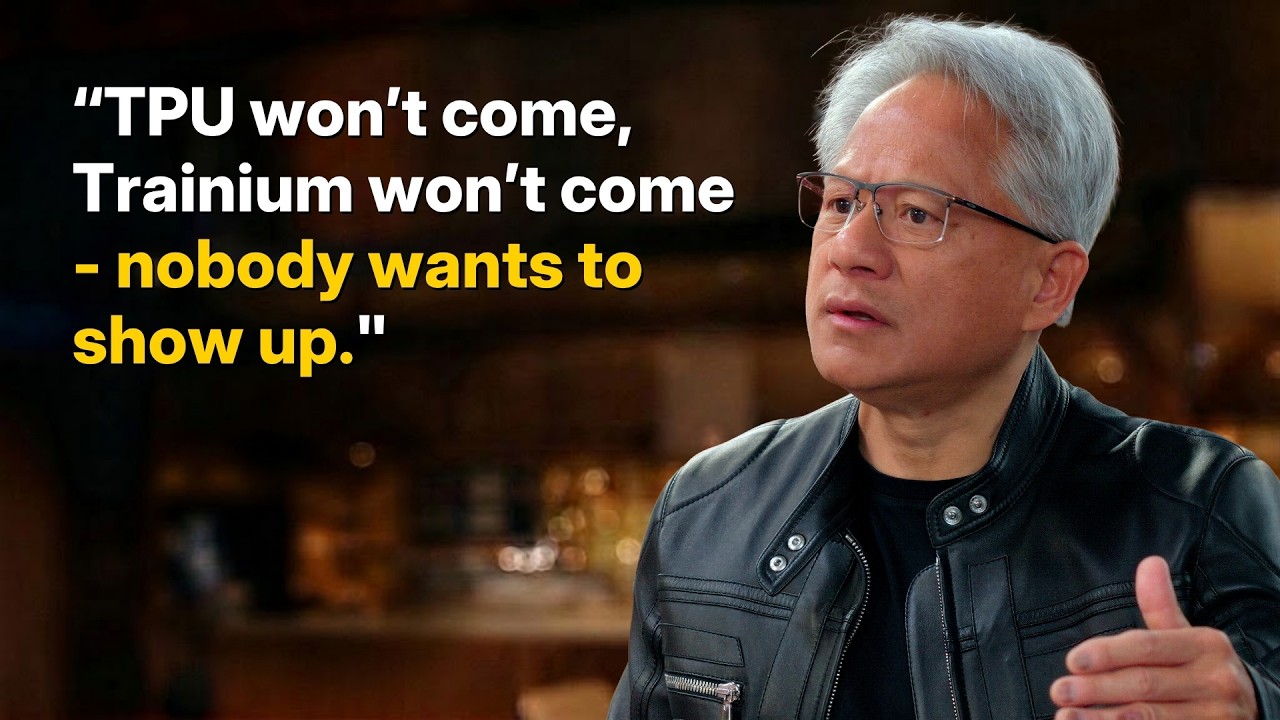
- Total Cost of Ownership (TCO): Huang asserts that Nvidia offers the best performance per TCO and per watt, bar none. He challenges competitors like TPU and AWS Trainium to publish their results on open benchmarks like MLPerf, stating they don’t because they cannot compete on cost-effectiveness. The high performance-per-watt is especially crucial as data centers are often power-constrained.
- The Power of the Ecosystem: The CUDA ecosystem is Nvidia’s “great treasure.” Its key advantages are:
- Richness: A vast array of libraries, frameworks (Triton, vLLM, etc.), and tools built on a well-tested, reliable foundation.
- Install Base: Hundreds of millions of GPUs in every cloud and on-premise, ensuring software written on CUDA can run almost anywhere.
- Versatility: The ability to run workloads across every cloud provider and in private data centers gives developers maximum flexibility.
- The Anthropic Anomaly: Huang characterizes Anthropic’s heavy reliance on TPUs and Trainium as a unique case, not a trend. He explains it was the result of early, multi-billion dollar investments from Google and AWS, which Nvidia was not in a position to make at the time. He considers it a “miss” not to have realized the necessity of such direct investment and states he won’t make that mistake again.
On Selling AI Chips to China
Huang argues strongly against overly restrictive export controls, framing it as a strategic misstep for the United States. His reasoning is multi-faceted:
- China’s Inherent Capabilities: China already possesses the key ingredients for advanced AI: abundant energy, massive domestic manufacturing for mainstream chips, and a huge pool of AI talent (50% of the world’s AI researchers). They can compensate for less advanced process nodes (e.g., 7nm) by deploying more chips in parallel, enabled by their vast energy and infrastructure.
- The Risk of a Bifurcated Ecosystem: The greatest danger, in his view, is forcing China to develop its own independent AI ecosystem. If their widely-used open-source models become optimized for a non-American tech stack (e.g., Huawei’s), the US risks losing its global technology leadership. The goal should be to ensure the world, including China, develops on the American tech stack (i.e., CUDA).
- Winning Through Competition, Not Concession: He believes that conceding the world’s second-largest market is a “loser mindset” that will harm American technology leadership in the long run. The US should compete to win that market. He argues that the performance leaps in AI come more from computer science and architecture than from lithography alone, meaning the US can stay ahead through innovation while still competing globally.
- Dialogue Over Isolation: Rather than trying to block capabilities that China can develop on its own, he advocates for dialogue between researchers and nations to establish norms around the use of AI.
Nvidia’s Strategy and Future
- Investment, Not Integration: Nvidia will not become a hyperscaler itself. Following its core philosophy, it supports the ecosystem by investing in “neoclouds” (e.g., CoreWeave) and foundation model companies (e.g., OpenAI, Anthropic) to ensure they thrive. The strategy is to support everyone and not pick winners.
- Allocation and Pricing: GPU allocation is primarily based on a first-in, first-out queue determined by purchase orders, not a highest-bidder auction. This practice is central to being a stable and dependable “foundation of the industry.”
- Architectural Focus: Nvidia has no plans to build chips on older nodes or pursue radically different architectures like wafer-scale, as simulations show their current path is superior. They will only add accelerators for new market segments, such as their recent integration of Groq to serve the emerging market for high-value, low-latency tokens.
- Beyond AI: Even without the deep learning revolution, Huang states Nvidia would be a very large and important company. Its mission has always been to advance science and industry through accelerated computing, a need that exists independently of AI because the scaling of general-purpose computing has ended.