AI is critical for humanity’s survival: Cisco President on the AI revolution | Jeetu Patel
Jeetu Patel, President and CPO at Cisco, shares his frameworks for transforming a 90,000-person company to be AI-first, building great companies, and leading at scale. He discusses Cisco's critical role in the AI infrastructure buildout, the necessity of AI for humanity's future, and his counterintuitive principles on communication and strategy.
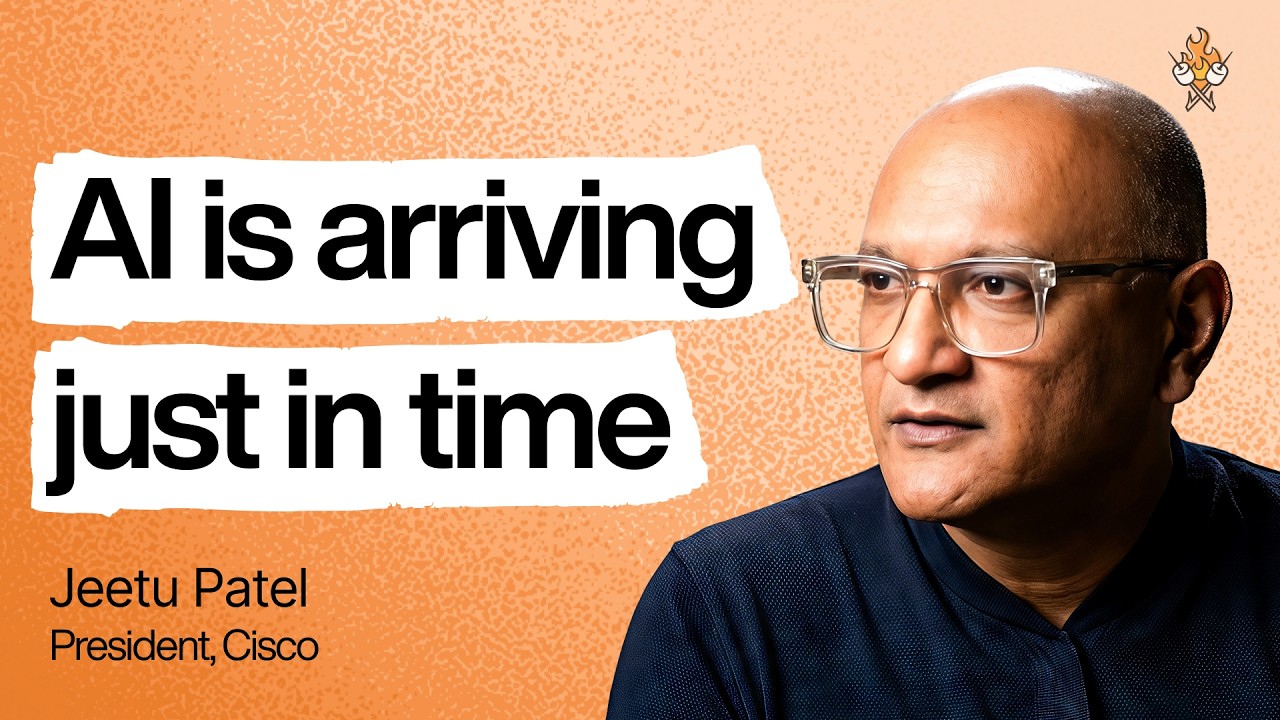
Artificial Intelligence is not just a hype cycle; it is a mega-trend, one of the most foundational movements in human history. Its importance extends beyond productivity gains; the survival of humanity may depend on a successful AI. With declining birth rates globally, we face a future demographic shift where a larger older population will need care from a smaller younger population. AI is arriving just in time to augment human capacity and prevent widespread suffering that could result from this imbalance.
Transforming Cisco into an AI-First Company
Transforming a 90,000-employee company like Cisco into an AI-first organization required a deliberate and multi-faceted approach. Innovation is a choice, and we made a conscious decision to go “all-in” on AI rather than hedging our bets.
Key pillars of this transformation included:
- Top-Down Conviction: We established that being AI-first was not up for debate. This eliminated “pocket vetoes” and aligned the entire organization. The message was clear: personal and company success are tied to becoming dexterous with AI. While AI wouldn’t necessarily take your job, failing to use AI would certainly make your role less relevant in the long run.
- Shifting to a Platform Model: We moved away from a holding company model, where individuals aimed to be General Managers of siloed businesses. The goal became to operate as a platform company, characterized by being “loosely coupled but tightly integrated.” This means customers don’t have to buy the entire Cisco suite at once, but when they use multiple products, they work together like magic, offering a consistent experience of reliability, trust, and elegant design.
- Embracing an Open Ecosystem: We shifted from a “walled garden” mentality to an open ecosystem. This involves being comfortable partnering with competitors. If a customer uses Cisco and another company’s product, we owe it to the customer to invest in the integration’s success, because customer success ultimately benefits us.
Cisco’s Role in the AI Infrastructure Stack
Cisco is a critical infrastructure company for the AI era, addressing three primary constraints that could hold AI back: infrastructure, trust, and data.
- Infrastructure: AI’s demand for power, compute, and network bandwidth is insatiable. Modern AI models are too large to train on a single GPU or even a single server. They require massive clusters of GPUs, often spread across data centers hundreds of kilometers apart, to operate as a single, coherent unit. Cisco provides the critical networking, optics, and data platform technologies that connect these GPUs, ensuring they run in perfect sync during a training run.
- Trust: AI models are often non-deterministic, and issues like hallucinations can be detrimental in enterprise systems. Cisco focuses on building the safety and security technologies required to create trust in these systems.
- Data: As we run out of public, human-generated data, the future of AI will rely on proprietary enterprise data, synthetic data, and machine data. Cisco plays a massive role in the machine data category.
A Six-Part Framework for Building Great Companies
To build a great, enduring company, six components are necessary. They are stack-ranked in descending order of importance, but all six must be present to win.
- Timing: The most important factor, and the one you control the least. Many great products have failed because the timing was wrong. It’s crucial to differentiate between a mega-trend and a hype cycle. Don’t fight a mega-trend, and don’t waste energy on a hype cycle.
- Market: The market always wins. A great team in a bad market will be dragged down, while a mediocre team in a great market will be pulled up. You must go after a large enough market, prosecuting it a chunk at a time.
- Team: A great team is well-rounded, where members complement each other’s weaknesses. It’s not just about people liking each other; it’s about assembling diverse skill sets.
- Product: The product is the soul of a company and the manifestation of the value you deliver. It is unethical to sell a mediocre product.
- Brand: Brand is about trust. Once a brand’s “mojo” is lost, it is incredibly difficult to resurrect.
- Distribution: Just because you build it, they will not come. You need a scaled mechanism to get your offering to the market.
Leadership and Communication at Scale
Leading a 30,000-person organization requires being intentional about communication to prevent the “telephone game” effect.
- Prevent “Packet Loss”: As a leader, you must be the custodian of the company’s message. Don’t delegate the storytelling. When a message cascades through multiple layers of management, it loses fidelity, much like packet loss in a network. Communicating directly ensures the story remains clear, intense, and unadulterated. This also forces simplification; if you can’t understand the story well enough to tell it yourself, you can’t expect sellers or customers to understand it either.
- Invert “Praise in Public, Criticize in Private”: This is a counterintuitive but powerful approach. The goal is to build deep trust and psychological safety in private conversations. Tell your team you have their back. This foundation of trust allows for open, direct, and constructive critique in public settings. The focus shifts from posturing to collaborative problem-solving. When everyone just offers praise in public, dashboards may look green, but you aren’t facing the hard facts needed to improve.
- Don’t Be Stingy with Words: A personal lesson learned from his late mother was that people don’t know what you’re thinking or how much you value them unless you are explicit. Even those closest to you cannot read your mind. In a business context, this means being clear with people about how much they mean to you and the value they bring. This builds a strong, supportive community.
Career Philosophy: Stamina, Hunger, and Platforms
For those aspiring to build a career, especially from outside traditional tech hubs, a few principles are key.
- Stamina Trumps Intellect: While intelligence is important, it can be developed through curiosity and persistence. Hunger, however, cannot be taught. The drive, persistence, and staying power to see things through are more critical than raw intellect.
- The Power of the Platform: Success is often a product of the platform you have access to. A brilliant individual without access to the right platform (of education, technology, or network) may not achieve their potential. Seek out platforms that provide a springboard for your talents.
- Be Prepared for Luck: A lot of success involves luck. However, when luck presents itself, you must be prepared to capitalize on it. This means doing the work, being curious, and avoiding intellectual laziness. Build a community around you, be useful to others, and don’t be afraid to ask for help.