LLM vs. SLM vs. FM: Choosing the Right AI Model
A guide to understanding the differences between Large Language Models (LLMs), Small Language Models (SLMs), and Frontier Models (FMs). Learn the unique strengths of each model type and see practical use cases for document classification, customer support, and incident response to help you choose the right model for your AI project.
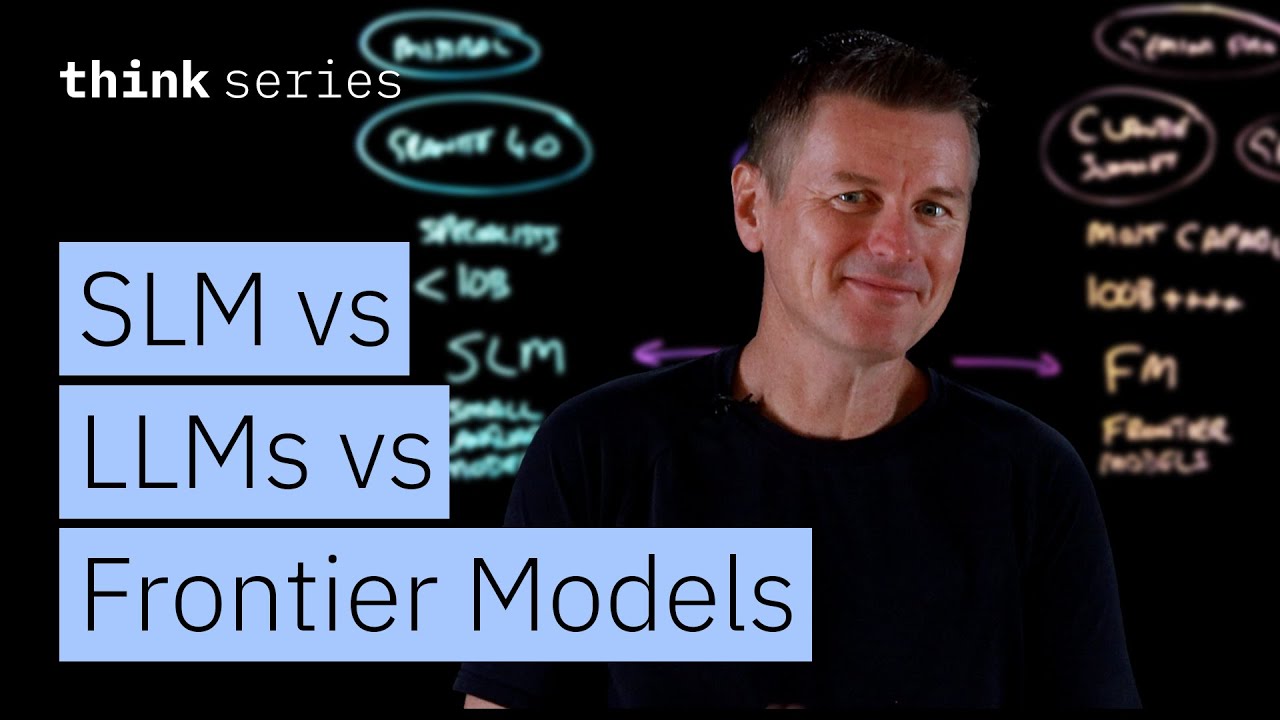
While Large Language Model (LLM) is a widely recognized term in AI, it’s helpful to understand its relationship with two other common terms: Small Language Model (SLM) and Frontier Model (FM). These aren’t three distinct categories but rather points on a spectrum, with LLM serving as the umbrella term. SLMs can be seen as efficient specialists, while FMs represent the cutting edge of AI capability. The key is that they are all language models, but they are labeled and used differently based on their specific strengths and the problems they are suited to solve.
Understanding the Model Types
-
Large Language Models (LLMs): These are the generalists of the AI world, with tens of billions of parameters. The number of parameters—the weights learned during training—correlates with the model’s knowledge, nuance, and reasoning ability. LLMs possess broad knowledge across many domains and are capable of handling sophisticated, back-and-forth conversations. Due to their size, they require significant GPU memory and processing power, typically running in cloud or SaaS environments.
-
Small Language Models (SLMs): In contrast to LLMs, SLMs are specialists with fewer parameters (e.g., under 10 billion). Rather than being a “worse” version of an LLM, a well-tuned SLM can often match or outperform larger models on focused tasks like document classification, code routing, or summarization. They achieve this with greater speed and cost-efficiency. Examples include IBM’s Granite models and some open-source options from Mistral.
-
Frontier Models (FMs): These models are at the forefront of AI, representing the most capable systems available today. They often contain hundreds of billions of parameters and feature deep tool integration. What truly sets them apart is their superior reasoning and ability to handle highly complex tasks. Models like Anthropic’s Claude series, OpenAI’s GPT-5, and Google’s Gemini Pro fall into this category.
Matching the Model to the Task
The most capable model isn’t always the best choice. The optimal strategy is to select a model based on the specific requirements of the use case.
Use Case 1: Document Classification and Routing with SLMs
Imagine a company that receives thousands of documents daily (e.g., support tickets, insurance claims) that must be classified and routed to the correct department. An SLM-powered classification service is a perfect fit for this task.
- Speed: An SLM with 3 billion parameters has far less computation to perform per inference than a 70-billion-parameter model, resulting in faster processing.
- Cost: Fewer parameters mean lower computational costs, requiring less memory and fewer GPU resources.
- Governance: For industries like finance and healthcare, running an SLM on-premise ensures that sensitive data never leaves the secure environment, eliminating compliance concerns associated with external API calls.
Use Case 2: Complex Customer Support with LLMs
Consider a complex customer support issue where a billing discrepancy is tied to a service configuration change and a history of related tickets. This requires synthesizing information from multiple sources like a billing database, technical configuration data, and ticket history.
- Breadth of Knowledge: LLMs are pre-trained on broader and more diverse datasets than SLMs, covering the wide range of domains a complex support ticket might touch upon (e.g., technical documentation, customer service interactions).
- Generalization: Customer queries have high variability. An LLM’s broad training allows it to generalize to scenarios it hasn’t explicitly seen before, enabling nuanced reasoning about how disparate concepts relate to one another.
Use Case 3: Autonomous Incident Response with FMs
In this scenario, a critical system alert is triggered at 2 a.m. Instead of waking up an on-call engineer, an AI system must investigate and resolve the issue. This involves querying monitoring systems, checking logs, identifying the root cause, determining a fix, and executing it via API calls (e.g., restarting a service or rolling back a deployment).
- Agentic Capabilities: Frontier models excel at multi-step investigation and execution. They are trained to plan complex workflows, break them into sequential steps, call appropriate tools or APIs, evaluate the results, and adjust their approach accordingly.
- Coherent Reasoning Chain: System failures require a logical chain of investigation. Frontier models can maintain coherent reasoning across these extended and complex chains, keeping track of learned information and determining the next best step. While most teams today use these models as AI co-pilots with a human in the loop, the underlying agentic capability resides within the frontier model.
Conclusion
The choice between an SLM, LLM, and FM comes down to matching the model’s capability to the specific need.
- Use an SLM for speed, efficiency, and on-premise control on focused tasks.
- Use an LLM for tasks requiring broad knowledge and nuanced reasoning across multiple domains.
- Use a Frontier Model for complex problems that demand the absolute best reasoning and agentic capabilities.