Paperclip: Open Source Human Control Plane for AI Labor — Dotta Bippa
Dotta, the creator of Paperclip, introduces it as an open-source orchestrator for building "zero-human companies." This talk demonstrates how to set up an organization of AI agents, leverage skills and custom instructions for reliable work, and automate business processes. Through a live demo, Dotta showcases creating a company from scratch, managing agent workflows with QA and routines, and outlines the exciting future roadmap for the platform.
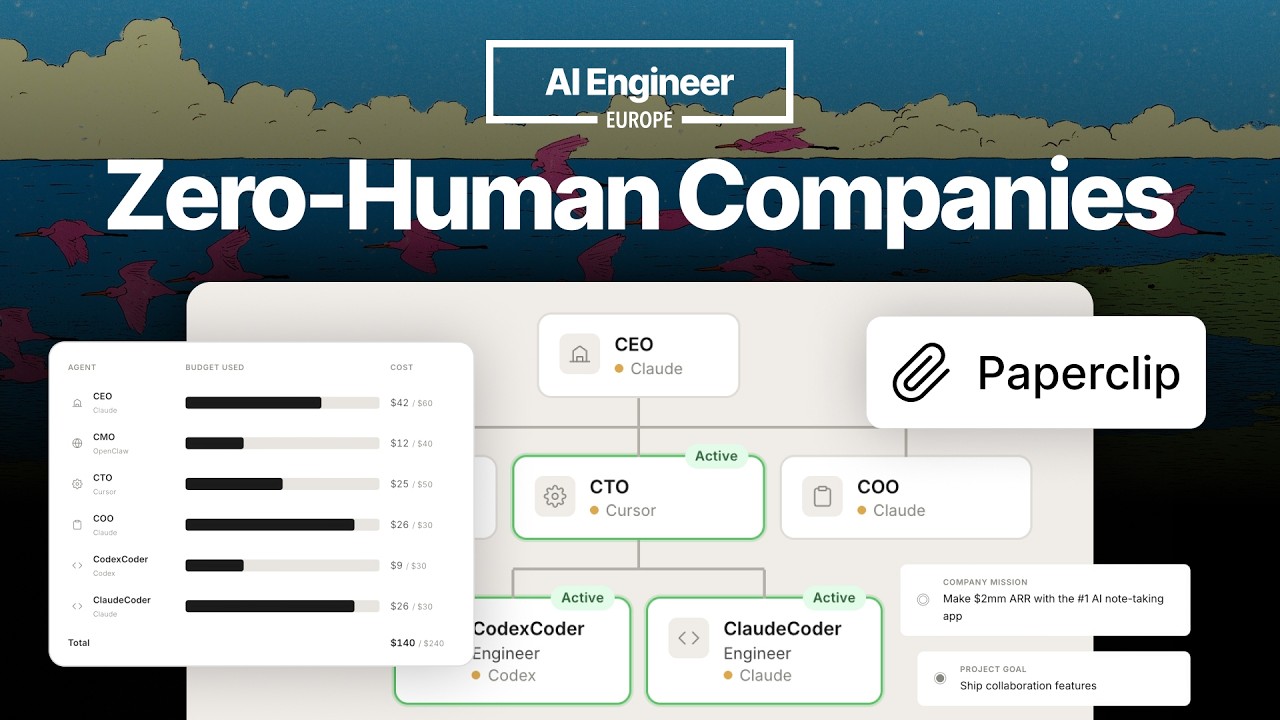
Paperclip is presented as an open-source orchestrator designed to be a “human control plane for AI labor,” enabling users to build and manage a “zero-human company.” The core concept is to create an organizational chart of AI agents, where the user can direct a CEO agent who then delegates tasks to a hierarchy of specialized agents.
Key Concepts & Getting Started
The fundamental idea is to allow users to “invoke your taste” in how AI agents perform work. Instead of a fully autonomous system, Paperclip involves the user in the entire process, from high-level design to task execution, ensuring preferences are respected.
Getting started is as simple as running npx paperclip-ai onboard in a terminal. The speaker, Doda, demonstrates a live instance used to manage Paperclip itself, showcasing an org chart with a CEO, CTO, and various coders.
A crucial feature is the “Bring Your Own Agent” (BYOA) capability. Users can integrate any model—such as Gemini, Claude, or open-source alternatives like Hermes—as an “employee” within the Paperclip framework. The system handles memory, communication, and negotiation between these diverse agents.
Practical Application: A Real-World Example
To illustrate Paperclip’s power, a practical example of creating a promotional video to celebrate 40,000 GitHub stars is detailed:
- Task Assignment: A task is assigned to the CEO agent to create a video.
- Agentic Actions: The CEO agent, leveraging its “agentic surface,” hires a new “video writer” agent.
- Skill Integration: The CEO installs a relevant skill, “Remotion best practices,” from a built-in skill manager. Remotion is an open-source tool for creating videos programmatically.
- Context-Aware Prompting: The user provides a simple prompt. The agent accesses the necessary context—such as the company’s branding guide and stats dashboard—which is already integrated into Paperclip’s knowledge base.
- Iterative Feedback: The agent generates a plan. The user provides feedback (e.g., shortening video cuts from 6 to 2 seconds). This collaborative loop results in a high-quality, on-brand animated video in about five minutes.
Advanced Features and Workflows
Paperclip offers several features to manage and scale AI-driven work reliably:
- Skill Management & Learning: The system supports creating company-specific skills that evolve from user feedback. For example, repeated feedback about video pacing can be codified into a custom “Paperclip Remotion skill.” While currently a manual process, automated organizational learning is on the roadmap.
- Reliable Workflows: To combat the unreliability of standalone agents, Paperclip provides a “vendor-neutral harness.” This includes setting up mandatory QA and approval steps. For instance, a task can be configured to require a review from a QA agent (equipped with a browser skill) before being marked as complete.
- Routine Automation: Users can create reusable routines for recurring tasks, such as generating reports from Twitter bookmarks, posting PR updates to Discord, or writing release changelogs. These routines can use template variables and incorporate existing skills.
- Cost Management: Paperclip tracks spending and allows setting budgets per agent or project. It supports using cheaper models for less critical tasks via integrations like OpenRouter.
Building and Managing Your AI Organization
The speaker advises starting small, building the organization agent by agent rather than importing large, pre-defined templates. The key to success is carefully crafting each agent’s instructions and purpose. The speaker shares their own detailed instructions for a coder agent, which includes directives like, “If there’s a blocker, tell us your best guess on how to fix it.”
Paperclip is emphasized as a business tool, not just a coding utility. It is designed for managing marketing, sales, and financial operations, making it accessible to non-technical users.
Future Roadmap
Paperclip is a rapidly evolving project. Key features on the immediate roadmap include:
- Multi-human user support for team collaboration.
- A dedicated CEO Chat interface.
- Maximizer Mode for letting agents work continuously towards a goal.
- Cloud sandboxing for secure agent execution (e.g., E2B).
- A free, open-source desktop app and a hosted Paperclip Cloud service.
- General improvements to stability, memory management, and the knowledge base.