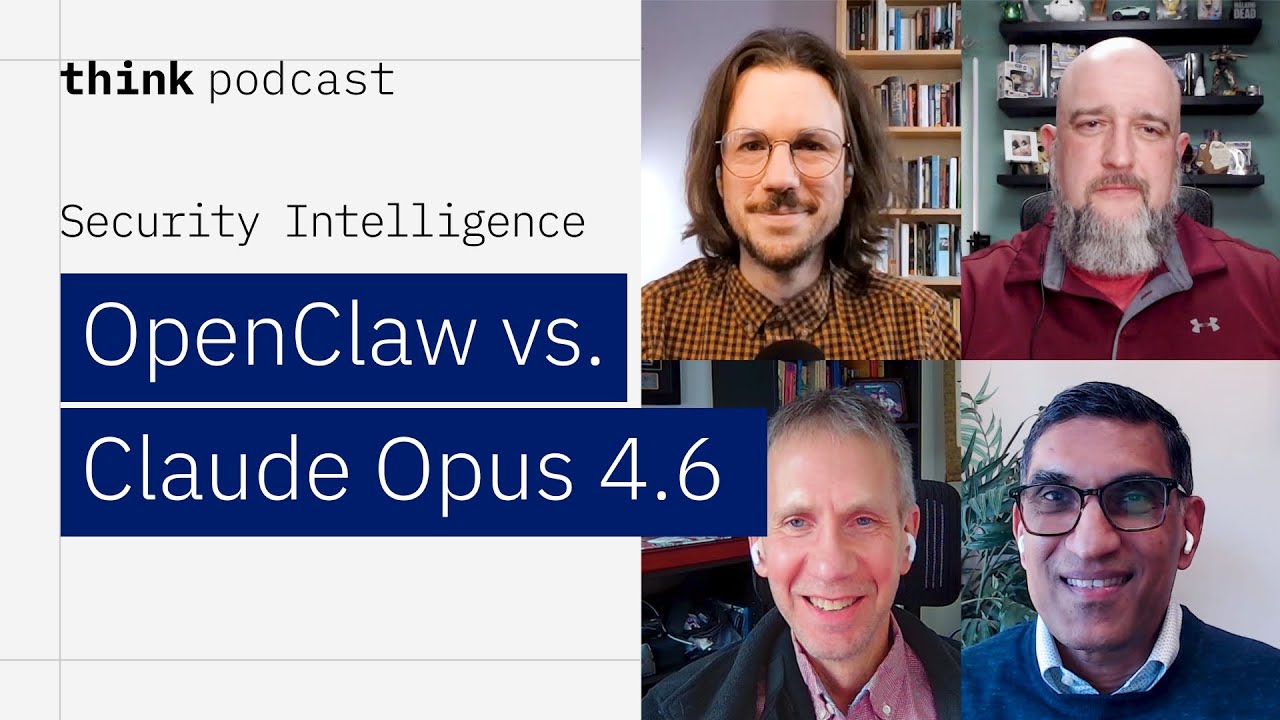
OpenClaw and Claude Opus 4.6: Where is AI agent security headed?
A panel of cybersecurity experts discusses the security risks of the rapid adoption of AI agents, the "move fast and break things" development culture, the lessons from the Notepad++ supply chain breach, and the professionalization of ransomware by groups like DragonForce.
The Rise of AI Agents and Shadow AI
The conversation begins by contrasting the open-source, customizable nature of AI agent platforms like OpenClaw with proprietary, more locked-down models like Claude Opus 4.6 and its new “agent teams.” While both approaches present benefits, they share a core security challenge: these are autonomous systems operating with minimal supervision.
The panelists agree that the primary security principle for AI agents must be least privilege. An agent, whether open-source or proprietary, should be treated like a privileged insider account and given only the absolute minimum access required to perform its function, for the shortest time necessary. Running agents under a super-user account is a recipe for disaster.
A significant concern is the proliferation of “Shadow AI”—employees using unapproved AI tools at work. A recent survey highlighted that 69% of executives prioritize speed over security in AI adoption, inadvertently fueling this trend. When organizations don’t provide sanctioned, tested AI options, employees will inevitably turn to unsanctioned ones. The proposed solution is not to say “no” to AI agents but to say “how”:
- Provide Sanctioned Options: Vet, approve, and provide a curated list of AI agents for employees to use.
- Implement Guardrails: Enforce rules and defined playbooks for how agents can operate, preventing them from performing open-ended, potentially destructive tasks.
- Educate Users: Inform employees about the risks of data exposure and other dangers associated with unvetted AI tools.
Re-evaluating the “Move Fast and Break Things” Culture
The discussion pivots to whether the tech industry’s long-standing philosophy of “move fast and break things” has led to a security crisis by normalizing the release of vulnerable code. The panelists argue that while speed is a business necessity, it must be balanced with discipline. Security should not be seen as a roadblock but as the “brakes on a car”—a necessary component that allows you to go faster, safely.
The era of AI is accelerating the pace of development, making this balance even more critical. The proposed alternative is to “make smart and safe things” through established practices:
- Bake Security into the Pipeline: Integrate security scanning and best practices directly into DevOps and MLOps workflows (DevSecOps).
- Demand Transparency: Push for greater transparency from all software and AI vendors. The concept of a Software Bill of Materials (SBOM) should be extended to create “AI Bill of Materials” or “Agent Bill of Materials” to understand the components and potential risks of AI systems.
- Use AI for Defense: AI is not just a source of new risks; it can also be a powerful defensive tool. AI models can be used to perform automated code reviews at scale, identifying vulnerabilities in codebases far faster than human teams can.
Lessons from the Notepad++ Supply Chain Breach
The recent breach of Notepad++, where a backdoor was distributed through its updater client, serves as a case study for broader failures in supply chain security and software inventory management. The attack was particularly insidious because it weaponized a core security practice: patching software.
The incident highlights several key takeaways for organizations:
- Comprehensive Software Inventory: Inventories must include every piece of software, including common, “boring” utilities like Notepad++,
curl, orvi, which are often overlooked but can be potent attack vectors. - The Importance of Zero Trust: The core principle of Zero Trust—assuming breach and verifying everything before trusting it—is more relevant than ever. This mindset must be applied even to seemingly benign tools and updates.
- Continuous Monitoring: Organizations need to continuously monitor their environments for anomalous behavior. This includes tracking where software updates are coming from and potentially mirroring public repositories to a sanctioned, internal source.
- AI-Powered Oversight: Given the complexity of modern systems, manual verification is impossible. AI can be leveraged to scan systems, analyze behavior, and flag potential threats at a scale that humans cannot match.
The Professionalization of Ransomware
The episode concludes with an analysis of the DragonForce ransomware gang, which is attempting to become a major “cartel” by professionalizing its operations. They are lowering the barrier to entry for aspiring cybercriminals by offering Ransomware-as-a-Service with features like:
- Easy online registration for affiliates.
- Support services to help affiliates analyze stolen data and create ransom scripts.
- Test environments for practicing attacks.
- Collaboration and coalition-building with other ransomware groups.
This “move fast and break things” business model for cybercrime makes sophisticated attacks more scalable and accessible. The panelists note that the logical endpoint of this trend is fully autonomous AI agents that can identify targets, find vulnerabilities, execute attacks, and exfiltrate data with no human intervention.
For defenders, the key insight is that scaling requires patterns. As these groups professionalize, they will rely on repeatable Tactics, Techniques, and Procedures (TTPs). This makes them more predictable, and security teams can focus on identifying and defending against these common patterns.